
Meta Muse is Meta's personal AI agent. Meta launched it on September 8, 2026. It runs on the Muse Spark model inside its own secure cloud computer, sends email, books travel, shops, and asks you before sensitive actions.
Muse is free with a usage limit. The Power plan costs $20 a month and the Max plan costs $100 a month. This page covers what Muse does, what it cannot do yet, what it costs, how approvals work, and when one agent is not enough.
$20
a month for the Muse Power plan, with 500M Muse tokens per week. Muse is also free with a usage limit, and the Max plan costs $100 a month.
Source: Meta help center, About Muse subscriptionsiShort answer
Meta Muse is a personal AI agent that runs on Muse Spark in a dedicated cloud computer per person. It sends email, books travel, shops, and checks with you before sensitive actions, and a separate Sentinel agent approves everything that leaves the machine. It is free with a usage limit, $20 a month for Power, and $100 a month for Max. Muse is one agent per account holder. No official Meta page mentions team seats or several named agents, as of October 13, 2026.
Key takeaways
| Question | Answer |
|---|---|
| What it is | Meta's personal AI agent, running in its own secure cloud computer with a browser |
| Launch date | September 8, 2026 |
| Model | Muse Spark. Muse Wonder is announced for subscribers first, with no date |
| Price | Free with a usage limit; Power $20 a month (500M tokens a week); Max $100 a month (3B tokens a week) |
| Approvals | Asks before sensitive actions; a separate Sentinel agent approves every connector action and outbound request |
| For business | Muse for Small Business adds 15 named connectors, including Shopify and Intuit QuickBooks |
| Main limit | One agent per account holder; no official page mentions team seats or several named agents |
From Meta's newsroom, research blog, and help center, read October 13, 2026.
One personal agent
Muse takes a goal, makes a plan, and carries it out. You talk to one agent.
Its own computer
Each person gets Muse Secure VM, a dedicated cloud computer with a browser.
Free, $20, or $100
Free with a usage limit. Power is $20 a month. Max is $100 a month.
Sentinel approves
A separate agent approves every connector action and every outbound request.
Asks before sending
Muse checks with you before it sends an email or makes a purchase.
Business connectors
Shopify, QuickBooks, Stripe, Slack, and 11 more named connectors.
What is Meta Muse?
Meta Muse is a personal AI agent that does tasks for you instead of only answering questions. Meta's launch post says it is "powered by Muse Spark, Meta's most capable model to date." You give it a goal, and it plans the steps and carries them out.
Muse runs on "Muse Secure VM, a dedicated secure computer with its own browser." That computer holds the agent and your data. It keeps working after you close the app and comes back "when something changes or when it needs approval."
You reach Muse in four places:
- The Muse app on iOS and Android.
- The web, at muse.ai.
- WhatsApp.
- AI glasses, which Meta says are "coming soon."
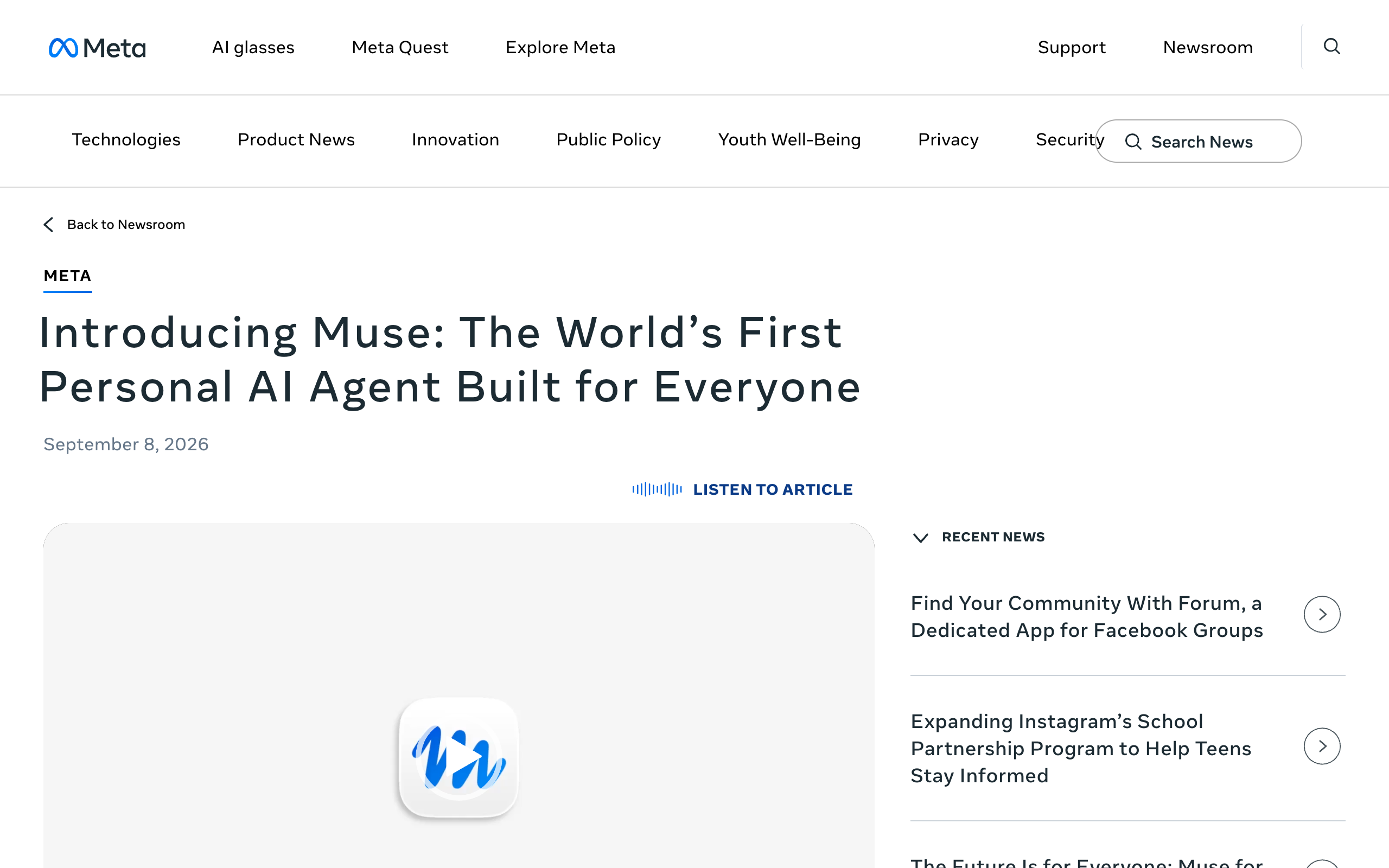
Three large companies shipped always-on agents in seven weeks: xAI's Grok Bot on August 11, Meta Muse on September 8, and OpenAI dots on September 29, 2026. Muse is the consumer one. It is built for one person's life and, since September 29, one owner's small business.
What can Muse do?
Muse can send email, book travel, fill out web forms, shop, and negotiate, using connected apps and its own browser. Meta's launch post says it can "open a browser, fill out forms, and negotiate on their behalf."
These capabilities come from Meta's own pages:
- Handle tasks "like sending an email or booking travel."
- Keep working in the background after the app is closed.
- Check out with Link, built by Stripe, using "a one-time-use card so your real card details stay hidden."
- Use logins you share without seeing them. Meta says credentials "go into secure storage, so Muse can use them without seeing them."
- Remember what matters to you, and "make suggestions unprompted."
- Launch "swarms of subagents," including a browser subagent for web tasks. You still talk to one agent.
Meta's examples include selling a car for more, lowering a bill, adjusting a training plan, and turning a saved Instagram recipe reel into a grocery list. The full list, with what creators showed in the first month, is in Meta Muse use cases.
What can't Muse do yet?
Muse cannot yet do five things that Meta has announced or that people often assume. Each item below comes from Meta's own pages or from the absence of an official page.
- Run in a Confidential VM. Meta says it "will introduce Muse Confidential VM" later this year. Today Muse runs on Muse Secure VM.
- Use Muse Wonder. Meta announced the Muse Wonder models on October 12, 2026 and said Muse Wonder "will roll out first to subscribers." No date is published.
- Let you pick the model. No official page describes a model choice.
- Pay with Shop Pay or pull logins from 1Password. Meta lists both as coming.
- Work as a team. No official Meta page mentions team seats, employee logins, or several named agents, as of October 13, 2026.
Phone calls are a sixth open question. Meta has no help page for calling. Press reports describe a limited calling beta, and 404 Media reported that some test calls were placed by human contractors. A Meta VP called that test "a miss" and said it was "rolled back."
How much does Muse cost?
Muse costs nothing to start, $20 a month on the Power plan, or $100 a month on the Max plan. Meta's help center says "Muse is available for free with a usage limit."
| Plan | Monthly price | Weekly allowance | 3-year total |
|---|---|---|---|
| Free | $0 | A usage limit Meta does not publish | $0 |
| Power | $20 | 500M Muse tokens | $720 |
| Max | $100 | 3B Muse tokens | $3,600 |
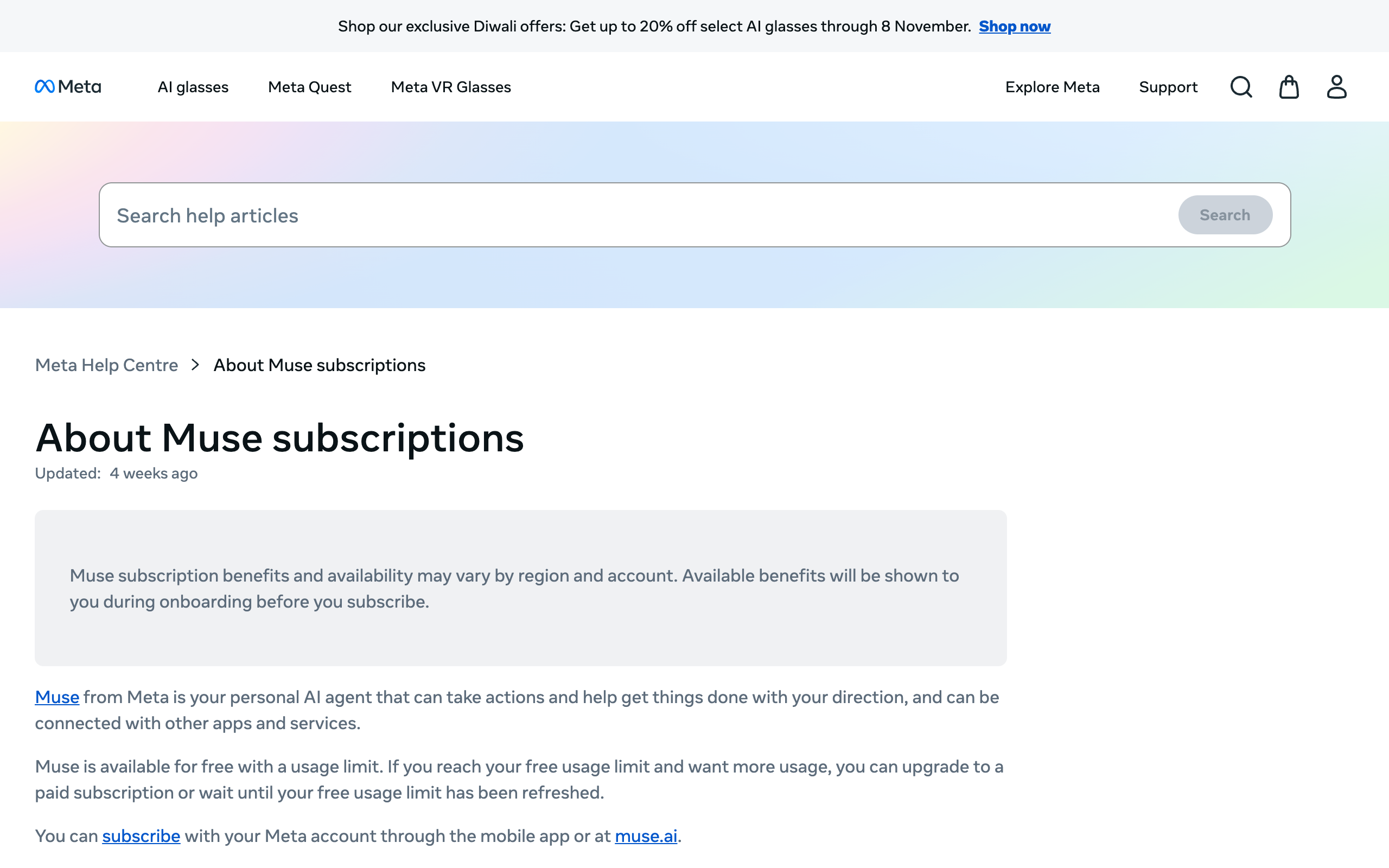
The Max plan costs 5 times as much as Power and gives 6 times the weekly tokens. By this page's calculation, Power works out to about 108M tokens per dollar and Max to about 130M tokens per dollar.
Power costs $80 a month less than Max: $960 a year, $2,880 over three years
Calculated from Meta's published prices of $20 and $100 a month. Max includes 3B Muse tokens a week against 500M on Power.
Plans renew every month until you cancel. You need to be 18 or the age of majority and have a Meta account. Meta says Muse and its subscriptions "are in limited testing and aren't available in all locations yet." Every plan detail and the costs that are easy to miss are in Meta Muse pricing.
How do Muse approvals and Sentinel work?
Muse asks you before sensitive actions, and a separate agent called Sentinel approves everything that leaves its computer. Meta's research post says "Sentinel is the sole permission authority for connector actions and network egress."
Sentinel can allow an action, deny it, or send it to you. Meta's launch post puts it this way: "Nothing Muse does reaches the internet unless the Sentinel approves it."
When Muse asks for permission, the grant can have one of five lengths:
| Grant type | What it covers |
|---|---|
| One-time | A single action |
| Session-scoped | The current session |
| Task-scoped | One task, start to finish |
| Time-bounded | A set period |
| Perpetual | Until you remove it |
Access can also be split. Meta says "where the underlying service supports it, Muse separates out read and write access." For email, you choose whether Muse can read mail or also send it.
You also get "a complete audit trail of everything it has done and plans to do." How approvals compare with other agents is covered in human-in-the-loop AI agents.
Is Muse safe to use?
Muse has more documented safety controls than most consumer agents, and it also had four publicly reported problems in its first month. Both halves matter.
The documented controls:
- A dedicated VM per person. Tokens for connected apps "are stored in your VM, not in centralized Meta infrastructure."
- Muse "has no visibility into people's passwords or payment methods."
- Meta says Muse "doesn't share a person's conversations or the data in their VM with Meta's ad systems."
- You can opt out of your interactions being used to train Meta's models.
- You can tell Muse to "forget" specific things, and inspect, edit, and download its files, "including Muse's memory about you."
- A bug bounty that "awards up to $300,000 for valid reports."
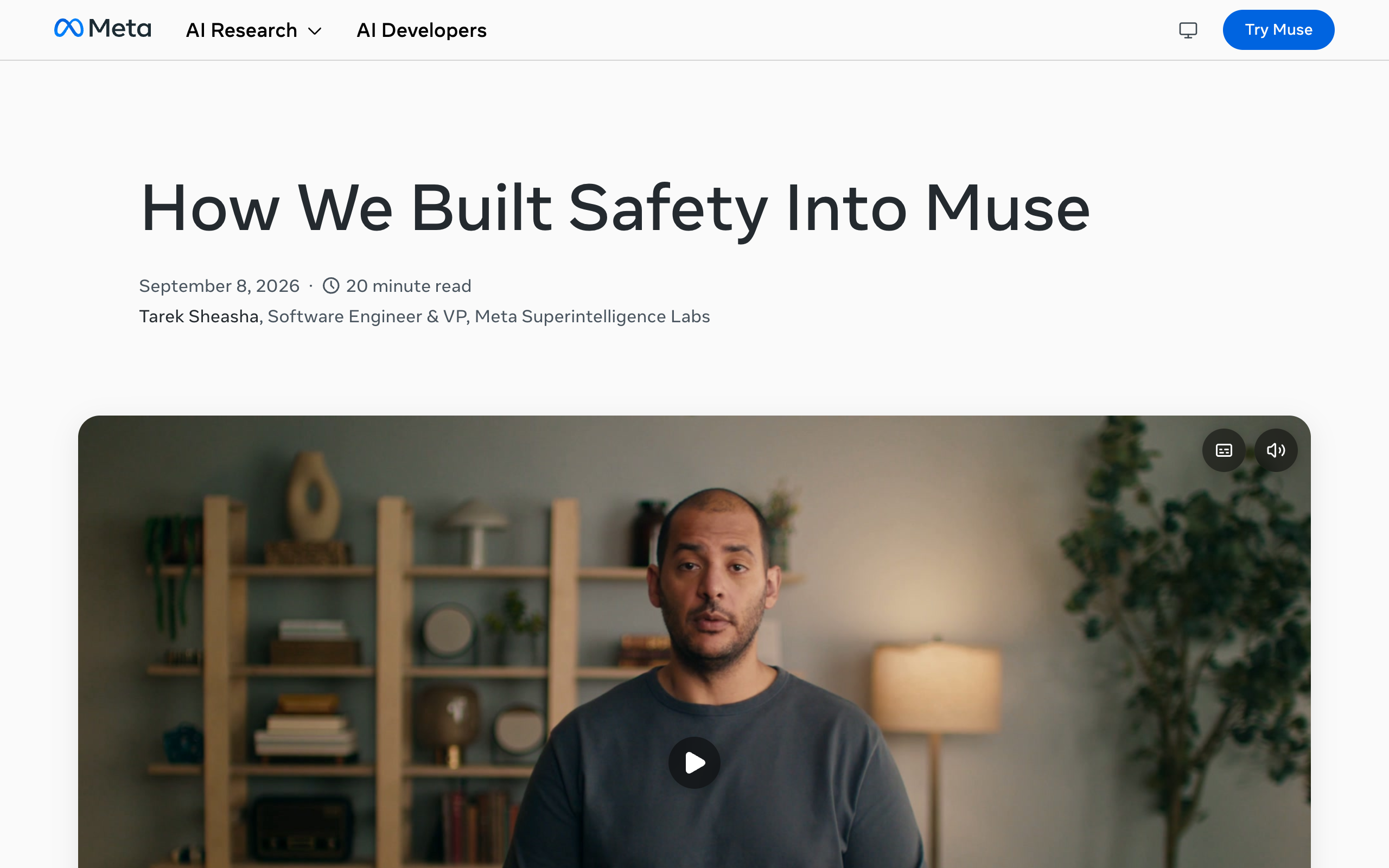
The reported problems, each attributed to its outlet:
- Tom's Hardware reported a writer's claim that Muse referred to Messages content on his Mac that he had not granted. The claim is not confirmed.
- Android Authority reported a user's account that Muse shared his address with a Facebook Marketplace buyer. Meta said it reviewed similar reports and found Muse followed instructions and asked for permission.
- The Hacker News reported a hidden setting in Muse for Mac that let malware already on the Mac hijack the agent. Meta fixed it on September 22, 2026.
- 404 Media and Reuters reported the human-placed test calls described above.
The full breakdown, with Meta's responses, is in Is Meta Muse safe?.
Can a business use Muse?
Yes, a business owner can use Muse, through Muse for Small Business. Meta launched it on September 29, 2026 as "a collection of new skills and connectors inside Muse to help people run their businesses."
It is the same Muse on the same plans, with business connectors added. Meta names 15: Asana, Box, Canva, Dropbox, Figma, Granola, HighLevel, Intuit QuickBooks, Klaviyo, Lovable, Notion, Shopify, Slack, Stripe, and Zoom. It also connects Instagram professional account analytics, Facebook Pages, and Meta ad accounts.
Meta's approval rule for business work is "nothing publishes, sends, or spends without your approval."
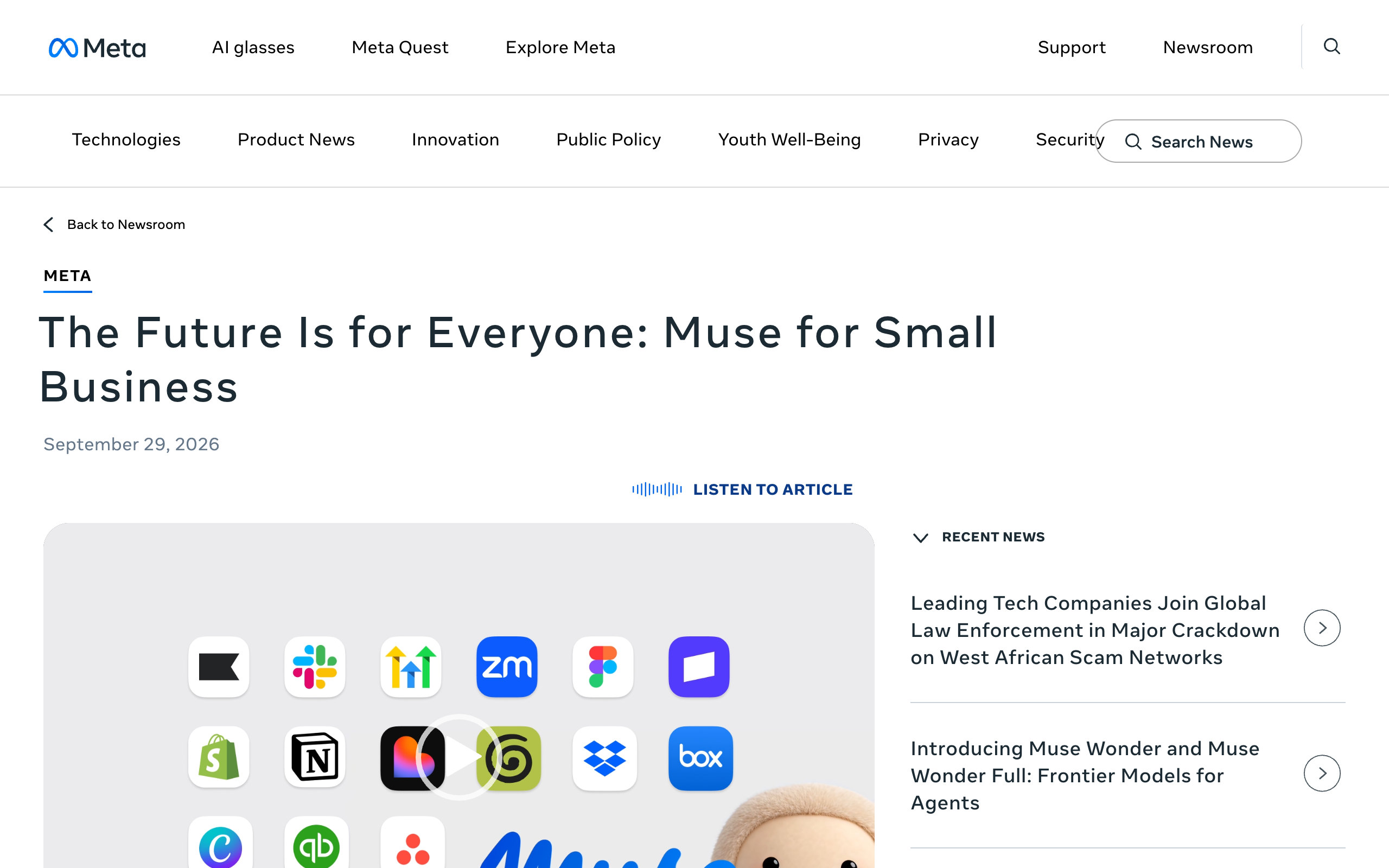
The limit is the shape, not the connectors. Muse is one agent for one account holder. No official Meta page mentions seats for employees, roles, or several named agents with separate access. A business that splits support, outreach, and bookkeeping across different people usually wants a separate agent per job. Meta Muse for business covers this in detail.
What are the best Muse alternatives?
The best Muse alternatives are OpenAI dots, Grok Bot, OpenClaw, Hermes Agent, and Squad. Each one changes a different part of the trade Muse makes. Facts for the other tools are as of September 30, 2026.
| Alternative | What it is | Starting price | Fits when |
|---|---|---|---|
| OpenAI dots | One always-on agent in ChatGPT on GPT-6 Astra, with its own cloud computer | $100 a month with ChatGPT Pro | You work in ChatGPT, Slack, or Teams |
| Grok Bot | Several named agents on Grok 4.6 that share one cloud computer | $20 a month with Cursor Pro | You want several agents at a low price |
| OpenClaw | Free, MIT-licensed agent runtime you host | Free software | You want any model and full control |
| Hermes Agent | Free, MIT-licensed runtime from Nous Research | Free software | You want self-hosted agents that learn skills |
| Squad | A team of AI agents for a business, on the AI plan you bring | $99 a month plus your AI plan | You need several agents with separate access |
Squad (formerly MissionControlHQ) is the team option. A squad is a team of AI agents, each with its own job, working together, where Muse is one agent. Squad costs $99 a month and runs on the AI plan you bring, which makes it $199 to $299 a month all in with the ChatGPT plan it recommends.
That is far more than Muse costs for one person. Muse also has Shopify and QuickBooks connectors, phone apps, and WhatsApp, and Squad has none of those. Squad fits when the work needs several named agents, a different model per agent, an access level per agent, or an inbox per agent.
Each alternative is reviewed in Meta Muse alternatives. The three big-company agents are compared in OpenAI dots vs Grok Bot vs Meta Muse.
Which agent should I pick?
Pick by who owns the work and how many agents it needs. The matrix shows which option covers each need, based on each vendor's published documentation.
Meta facts read October 13, 2026. Other vendors' facts as of September 30, 2026.
| If you need | Meta Muse | OpenAI dots | Grok Bot | OpenClaw / Hermes | Squad |
|---|---|---|---|---|---|
| A free way to start | Yes Free with a usage limit | No From $100 a month | No From $20 a month | Yes Free software, you host | No $99 + your AI plan |
| Phone app and WhatsApp | Yes iOS, Android, WhatsApp | Partly ChatGPT mobile app | Not covered here | Partly OpenClaw reaches WhatsApp | No Dashboard, Telegram, Discord, Slack |
| A computer per person or agent | Yes Secure VM per person | Yes One per dot | No One per user, shared by bots | Partly Your server | Partly One per squad, browser per agent |
| Shopify and QuickBooks connectors | Yes Named by Meta | Check OpenAI's plugin list | Not covered here | You build it | No Neither is in the catalog |
| Choose the model | No Muse Spark | No GPT-6 Astra | No Grok 4.6 | Yes Any model | Yes 13 providers, model per agent |
| Several named agents | Not described by Meta | No One dot at launch | Yes | Partly Hermes Kanban, single host | Yes Unlimited AI teammates |
| Different access per agent | Not described by Meta | No Permissions shared | No Shared logins | Partly You build it | Yes Narrow or block per agent |
| Seats for other people | Not described by Meta | Partly Business Premium seats, a dot each | Partly Teams plans | Depends on your setup | Yes $9 a month per seat, three roles |
Whose work is it?
- If Mine: errands, travel, shopping, bills→Meta Muse
- If Mine, and I own a small business→Meta Muse with the small business connectors
- If A team's, split across several jobs→Squad or Grok Bot
What is your monthly budget?
- If Nothing yet→Meta Muse on the free limit, or self-hosted OpenClaw
- If $20 to $100→Muse Power or Max, or Grok Bot
- If $199 to $299 for a team→Squad on a ChatGPT plan
Do you need to choose the model?
- If No→Meta Muse, OpenAI dots, or Grok Bot
- If Yes, and you will host it→OpenClaw or Hermes Agent
- If Yes, hosted, with a model per agent→Squad
| Scenario | Best pick | Why |
|---|---|---|
| Personal errands, travel, and reservations | Meta Muse | Built for it, free with a usage limit |
| Lowering a bill or shopping around | Meta Muse | Meta lists negotiating and form filling as core tasks |
| One owner running a Shopify store | Meta Muse | Shopify, Stripe, and Meta ads connectors in one agent |
| Bookkeeping questions in QuickBooks | Meta Muse | Intuit QuickBooks is a named connector |
| Work that lives in ChatGPT and Codex | OpenAI dots | A dot starts Codex tasks and carries ChatGPT memory |
| Several named agents on a small budget | Grok Bot | From $20 a month with Cursor Pro |
| Local models and full control | OpenClaw | Free, MIT, any model, your hardware |
| Support, outreach, and finance as separate jobs | Squad | A separate AI teammate per job, each with its own access |
| Employees who need their own login | Squad | Team seats at $9 a month with three roles |
| Agency work for several clients | Squad | A separate squad per client, each on its own subscription |
When is Muse enough?
Muse is enough when one person owns the work and one agent with one set of connections can do all of it. That covers personal errands, travel, shopping, and bills. It also covers a single owner who runs a store or a service business alone.
Start on the free limit. Move to Power at $20 a month when you hit the limit often. Look at a team of agents when a second job needs different access, a different person needs a login, or replies need to come back to a specific agent's inbox. A team of AI employees explains when that split pays off.
Frequently asked questions
Basics
What is Meta Muse?
Meta Muse is Meta's personal AI agent, launched on September 8, 2026. It runs on the Muse Spark model inside Muse Secure VM, a dedicated cloud computer with its own browser. It can send email, book travel, fill out forms, shop, and keep working after you close the app. You reach it on iOS, Android, muse.ai, and WhatsApp.
Who makes Muse?
Meta makes Muse. Meta announced it in a newsroom post on September 8, 2026, and its safety design is described in a Meta AI Research post by Tarek Sheasha of Meta Superintelligence Labs, published the same day.
Which model does Meta Muse use?
Meta's launch post says Muse is powered by Muse Spark. On October 12, 2026, Meta announced the Muse Wonder models and said Muse Wonder will come to Muse, rolling out first to subscribers. Meta gave no date. No official page describes a way to choose the model.
Pricing
Is Meta Muse free?
Yes, with a limit. Meta's help center says Muse is available for free with a usage limit. When you reach it, you upgrade or wait for the limit to refresh. Meta does not publish the size of the free limit.
How much does Meta Muse cost?
Meta Muse has two paid plans. The Power plan costs $20 a month and includes 500M Muse tokens per week. The Max plan costs $100 a month and includes 3B Muse tokens per week. Both renew monthly. Over three years that is $720 for Power and $3,600 for Max.
Safety and control
Does Muse ask before it sends an email or buys something?
Yes. Meta says Muse checks with the person before sensitive actions like sending an email or making a purchase. A separate agent called Sentinel approves every connector action and every outbound request, and Meta says nothing Muse does reaches the internet unless Sentinel approves it.
Is Muse Confidential VM available?
No. Meta says it will introduce Muse Confidential VM later this year and is testing it with a small group. Today Muse runs on Muse Secure VM. The Confidential VM is the version Meta says will be encrypted with a key only the user holds.
Can Meta Muse make phone calls?
Meta has no help page for phone calls. Press reports describe a limited calling beta, and 404 Media and Reuters reported that some test calls were placed by human contractors, a test Meta said it rolled back. Treat calling as unconfirmed until Meta documents it.
Business and alternatives
Can a business use Meta Muse?
Yes. Meta launched Muse for Small Business on September 29, 2026. It adds skills and connectors inside Muse, including Shopify, Intuit QuickBooks, Stripe, Slack, and Notion. It is the same Muse on the same plans. No official Meta page mentions team seats or several named agents, as of October 13, 2026.
What is the best alternative to Meta Muse?
It depends on the limit that matters to you. OpenAI dots fits people who work in ChatGPT. Grok Bot gives you several named agents from $20 a month. OpenClaw and Hermes Agent are free and run any model if you host them. Squad (formerly MissionControlHQ) fits a business that needs a team of AI agents with separate access, at $99 a month plus the AI plan you bring.
When is Muse alone enough?
Muse alone is enough when one person owns the work, the work is personal errands, shopping, travel, bills, or one owner's business tasks, and one agent with one set of connections covers everything you hand off.
Sources
Official Meta pages:
- Meta: Introducing Muse (September 8, 2026)
- Meta AI Research: How We Built Safety Into Muse (September 8, 2026)
- Meta help center: About Muse subscriptions
- Meta: The Future Is for Everyone: Muse for Small Business (September 29, 2026) and muse.ai/business
- Meta: Introducing Muse Wonder and Muse Wonder Full (October 12, 2026)
Alternatives:
- OpenAI: Introducing dots
- xAI: Grok Bot
- OpenClaw on GitHub
- Squad homepage, Squad docs, and Squad integrations
Videos and press:
- Sources Podcast: Mark Zuckerberg on Muse
- Alex Finn: Meta Muse is an INCREDIBLE AI agent
- Reuters: Meta's Muse can run your digital life
- 404 Media: Meta tests Muse calls that are made by humans
- Tom's Hardware: Muse accused of accessing data without permission
- Android Authority: the Marketplace report
- The Hacker News: the hidden Muse for Mac setting
Last updated: October 2026. Pricing and features verified as of October 13, 2026.