
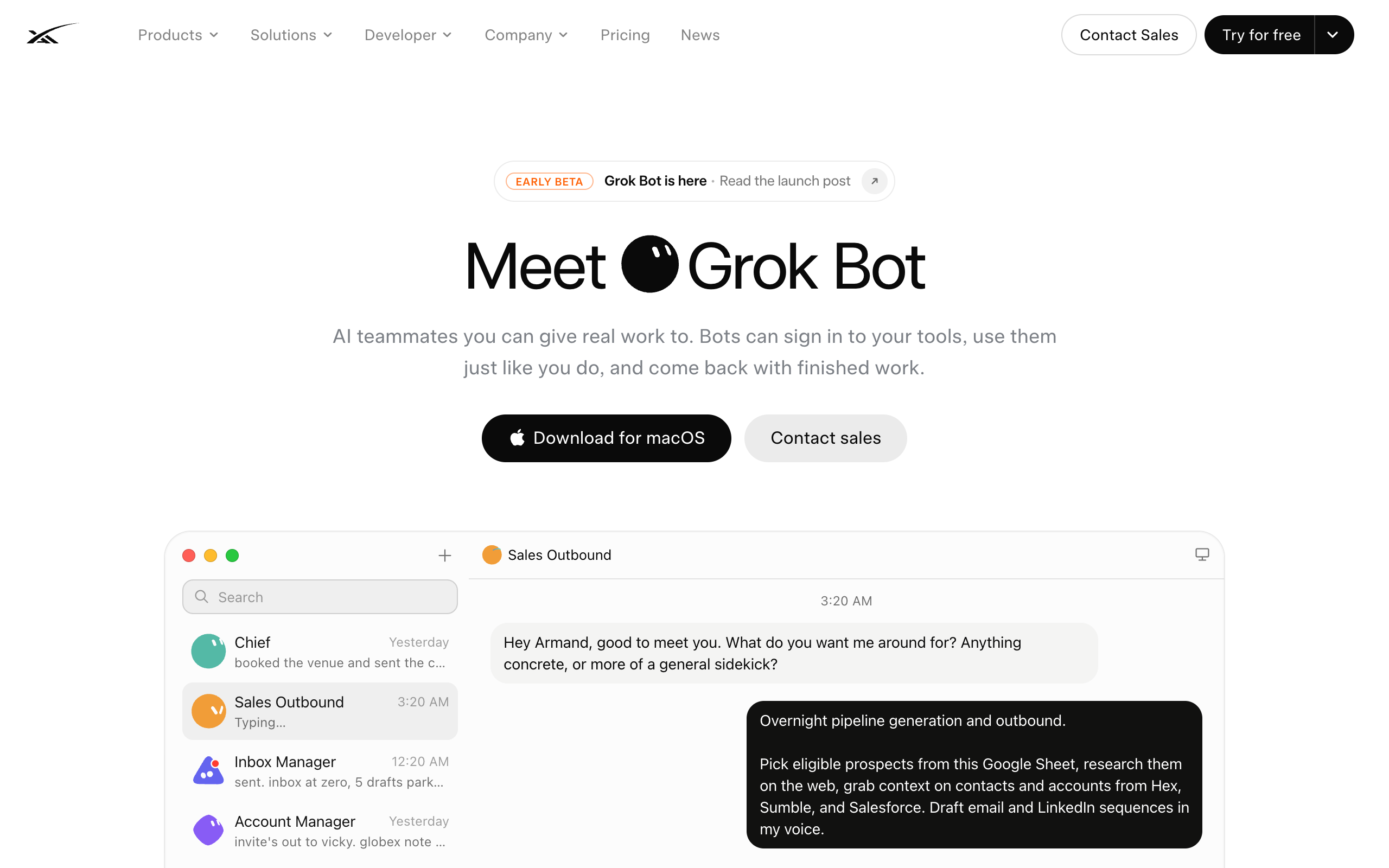
On 11 August 2026, xAI shipped Grok Bot into early beta with a product page that reads like an org chart. Sales Outbound. Talent Scout. Account Health. Chief of Staff. Named teammates that sign into your tools, work through the night with your laptop closed, and pass work to each other in a shared thread.
A year ago that setup meant a Mac Mini on a shelf and a weekend of YAML. The interesting part of the launch is not the product. It is that a company which never has to explain itself decided this shape was ready for consumers.
Two weeks in, the recurring complaint in early users' posts was not about the agents. It was the usage meter: Grok Bot's plans meter weekly usage, and when the meter reads 100% used, the product's answer is a reset clock or, per xAI's FAQ, additional usage billed based on token cost on top of the subscription. The tiers and that per-token meter are the only dials.
That is what a bundled model means in practice. When the meter fills, the work waits for the reset or moves onto per-token overage on one provider's meter; there is no other account and no other model to hand the run to.
57%
of organizations now deploy AI agents for multi-stage workflows, and 16% have progressed to cross-functional processes spanning multiple teams. The work moved past one agent answering one prompt before the tools did.
Source: Anthropic, The 2026 State of AI Agents Report (500+ technical leaders, with Material)iShort answer
Grok Bot is the clearest proof yet that founders want a squad, meaning a coordinated set of specialist AI agents rather than one generalist wearing five hats. What it ships is the agents. What it leaves out is the rest of running one: when the bundled model's meter hits 100% your choices are the reset clock or per-token overage, with no account to stack and no fallback provider, and around the agents there is no one to design the squad with you, no task board or ticketing with per-run token reporting, and no email route to a bot. None of this is settled: Grok Bot is weeks old and in early beta, so the useful move today is keeping your options portable rather than picking a winner. Squad (formerly MissionControlHQ) ships that missing operation at $99/mo flat as of September 2026, on your own AI accounts with no token markup, across thirteen providers including Grok itself, with account stacking and fallback models for the day the meter fills.
Key takeaways
| The question | The answer |
|---|---|
| The real gap, in one line | Grok Bot ships the agents and skips the operation: no one designs the squad with you, no task board or ticketing with per-run token reporting, no email route to an agent, no model choice |
| What 100% used means there | Waiting, or per-token overage billed on top of the plan. There is no second account to stack and no fallback provider. On your own subscriptions you stack accounts and set fallback models |
| Where the category actually is | Opening, not settled. Grok Bot shipped in early beta in August 2026 with gaps its users name openly, and the open runtimes rotate free frontier models every few weeks |
| What Grok Bot genuinely nails | Zero setup, one sign-in that every bot inherits, agent-to-agent handoff, and work that continues with the laptop closed |
| What Grok Bot costs | Included with Cursor plans from $20/mo, Cursor Teams seats from $40/user/mo, and linked SuperGrok plans from $30/mo. A one-time free trial |
| When boundaries decide it | When access should follow context: the support agent gets the support inbox, only the chief of staff sends as you, and the payment login stays with the agent trained on it. Grok Bot's FAQ: isolation is per user, not per bot |
| When Grok Bot alone is enough | One operator, one business, and a weekly allowance that genuinely covers the work. If you already pay for a Cursor or SuperGrok plan it is included |
Grok Bot solved setup. It left the meter and the operation, and those are what an alternative has to ship.
The meter
A bundled model means bundled limits: at 100% used you wait for the reset or pay per-token overage. No account stacking, no fallback provider, no other model to hand the run to.
The missing operation
Nobody designs the squad with you, work lives in chat threads rather than a board with tickets and statuses, and no agent can be reached by email.
The visibility gap
No per-run token reporting, no status timeline per agent, no read-only dashboard to hand a client or co-founder.
Access follows context
An agent should hold a login only when it knows what to do with it, and what never to do. One shared computer means every bot holds every login, whatever it knows.
What Grok Bot actually ships
Grok Bot gives you named AI teammates that operate a cloud computer, sign into your tools through a real browser, and keep working when your laptop is closed. xAI's framing is deliberate: "AI teammates you can give real work to. Bots can sign in to your tools, use them just like you do, and come back with finished work." xAI's gallery names 56 of those roles, and the Grok Bot directory lists each one with what it does and where it stops.
11 Aug 2026
Launched, in early beta
$20/mo
Entry price, included with Cursor Pro
1
Cloud computer, shared by every bot on the account
xAI only
Models available to a bot
24/7
Bots keep running with your laptop closed
macOS, iOS
Where you talk to your bots
Four things in it are genuinely well built, and any honest Grok Bot alternative has to match them rather than pretend they do not matter.
Setup is close to nothing. There is no server to rent, no runtime to update, no gateway to keep alive. The product page's own comparison point is the laptop: bots "run in parallel, 24/7, even when your laptop is closed."
One sign-in covers every bot. Because the machine is shared, authorizing an account once in one conversation makes it available to every other bot. This is the single largest source of friction in agent onboarding, and Grok Bot removes it almost entirely.
Bots teach each other and learn by demonstration. You can ask a bot to watch you complete a workflow once, and it saves the result as a routine it runs on its own afterwards. xAI's line is "Show one a workflow today, hand off the project by Friday."
Agents talk to each other in the open. Put several bots in one thread and they pass work between themselves, with the human watching rather than approving each hop. One reviewer with a 300,000-subscriber channel described running a dozen bots at once, with a chief of staff coordinating the rest. That fleet is one of the user-built setups documented, each with a source, in Grok Bot examples.
That last pattern matters for a reason that has nothing to do with xAI. It is the same shape founders keep rebuilding by hand.
Why this launch matters more than the product
The launch matters because it settles an argument about whether ordinary businesses want a team of agents, and the answer turned out to be yes. When a company this size ships named roles, a chief of staff, and agent-to-agent handoff as a consumer product, the category stops needing a defense.
Reviewers reached for org-chart language without being prompted. One reviewer described Grok Bot as "a small company contained inside one application," where "every row in the sidebar is a named teammate with a continuing role." A commenter wrote: "It starts to feel less like using AI and more like managing a team."
Grok Bot is not finished, and its own users say so. Automation triggers are limited: the routine trigger list covers Slack, Git, Teams, Linear, Sentry, and PagerDuty, but not email. One reviewer reported that agents in a group thread could not save routines and had to have them created by hand. His conclusion was "I'm sure this is going to be something that should be improved over time."
Every product in this category is weeks old, including the ones that look settled. A category this young does not reward picking the winner early. It rewards keeping the expensive parts portable: the model you pay for, the skills you write, and the instructions your agents run on.
OpenAI's dots, launched on 29 September 2026, are compared with Grok Bot in OpenAI dots vs Grok Bot.
The meter: what 100% used means when the model is bundled
The single best thing about running agents on your own AI subscription is what happens when you run out, because on your own subscription running out is a solvable problem.
Grok Bot bundles the model into the plan, so the plan's weekly allowance is the ceiling for everything your bots do. At 100% used the product shows a reset clock, and xAI's FAQ names one release valve: additional usage billed based on token cost, on top of the subscription. The flat plan turns metered exactly when your bots are busiest, on one provider's meter, and because the model is bundled there is no second account to point the same bots at and no other provider to hand the run to.
On a bring-your-own-subscription setup the same moment has three exits instead of a clock or a metered bill:
Stack accounts. More than one account of the same plan can back a squad, so a second subscription is more capacity rather than a second product.
Chain fallbacks. Squad supports one ordered fallback list across providers: when a run fails or hits a rate limit, the next model in the list picks up the run. Out of ChatGPT usage at 2 a.m. means the run continues on the next provider, not a paused squad. Backup models for AI agents covers the setup.
Match models to work. Different agents can run different models, so the use case that needs a specific lab's model gets it while everything else runs on the cheap fast one. Grok's own models are one of the thirteen providers, which means preferring xAI's models and controlling your own usage are not mutually exclusive.
The same logic covers the price of being wrong about the whole category: your AI subscription stays yours, at the provider, with no markup. If you leave, you keep it.
The missing operation
Set the model question aside and compare what surrounds the agents, because this is where the products stop being the same shape at different prices. Grok Bot gives you named agents and chat threads. Running a business on agents needs the operation around them, and that is the part Squad ships whole.
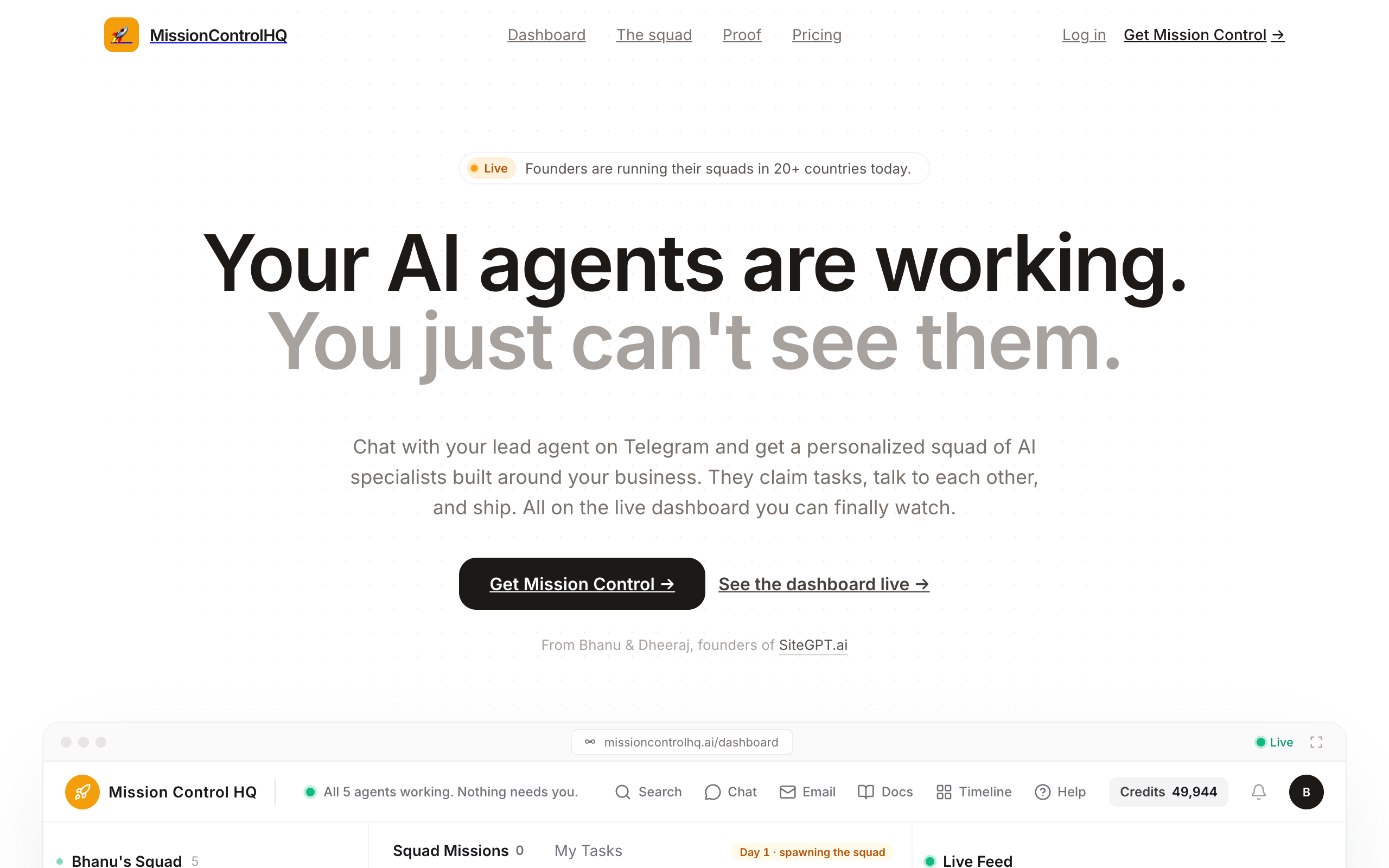
A chief of staff you do not have to design. Grok Bot hands you an empty sidebar and assumes you can name the roles your business needs. Squad's lead agent interviews you after signup and proposes a named squad with roles and personalities, which you approve, rename, edit, or replace. The build takes about two minutes, then a short onboarding conversation with the lead, and no two squads come out the same.
A board, tickets, and a status timeline instead of scrollback. Work lives on a shared task board with queues every agent reads and writes, threads with @-mentions, and a centralized ticketing lane for the questions only you can answer. Each agent has a status timeline, so you see what it is doing at a glance instead of reading an entire chat to find out.
A managed document store, built in. Deliverables land as documents with folders, editing, and archiving. On Grok Bot you assemble your own store out of the shared machine's files.
Agents you can email. Each agent can have its own inbox and address as a $10/month add-on: forward it work, and replies come back to that agent. Grok Bot's routine triggers cover Slack, Git, Teams, Linear, Sentry, and PagerDuty, and not email.
Drafts before sends, when you ask for them. Agents can hold drafts and escalations as cards for your sign-off, with allow and block rules and hard send caps behind them. Draft-first is an instruction you give the agent; the send caps are enforced.
Research tools with zero setup. Fifty-plus built-in scrape and search tools (web, social, reviews, SEO data, lead search) with a monthly credit allowance, so an agent can pull from public sources without you wiring up a single API key.
A secret vault. Credentials go into the vault and agents read them at run time. You never paste a password into chat.
A computer that arrives ready. Each squad's environment comes provisioned with a dedicated cloud computer and a separate browser per agent that your agents sign into sites with. On Grok Bot, keeping the shared computer updated is a settings job.
Receipts. Per-run model and token reporting with a runs ledger, attributable per agent. Neither a bundled subscription nor a self-hosted runtime shows you this by default.
A dashboard someone else can watch. A read-only share link covers the board with each mission's thread, agent profiles, and docs, for the co-founder or client who keeps asking what the agents did.
A real exit. Export your agents, missions, and docs as a JSON file whenever you want. With the AI subscription already yours, leaving costs a decision rather than a rebuild.
$99/mo
Flat, one plan, no tiers (September 2026)
13
AI providers you can bring, including Grok itself
$0
Markup on your tokens
70+
App integrations, with per-agent access controls
~2 min
Build time, then an onboarding conversation with the lead agent
$10/mo
Per agent email inbox, a paid add-on
The Boundary Test: access should follow context
One question from earlier coverage deserves to keep its name. The Boundary Test: can this setup structurally stop agent A from touching what agent B touches? Not by instruction, by architecture.
The reason it matters is not paranoia about the agents. It is that an agent's access should match its context. Your support agent knows the support playbook, so it gets the support inbox. Your chief of staff knows how you write, so it alone sends email on your behalf. Your payment provider's login belongs only with an agent that knows what to do and, more importantly, what never to do in that system. Handing every login to every agent means the agent with the least context about a system has the same access to it as the one you trained.
xAI documents its position plainly, which deserves credit rather than criticism. From the official FAQ: "Every Grok Bot shares one persistent cloud computer. Your Bots share that machine (files, browser, logins), so they can hand work off and keep context. Isolation is per user, not per Grok Bot." The shared machine is precisely what makes the handoff feel effortless, and the trade is exactly the one above: sign into a tool once, and every bot on the account can reach it, whatever it knows.
The security documentation goes further and says it outright. From Approvals, security, and privacy: “All of your Bots share one cloud computer assigned to your user account. Files, browser sessions, and command line credentials on that computer are available across your Bot roster,” followed by the flat instruction: “Do not use separate Bots as a security boundary.” The same page states that deleting a Bot does not remove shared-computer files or browser sessions, and the recommended hygiene, signing out of services, removing sensitive files, revoking connectors, is work you do by hand.
The reaction since launch shows founders reading those docs the same way. One widely shared post put it: “The most important line in the Grok Bot documentation is not ‘works 24/7.’ It is this: Every Bot on your account shares one computer”, with browser cookies, signed-in sessions, and local files on the shared list. Another: “You can name them Researcher, Coder, Inbox. They still share the same files, the same browser, the same logins.” A warning that went around with video noted that one sign-in hands the browser session and files to all five workers, and a tester who dug underneath the pitch called the shared profile dangerous for exactly the workflows people are wiring bots into. To be fair to xAI, most of that discussion treats it as a documented design choice to configure around, narrower accounts, approvals, signing bots out, not a hidden leak. The configuration work lands on you either way.
The extreme case is agencies. From the comments of a Grok Bot walkthrough:
Skills and plugins are shared across every bot, is there any way to scope them to one bot? Running an agency with 36 clients, and I need bot A to be structurally unable to touch client B's accounts.
The open-source runtimes hit the same wall from the other direction: Hermes Agent's own documentation states that profiles do not sandbox the agent, so separate profiles share the operator's disk unless you build the containers yourself.
The relevant Squad facts are three. Each agent has its own browser by default, so signing one agent into a tool does not sign in the rest, and an ignorant agent never inherits access it was not given (agents can still share when you tell them to). Every connection carries an access level, and the levels vary by app; you can narrow or block any single agent without signing in again, and calls outside the level are refused. And each customer's squad runs in its own isolated environment. Skills are the half that does not scope: the library is squad-wide, the same as Grok Bot's, and for access control the connection is usually the half that matters, since that is what reaches the account.
What Grok Bot costs, and what it locks
Grok Bot has no standalone price. It is included with Cursor Pro at $20 a month, Cursor Pro+ at $60, and Cursor Ultra at $200, with Cursor Teams seats at $40 or $120 per user, and with a linked SuperGrok ($30 a month), SuperGrok Plus ($100), SuperGrok Heavy, or X Premium+ subscription. Each plan includes weekly Grok Bot usage, and there is a one-time free trial. If you already pay for a Cursor plan or a SuperGrok plan, Grok Bot is included at no extra cost. Every plan is compared on the Grok Bot pricing page.
| Grok Bot | Squad | |
|---|---|---|
| Entry price | $20/mo (Cursor Pro) or $30/mo (SuperGrok) | $99/mo flat, one plan |
| Model cost | Included, xAI models only | Your own subscription, recommended $100-200 tier, no markup |
| Typical all in | $20-200/mo, plus any on-demand usage | $199-299/mo |
| Who picks the model | The vendor | You, across 13 providers including Grok, with per-agent overrides |
| At 100% usage | Wait for the reset, or pay per-token overage on top of the plan | Stack accounts, or fall back to the next model in the fallback list |
| Who designs the squad | You do, into an empty sidebar | The lead agent interviews you and proposes named roles you approve or edit |
| Work surface | Chat threads | A shared task board, tickets, threads with @-mentions, an activity feed, and a status timeline per agent |
| Cost attribution | Not surfaced per agent | Per-run model and token reporting, runs ledger |
| Approvals | Per-action approvals on sends and posts | Drafts wait for your Approve & send when you ask for draft-first; agents open tickets for decisions |
| Reaching an agent by email | Routine triggers cover Slack, Git, Teams, Linear, Sentry, and PagerDuty, not email | Each agent can have its own inbox ($10/mo add-on): email it work, replies come back to it |
| The computer | One shared cloud machine, updates are your settings job | A dedicated cloud computer with a separate browser per agent, one per customer |
| Browsers and access | Shared browser and logins, isolation per user | Own browser per agent by default; per-connection permission levels set per agent |
| Secrets | Shared machine's logins | A vault agents read at run time, never pasted in chat |
| Leaving | Rebuild elsewhere | JSON export of your agents, missions, and docs |
The two Squad bars are Squad at $99 a month flat, plus the AI subscription you bring at the recommended $100 or $200 tier. The other bars are Cursor and xAI list prices, with Grok Bot and the model included.
Grok Bot is the cheaper way to start: $20 a month with Cursor Pro covers the bots, the model, and the computer. The rows that separate the two products are the ones about the meter and the model.
A creator who already runs three other agent platforms daily put the trade in one paragraph:
You do not own the harness. You do not pick the model. The data does live on their cloud PC. This is the tax you stop paying on the open stack.
He also concluded that Grok Bot had "earned a seat" in his workflows anyway, which is the honest version of this. A bundled model is a real convenience and a real dependency at the same time.
The dependency compounds. Model quality moves monthly, pricing moves monthly, and the agent you built around one vendor's model is the agent you cannot move when a better or cheaper one appears. One Grok Bot user had already found the other end of it: "i love GROK bot but i have 20 agents, unless they allow me to import Hermes agents, I'm not REBUILDING everything."
Price is the most common objection in the comments. The reviewer whose walkthrough drew 82,000 views raised it in his own pinned comment: "It's expensive to try. You need Cursor Ultra or Grok ultra plan ($200) min to access. I would probably wait for a cheaper plan unless you're dying to try." xAI added cheaper plans on 26 August 2026, and Grok Bot now starts at $20 a month.
The open route, and what it actually asks of you
The open route gives the model choice back and charges for it in operations rather than dollars. Hermes Agent, the open-source runtime from Nous Research, is MIT-licensed, free to run, and sitting at 232.7k GitHub stars as of August 2026, which makes it the most obvious Grok Bot alternative for anyone whose main objection is the locked model.
The wider open-source field is compared in OpenClaw alternatives. Paperclip, a self-hosted control plane that coordinates those runtimes, is covered in Paperclip alternatives.
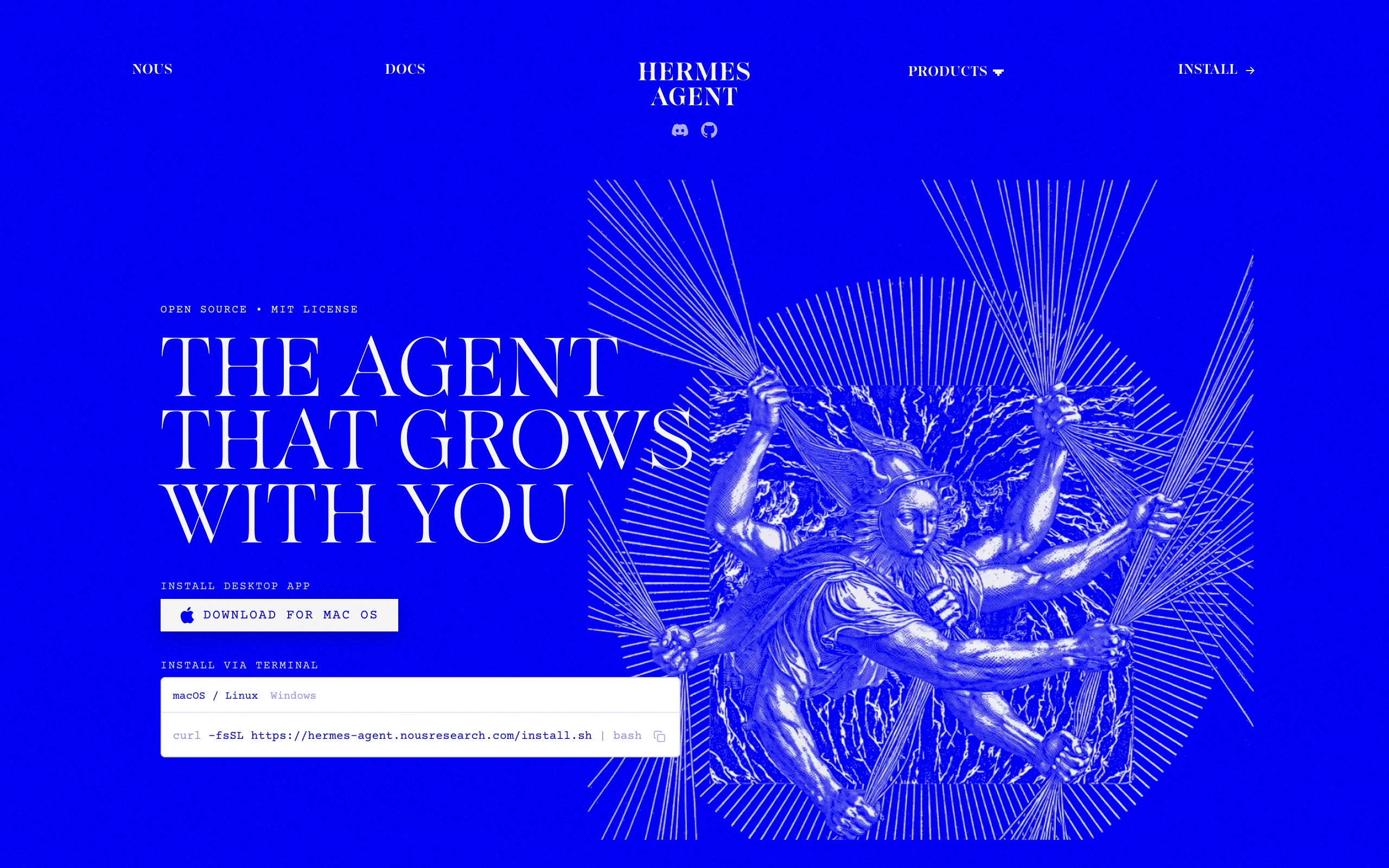
Credit where it is earned. Hermes loads only the names and descriptions of its skills up front, at roughly 3,000 tokens regardless of how many skills exist, and pulls the full content only when a skill is actually needed. It writes new skills from completed work, so repeat tasks get faster. Its skills follow the cross-vendor SKILL.md standard, which means a skill written for one tool runs in another without modification. Portable skills mean the thing you build is increasingly not locked to the runtime you built it on.
The costs are real and mostly not financial. You own hosting, updates, uptime, and security, and the agent stops when your machine does.
An engineer who deployed Hermes on Google Cloud and read its source published the sharpest available critique. Nicolas Neira's findings are that Hermes' own documentation states profiles do not sandbox the agent, and that its architecture is "one agent with five interfaces" rather than five independent services. He also cites an audit in which one operator's 129 sessions turned up 112 containing at least one violation of the approval gate. His verdict on the standard advice was blunt: "The VPS isn't bad, but presenting it as if it were equivalent to a production architecture, that is wrong."
Self-hosting does not give you cost visibility either. One Hermes user reported burning 50 million MiniMax tokens in thirty minutes on fifteen conversational prompts. That is a number you find out about afterwards.
Pros
- Free and MIT-licensed, with 232.7k GitHub stars as of August 2026
- Any model you want, including the ones that go free for a few weeks at a time
- Skills follow the cross-vendor SKILL.md standard, so what you build travels
- Loads roughly 3,000 tokens of skill names up front regardless of library size, then pulls full content on demand
- Writes new skills from completed work, so repeated tasks get faster
- Seven execution backends, from local to Docker to serverless sandboxes
Cons
- Its own documentation states profiles do not sandbox the agent, so separate profiles still share the disk on the local backend
- You own hosting, updates, uptime, and security, and the agent stops when your machine does
- No per-agent cost attribution, so token burn is something you discover afterwards
- No squad designed with you, no tickets or approvals, no per-run cost receipts: beyond Kanban's task board, the operation layer is yours to build
- One reviewer's reading of the architecture is one agent with five interfaces rather than five independent services
- Nothing to hand a co-founder or client who wants to see the work without a login
None of this makes Hermes a bad choice. It makes it a choice with an operator attached, and the honest question is whether that operator is you. If the answer is no, the same squad shape runs on a hosted coordination layer where updates, uptime, and the operation around the agents are somebody else's job. There is a fuller treatment in mission control for Hermes Agent.
What to look for in a Grok Bot alternative
Seven criteria separate the options. Run these in order, because the first three eliminate more candidates than the rest.
1. Can you pick the model, and keep the plan you already pay for? The runtime and the intelligence are separable, and platforms that fuse them are making a bet on their own model staying competitive. Bring-your-own-subscription setups let you move without rebuilding, and they run on the ChatGPT, Claude, or SuperGrok plan already on your card, with no token markup.
2. What happens at 100% usage? Ask it before the meter does. Look for account stacking and an ordered fallback list across providers, so a filled meter degrades to the next model instead of stopping the squad.
3. Do you have to already know what team you need? Removing infrastructure setup is not the same as removing design setup. Grok Bot hands you an empty sidebar, which assumes you can already name the roles your business needs. Most founders cannot on day one, and the wrong org chart is expensive in a way a wrong server never is. On Squad the lead agent interviews you about the business and proposes a named squad you approve, rename, edit, or replace, in one short conversation.
4. Is there an operation, or just chat? Agents passing messages is not the same as agents working a common board. Look for a task board every agent reads and writes, a ticketing lane for the calls only you can make, a status timeline per agent so you never have to reconstruct a day from scrollback, a managed document store, and per-run token reporting.
5. Can work reach the squad the way work actually arrives? Email, mostly. An agent with its own inbox and address can be forwarded a thread and answer from it. Check the trigger list of anything you evaluate; Grok Bot's covers Slack, Git, Teams, Linear, Sentry, and PagerDuty, and not email.
6. Is the computer ready, and whose job are updates? An agent computer should arrive provisioned with a real browser and hold credentials in a vault rather than a chat scrollback. If the platform gives you an update button, you are the operator now.
7. What does leaving look like? Portable skills, a data export available any time, and a model subscription that was yours all along are what make the next switch cheap. In a category this young, the exit is a feature. Agencies should add the Boundary Test from above as an eighth check: per-agent browsers and per-connection permission levels, or one shared machine.
$199-299/mo for a coordinated squad, against roughly $4,000/mo for one junior hire
93% to 95% less per month, and about $7,164 to $10,764 over three years against roughly $144,000 in salary alone, before payroll taxes, benefits, equipment, and ramp. Figures as of September 2026.
How to choose
When your AI usage runs out mid-week, what should happen?
- If waiting for the reset is acceptable→Grok Bot's bundled allowance will not bother you
- If the work has to keep moving→you want your own subscriptions with stacking and fallback models. Squad runs both; Grok Bot has neither
Who should own the model choice?
- If the vendor, in exchange for zero setup→Grok Bot from $20/mo, model included
- If you, and you will run the infrastructure→Hermes Agent, free and MIT, any model, your server
- If you, but somebody else runs the infrastructure→Squad at $99/mo flat, on the AI subscriptions you already pay for
Do you already know which teammates your business needs?
- If yes, the roles are obvious and you can name them today→any of the three works. An empty sidebar is not a problem when you know what goes in it
- If no, and that is the actual reason you have not started→you want the squad designed with you. Squad's lead agent interviews you and proposes the roles; Grok Bot and Hermes both start blank
Does anyone besides you need to see the work?
- If no, it is your own operation→any of the three works
- If yes, a co-founder, client, or investor→you need a shareable read-only dashboard. Squad ships one; agent runtimes generally do not
| Scenario | Best pick | Why |
|---|---|---|
| Solo founder, one business, already paying for a Cursor plan | Grok Bot | It is included, setup is near zero, and the allowance may cover you. |
| Your usage meter has ever hit 100% while work was due | Squad | Account stacking plus a cross-provider fallback list: the run continues on the next model instead of waiting for a reset. |
| You want to keep your existing ChatGPT or Claude plan | Squad or Hermes Agent | Both let you bring your own model. Grok Bot bundles it, so you pay twice for intelligence. |
| You know you want agents but cannot say which ones | Squad | The lead agent interviews you and proposes the roles. Grok Bot and Hermes both hand you an empty sidebar. |
| Work arrives by email | Squad | Per-agent inboxes with real addresses. Grok Bot's triggers do not cover email. |
| Nobody can tell you what last month's agent work cost | Squad | Per-run model and token reporting plus a runs ledger. Bundled plans hide it, self-hosting bills you after the fact. |
| A client or co-founder keeps asking what the agents did | Squad | The status timeline answers it per agent, and the read-only share link answers it once instead of weekly. |
| Agency running work for separate clients | Squad | Own browser per agent by default and per-connection permission levels per agent. Grok Bot's isolation is per user, not per bot. |
| You are technical and enjoy running infrastructure | Hermes Agent | Free, MIT, any model, and genuinely well engineered on skills. |
| You already built 20 agents somewhere else | Wait, and favor portable skills | The cross-vendor skill standard is doing more for portability than any migration tool. |
| Coding sessions | Codex or Claude Code alone | A squad adds nothing to work one person drives in one session. |
| One-off research or a single document | A prompted chat tool | No coordination layer earns its fee on work that happens once. |
If your row landed on the meter, the missing operation, or the share link, that is one product rather than three, and the build takes about two minutes, then a short conversation with the lead agent.
When Grok Bot alone is genuinely enough
Grok Bot alone is enough when one person owns all the work, the weekly allowance genuinely covers it, and you want xAI's models specifically. In that setup the shared machine is an accurate model of your life, the effortless handoff between bots is worth more than boundaries you would never use, and the bundle is the cheapest way to get xAI's models.
Two more cases favor it outright. If you already pay for a Cursor plan or a SuperGrok plan, Grok Bot is included, which makes the marginal cost of trying it zero. And if your objection to agents has always been setup, nothing else in this category removes as much of it.
The case against is specific. It applies when a filled usage meter would stop work you owe someone, when you want the model to be your decision, when you cannot name the squad you need on day one, when work arrives by email, when you need to know what each agent costs, when someone other than you needs to see the work, or when clients' accounts must stay structurally apart.
Grok Bot is best for a solo operator running one business, who already pays for a Cursor or SuperGrok plan, wants xAI's models specifically, and whose weekly allowance genuinely covers the work. For that founder the bundle is close to free and the setup is close to zero.
Questions founders ask about Grok Bot alternatives
The product
What is Grok Bot? Grok Bot is xAI's early-beta product for named AI teammates that sign into your tools through a browser, run work in parallel on a cloud computer while your laptop is closed, and hand tasks to each other in shared threads. It launched on 11 August 2026 and is included with Cursor plans from $20/month and linked SuperGrok plans from $30/month.
Can Grok Bot run on a model other than Grok? No. Grok Bot runs on xAI's models, and the subscription bundles the runtime, the machine, and the intelligence together. Creators who use several agent platforms name this as the central trade: you get a machine you do not have to maintain, and you give up the model choice.
Usage and pricing
What happens when Grok Bot hits its usage limit? You wait, or you pay per token: xAI's FAQ says additional usage is billed based on token cost on top of the subscription, so the flat plan turns metered right when your bots are busiest. Because the model is bundled, there is no second account to stack and no fallback to another provider. Platforms that run on your own AI accounts, such as Squad (formerly MissionControlHQ), let you stack accounts and chain fallbacks across thirteen providers.
How much does Grok Bot cost? Grok Bot has no standalone price. It is included with Cursor Pro at $20 per month, Cursor Pro+ at $60, Cursor Ultra at $200, and Cursor Teams seats at $40 or $120 per user, and with a linked SuperGrok ($30 per month), SuperGrok Plus ($100), SuperGrok Heavy, or X Premium+ subscription. There is a one-time free trial. Prices checked on cursor.com and x.ai on 14 September 2026.
What does a squad cost against Grok Bot? Squad is $99 per month flat as of September 2026, plus your own AI subscription at a recommended $100 to $200 tier, so $199 to $299 all in. Grok Bot starts at $20 a month with Cursor Pro and reaches $200 with Cursor Ultra, with the model included, so Grok Bot is the cheaper way to start. The deciding factors are usually what happens at 100% usage, who designs the squad, and what you can see and approve.
Boundaries and access
Do Grok Bots each get their own computer? No. xAI's own FAQ states that every Grok Bot shares one persistent cloud computer, including files, browser, and logins, and that isolation is per user rather than per bot. xAI presents this as the mechanism that lets bots hand work off and keep shared context. The trade is that every bot holds every login regardless of what it knows; platforms with a browser per agent let access follow each agent's context instead.
Can Grok Bot keep one client's data away from another client's? Not structurally, based on xAI's published FAQ, which states that isolation is per user rather than per Grok Bot and that bots share files, browser, and logins on one machine. Agencies and consultants running separate client workspaces should treat this as a real constraint until xAI documents otherwise. On Squad each agent has its own browser by default and every connection carries a per-agent permission level, so access follows each agent's context: an agent holds a login only when it knows what to do with it, and what never to do.
Can you scope skills and integrations to a single agent? The two halves have different answers. On Squad integrations scope per agent: the same account can have a lower level or no access for one agent, changes apply from the agent's next call without signing in again, and calls outside the level are refused. Skills do not scope; the library is squad-wide, as it is on Grok Bot. For client separation the connection is usually the half that matters, since that is what reaches the account.
Choosing between them
Does anything build the squad for you, or do you start from an empty sidebar? Grok Bot and open-source runtimes both start blank: they remove infrastructure setup and leave the design work with you, so you need to know which roles your business needs before you create them. On Squad the lead agent interviews you about the business after signup and proposes a named squad with roles and personalities, which you approve, rename, edit, or replace. The build takes about two minutes, then a short onboarding conversation with the lead, and no two squads come out the same.
What is the best Grok Bot alternative? It depends on what you are missing. If you want the model choice back and will run your own infrastructure, Hermes Agent is free, MIT-licensed, and at 232.7k GitHub stars as of August 2026. If you want the whole operation rather than just the agents, meaning a lead agent that designs your squad with you, a shared task board with tickets and per-run token reporting, drafts held for your approval, agents with their own email inboxes (a paid add-on), and thirteen AI providers including Grok itself, Squad at $99/month flat plus your own AI subscription is the closer match.
Is Grok Bot better than Hermes Agent? They optimize for opposite things. Grok Bot ships the machine and removes setup entirely, from $20 a month and with no model choice. Hermes Agent is free and lets you run any model, and asks you to own hosting, updates, and security. Neither designs the squad with you, shows each run's token usage, or drafts outbound work for your approval, which is the layer a coordination product such as Squad adds on top of either.
Is it worth switching agent platforms right now? Only if you are hitting a specific wall, because the category is weeks old and moving fast. Grok Bot shipped in early beta in August 2026 with known gaps its users name openly, including limited automation triggers. Portable skills and exportable instructions matter more than picking a permanent winner today, which is also why a setup that runs on the AI subscription you already pay for, such as Squad, lowers the cost of being wrong.
When is Grok Bot alone genuinely enough? When one person owns all the work, the weekly usage allowance genuinely covers it, and you want xAI's models specifically. If you already pay for a Cursor plan or a SuperGrok plan, Grok Bot is included, and the setup cost is close to zero.
Grok Bot proved the shape. The open runtimes proved the appetite. Between them they have settled the question of whether founders want a team of agents, and settled almost nothing else, which is roughly where a category should be twelve months in. What neither hands a founder is a way through the usage meter, the first draft of the org chart, a board with tickets and a status timeline per agent, agents you can email, token usage for every run, and an operation somebody else keeps alive, on the models you already pay for.
Sources
- xAI, Grok Bot: product description, capabilities, and the FAQ answers quoted here on shared computers and on data handling. Fetched 19 August 2026.
- Cursor, Pricing and Grok Bot plans, and xAI, Pricing: the plans and prices that include Grok Bot, weekly usage, and the free trial. Checked 14 September 2026.
- xAI, Grok Bot docs: Approvals, security, and privacy: the shared-computer boundary section quoted here ("Do not use separate Bots as a security boundary"), the note that deleting a Bot does not remove shared-computer files or browser sessions, and the manual remove-access checklist. Fetched 3 September 2026.
- Public posts on X reacting to the shared-computer design, quoted or referenced in the Boundary Test section: nyk, Artem, Argona, MAX, monokern, 0xMarioNawfal. All verified live 3 September 2026.
- Grok Bot's launch announcement on X, 11 August 2026, for the early-beta status and the product framing.
- Anthropic, The 2026 State of AI Agents Report: the 57% and 16% multi-stage and cross-functional figures, from a survey of more than 500 US technical leaders conducted with Material. Fetched 19 August 2026.
- Nous Research, Hermes Agent on GitHub: the 232.7k star count, MIT license, skill loading behavior, and the seven terminal backends. Fetched 19 August 2026.
- Creator reviews and their comment threads on YouTube, used for sentiment and for direct quotes from named commenters, labeled as such throughout: walkthroughs by Nate B Jones, Riley Brown, and Clearmud on Grok Bot, Craig Hewitt on running Hermes on a VPS (host-sponsored, so used here only for its comment thread), and Nicolas Neira on Hermes Agent's architecture and documentation.
- Squad (formerly MissionControlHQ): homepage and get started and pricing, for the $99/mo single plan, the email add-on, the provider list and fallback models, per-connection and per-agent access levels, per-run token reporting, the secret vault, data export, and share dashboards; docs: add, change, and pause agents for the status timeline per agent.
- Related on this site: Grok Bot pricing, Grok Bot examples, the Grok Bot directory, mission control for Hermes Agent, mission control for OpenClaw, connect AI agents to your business apps, AI agent running costs, why Squad, and Squad.
Last updated: 26 September 2026. Grok Bot pricing checked on cursor.com and x.ai on 14 September 2026; Squad pricing and features verified as of September 2026; other xAI and third-party sources fetched 19 August 2026.