
Hermes Agent is a free, open-source AI agent made by Nous Research and released under the MIT license. It runs on your own computer or server. It keeps memory between sessions, writes its own reusable skills, runs scheduled jobs, and takes messages from chat apps such as Telegram, Discord, Slack, and WhatsApp. The software costs $0. You pay for the server it runs on and for the AI model it calls. The GitHub repository, NousResearch/hermes-agent, had 258,788 stars on 30 October 2026.
This page explains what Hermes Agent is, how each part works, how to install it, what it costs per month, where its own documentation says it stops, and who should use it.
258.8k
GitHub stars on NousResearch/hermes-agent on 30 October 2026, with 56.9k forks. The code is MIT-licensed, and the latest release, v0.22.5, was published on 23 October 2026.
Source: GitHub, NousResearch/hermes-agentiShort answer
Hermes Agent is Nous Research's free, MIT-licensed AI agent. It runs on your own machine or server, keeps memory, writes skills from its own work, runs scheduled jobs described in plain language, and answers in chat apps. The software costs $0. A small server runs $6-24 a month on one common host, and the model bill depends on use. Its own docs say the Kanban board is single-host, profiles do not sandbox the agent, and the dashboard is not for the public internet. It fits technical people who want one agent they control. People who want someone else to run the machine look at a hosted option.
Key takeaways
| Question | Answer |
|---|---|
| What is Hermes Agent? | A free, MIT-licensed AI agent from Nous Research with persistent memory, self-written skills, scheduled jobs, and a chat gateway. 258.8k GitHub stars on 30 October 2026 |
| Who makes it? | Nous Research, Inc. The agent is separate from the Hermes language models Nous also trains |
| What does it cost? | $0 for the software. A server costs $6-24 a month on DigitalOcean. Model usage is extra. The example totals below run $21-324 a month, based on stated assumptions |
| What is Nous Portal? | Nous Research's paid subscription for models and tools, at $0, $20, $100, or $200 a month. Paid plans include hosting for one Cloud agent |
| What are its main limits? | Kanban is single-host, profiles do not sandbox the agent, built-in memory is capped at 2,200 and 1,375 characters, and the dashboard is not for public internet use |
| Who is it for? | Technical people who want one agent on hardware they control. It is not built for people who want no server work or a shared view for a team |
The four parts of Hermes Agent, as described in its own documentation.
The agent
One process with memory, skills it writes, subagents, and scheduled jobs. MIT license, written in Python.
The gateway
One background process that connects the agent to Telegram, Discord, Slack, WhatsApp, Signal, email, and more.
The machine
Your computer or a server you rent. Commands run on a local, Docker, SSH, Modal, Daytona, or Vercel Sandbox backend.
The model
Any model you pay for: Nous Portal, OpenRouter, OpenAI, Anthropic, Gemini, or a local server.
What Hermes Agent is and who makes it
Hermes Agent is an open-source AI agent from Nous Research, Inc. The README calls it "the self-improving AI agent built by Nous Research." The GitHub repository describes it as "the agent that grows with you." The license is MIT, so anyone can use, change, and redistribute the code.
The project is written in Python. The repository was created on 22 July 2025. The latest release on 30 October 2026 was v0.22.5, published on 23 October 2026. The docs say Hermes Agent collects no telemetry, usage data, or analytics. Conversations, memory, and skills stay in the ~/.hermes/ folder on your machine. API calls go only to the model provider you choose.
Searches for "hermes ai agent" and "nous hermes agent" sometimes mix up two things. Hermes Agent is software that runs an agent. The Hermes models are language models that Nous also trains. The Portal docs say the Hermes 4 models are available but "not recommended for agent work." Hermes Agent works with any capable model, from any provider.
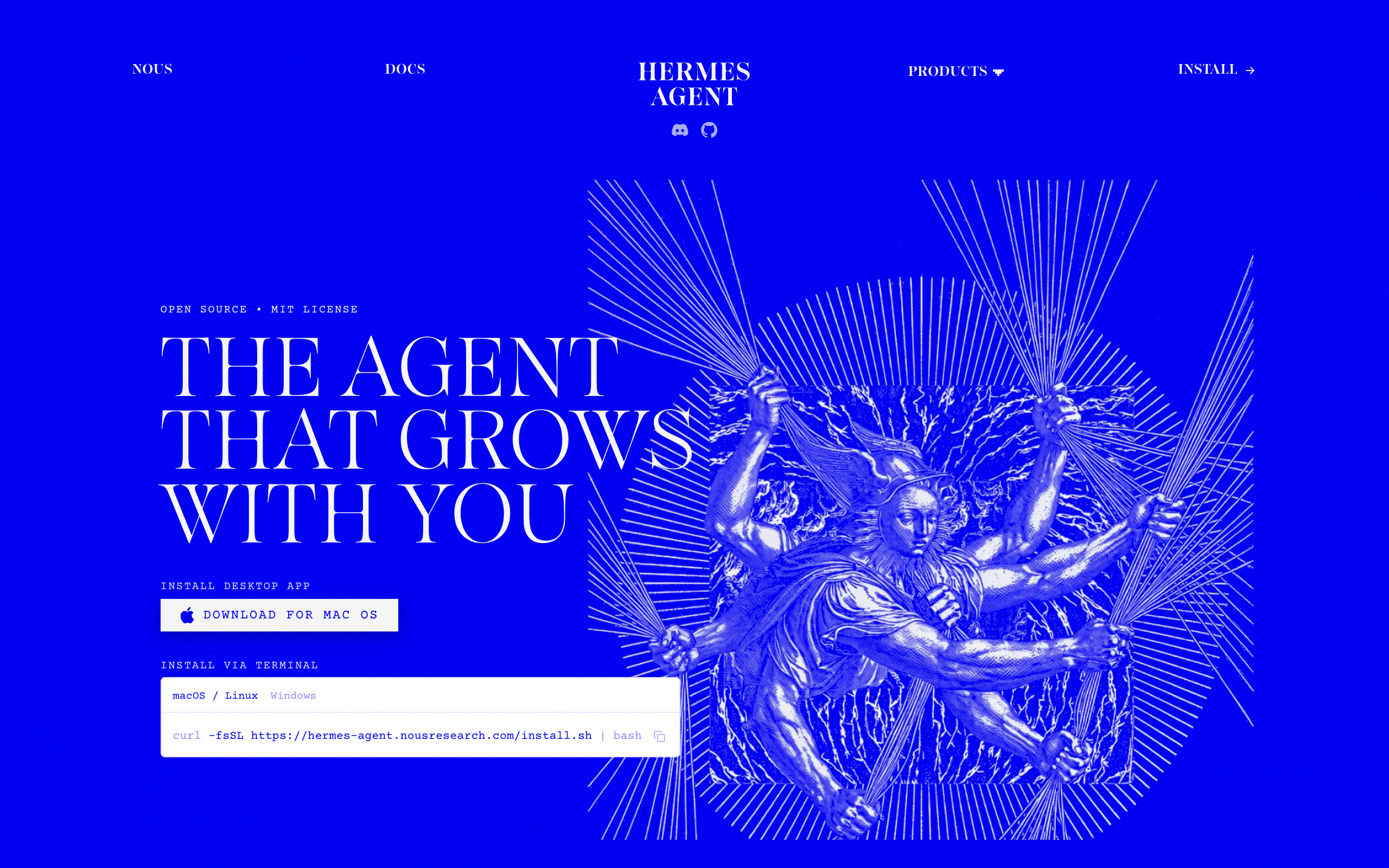
Nous Research states its mission as creating and proliferating "open access to intelligence." It also runs Nous Portal, a paid subscription for models and tools that works with Hermes Agent. The agent itself does not require Portal.
How Hermes Agent works
Hermes Agent works as one agent process that loads memory and skills at the start of each session, calls a model, runs commands on a chosen backend, and reports back through a terminal or a chat app. The sections below cover each part in the order a new user meets them.
Memory
Hermes Agent keeps two small memory files. MEMORY.md holds the agent's own notes about the environment, conventions, and lessons. It is capped at 2,200 characters, about 800 tokens. USER.md holds your preferences and communication style. It is capped at 1,375 characters, about 500 tokens. Both live in ~/.hermes/memories/.
The agent reads both files as a frozen snapshot at the start of each session. Changes made mid-session are saved at once but appear in the prompt only in the next session. Memory does not compact itself. When a write would pass the cap, the tool returns an error and the agent has to remove or merge entries first.
The agent also stores every session in a local SQLite database with full-text search, so it can look up what was said in earlier sessions. Memory is scoped per profile. Optional memory providers such as Honcho, Mem0, and Supermemory can run alongside the built-in memory.
Skills the agent writes
A skill in Hermes Agent is a SKILL.md file with a name, a description, and a procedure. Skills live in ~/.hermes/skills/ and follow the open agentskills.io format. The agent sees only a short index at first and loads a full skill when the task needs it.
The agent manages its own skills with a skill_manage tool. It can create a skill after a complex task and patch it later. A background review after a session can suggest changes. The command /learn makes the agent write a skill from a folder, a URL, or a described workflow. A setting named skills.write_approval holds every skill write for your review.
You can also install skills from the Skills Hub, which pulls from official skills, skills.sh, GitHub, ClawHub, and other sources. Hub installs pass a built-in scanner that checks for data exfiltration, prompt injection, and destructive commands. A skill the scanner marks "dangerous" stays blocked.
Scheduled jobs
Hermes Agent runs scheduled jobs that you describe in plain language. You can type /cron add "in 30m" "Remind me to check the build" in chat, run hermes cron create "every 2h" "Check server status" in a terminal, or ask the agent in a sentence. Schedules can be one-time delays, intervals, weekday and time phrases, cron expressions, or ISO timestamps.
A job can deliver its result to the chat where you made it, to a local file, or to Telegram, Discord, Slack, or email. A job can attach one or more skills. Jobs run inside the gateway process, which checks for due jobs every 60 seconds. If the gateway is not running, agent jobs are skipped. Each run starts a fresh session, so a job prompt has to contain everything the run needs.
Chat gateway
The gateway is one background process that connects Hermes Agent to messaging apps. The docs list Telegram, Discord, Slack, WhatsApp, Signal, SMS, email, Matrix, Mattermost, Microsoft Teams, Home Assistant, and many more. You set it up with hermes gateway setup. hermes gateway install registers it as a systemd service on Linux, a launchd agent on macOS, or a Task Scheduler task on Windows.
Access is closed by default. The docs say the gateway "denies all users who are not in an allowlist or paired via DM." A pairing code lasts one hour. Gateway conversations do not reset after inactivity, so a chat keeps its history until you type /new.
Sandbox backends
The terminal backend decides where the agent's shell commands run. The configuration docs say Hermes Agent ships six: local, Docker, SSH, Modal, Daytona, and Vercel Sandbox. An official plugin adds Singularity for HPC clusters. The default is local, which runs commands directly on your machine with no isolation. You switch with hermes config set terminal.backend docker.
Docker is the usual choice for isolation. The Docker backend drops all but a few Linux capabilities and limits the number of processes. The security section below covers what a backend does and does not protect.
Models
Hermes Agent works with any OpenAI-compatible API. The FAQ lists OpenRouter, Nous Portal, OpenAI, Anthropic, Google Gemini, z.ai, Kimi, and MiniMax. It also works with local servers such as Ollama, vLLM, and llama.cpp. You pick a model with hermes model.
Hermes requires a context window of at least 64,000 tokens. It rejects smaller models at startup. Each switch with /model resets the prompt cache.
Subagents and tools
The agent can start subagents with a delegate_task tool. The default is up to 10 at once, each with a fresh conversation and its own terminal. Children share the parent's working directory unless you turn on git worktree isolation. By default, subagents cannot start their own subagents.
Hermes also supports MCP servers over stdio and HTTP, so it can use tools from other MCP servers. Built-in tools cover web search, browser automation, vision, image generation, and text-to-speech.
How to install Hermes Agent and what it needs
Hermes Agent installs with one command on Linux, macOS, and WSL2:
curl -fsSL https://hermes-agent.nousresearch.com/install.sh | bash
On native Windows, run iex (irm https://hermes-agent.nousresearch.com/install.ps1) in PowerShell. After the install, reload your shell and run hermes. The quickstart docs also describe a Hermes Desktop installer for macOS and Windows. The macOS desktop installer supports Apple Silicon only. Intel Macs are not supported.
The installer does most of the setup work. It downloads its own pinned uv and Python. The docs say current first-party installs require Python 3.14 and that the installer supplies it. On Linux and macOS you need Git, curl, tar, and a SHA-256 tool. The installer also adds a pinned Chromium for browser tools and a computer-use driver. Flags such as --skip-browser turn those off.
The installation docs do not state a minimum amount of RAM or disk. Nous Portal's hosted Cloud agent is sized at up to 4 GB RAM on its Plus and Super plans, which gives one reference point for a server.
First-run steps from the quickstart:
- Run
hermes setup. It offers Quick Setup (Nous Portal), Full Setup (your own keys), and Blank Slate. - Run
hermes modelto pick a provider and model. - Start a chat with
hermesorhermes --tui. - Check that
hermes --continueresumes the last session. - Add a chat app with
hermes gateway setup. - Run
hermes doctorif something fails.
Android works through Termux on aarch64 phones. Update with hermes update, which follows the stable release channel.
The Hermes dashboard and Kanban board
The Hermes dashboard is a local web page that you start with hermes dashboard. It opens at http://127.0.0.1:9119. Its tabs are Status, Chat, Config, API Keys, Sessions, Logs, Analytics, Cron, Profiles, Skills, MCP, Webhooks, Pairing, Channels, and System. The docs say it "runs entirely on your machine," and that no data leaves localhost.
The Analytics tab shows token use, cache hit rate, and estimated or actual cost, by day and by model, for 7, 30, or 90 days. That makes it the built-in place to see what the model bill is doing.
The dashboard reads and writes your .env file, which holds API keys. The docs say to use it "only on a trusted network or behind a VPN, not for public-internet exposure." If you bind it to a non-loopback address, it refuses to start until you set up a login. The login can be a username and password, Nous Portal OAuth, or your own OIDC provider.
Kanban
Kanban is the task board for several Hermes agents. The docs describe it as "a durable task board shared across all Hermes profiles." Each task is a row in a SQLite file at ~/.hermes/kanban.db. A task's assignee is a named profile. A dispatcher inside the gateway checks the board every 60 seconds and starts a worker process for each ready task, using that profile's own configuration and model.
Task statuses are triage, todo, ready, running, blocked, review, done, and archived. Tasks can have parents and children, comments, and attachments. The dashboard plugin adds a Kanban tab with a column per status, drag and drop, and live updates.
The docs set clear scope limits. They say "Kanban is deliberately single-host." They also say "Running a shared board across two hosts is not supported." The dashboard plugin is "deliberately thin," and "budgets, governance gates, and org-chart views remain user-space," meaning you build them yourself. The docs suggest running the planner on a frontier model and the workers on cheaper models to control cost.
The page mission control for Hermes Agent covers Kanban and the hosted alternative in depth. This page does not repeat that comparison.
Multi-agent profiles in Hermes
A profile is a separate Hermes home directory. Each profile has its own configuration, API keys, personality file (SOUL.md), memory, sessions, skills, scheduled jobs, and gateway. You create one with hermes profile create and run it with hermes -p <name>. Each profile also gets a shortcut command, such as coder chat.
Profiles are how one person runs several agents on one machine. A research profile can use a cheap model and a coding profile a strong one. Each profile that connects to a chat app runs its own gateway process with its own bot token. The docs say "a bot can only belong to one profile."
The --clone flag copies config, keys, personality, skills, and curated memory into a new profile. It does not copy sessions or scheduled jobs. Messaging channels are not copied unless you pass --clone-channels.
The docs state one limit plainly: "Profiles do not sandbox the agent." On the local backend, every profile can reach the same files as your user account. A profile separates memory and settings. It does not separate disk access. The docs also warn against pointing two agent processes at one profile, because they will write into each other's memory.
What Hermes Agent costs
Hermes Agent costs $0 for the software and has two running costs: a server and a model. Nous Portal can cover both.
Software
The MIT-licensed code is free. The FAQ says "You pay only for LLM API usage from your chosen provider."
Server
You can run Hermes on a computer you already own. A rented server keeps it on around the clock. On 30 October 2026, DigitalOcean's Basic Droplets cost $6 a month for 1 GiB of RAM, $12 for 2 GiB, $18 for 2 GiB and 2 vCPUs, and $24 for 4 GiB and 2 vCPUs. The Hermes docs state no minimum, so these are price points and not a recommendation.
Model
The model bill depends on how many tokens the agent reads and writes. The docs warn that subagents multiply it. A parallel batch "typically burns the large majority of a run's total tokens." As one price point, Anthropic's pricing page lists Claude Sonnet 5.5 at $2 per million input tokens and $10 per million output tokens on 30 October 2026.
The table shows example monthly totals. The token volumes are assumptions chosen for illustration. They are not measured Hermes usage. The model cost ignores prompt caching discounts, so real bills can be lower.
| Setup | Assumption | Server | Model | Monthly total |
|---|---|---|---|---|
| Light personal use | 3M input and 0.3M output tokens, 2 GiB server | $12 | $9 | $21 |
| Daily jobs and chat | 20M input and 2M output tokens, 4 GiB server | $24 | $60 | $84 |
| Heavy use with subagents | 100M input and 10M output tokens, 4 GiB server | $24 | $300 | $324 |
| Portal Plus with Cloud agent | One hosted agent, usage within plan limits | included | included | $20 |
| Portal Super with Cloud agent | One hosted agent, usage within plan limits | included | included | $100 |
The model figures use Sonnet 5.5 prices: 3M × $2 + 0.3M × $10 = $9, 20M × $2 + 2M × $10 = $60, and 100M × $2 + 10M × $10 = $300. A cheaper model lowers every one of them. For the general method of estimating agent bills, see how much AI agents cost to run and AI agent cost control.
Over a year, the light and daily setups come to $252 and $1,008 a year ($21 × 12 and $84 × 12). The heavy setup comes to $3,888 a year.
Nous Portal vs Hermes Agent
Hermes Agent is free software that runs the agent. Nous Portal is a paid account from Nous Research that supplies models, tools, and optional hosting for it. You can run Hermes without Portal.
The Portal page lists four plans on 30 October 2026:
| Plan | Price per month | Included Cloud agent | Notes |
|---|---|---|---|
| Free | $0 | None listed | Free models only, standard rate limits |
| Plus | $20 | Up to 4 GB RAM, 25 GB disk | Hermes usage within limits that reset daily, weekly, and monthly |
| Super | $100 | Up to 4 GB RAM, 100 GB disk | Same limit structure |
| Ultra | $200 | Up to 8 GB RAM, 100 GB disk | Same limit structure |
Portal gives access to more than 300 models. Its Tool Gateway adds web search, image generation, text-to-speech, and cloud browser automation under one login. The docs call Portal "the recommended way to run Hermes Agent." They say that without the gateway you would need "five separate signups." hermes setup --portal connects it in one step.
Every paid plan includes hosting for one Cloud agent, up to the plan's size. Larger sizes and extra agents use credits. You can top up with $10, $20, $50, $100, or $200. The page says an eligible ChatGPT account can be connected for supported inference without a paid Nous subscription, and that tools and Cloud hosting are still charged separately. The Portal page gives no per-day or per-month price for Cloud hosting beyond the plan allowances.
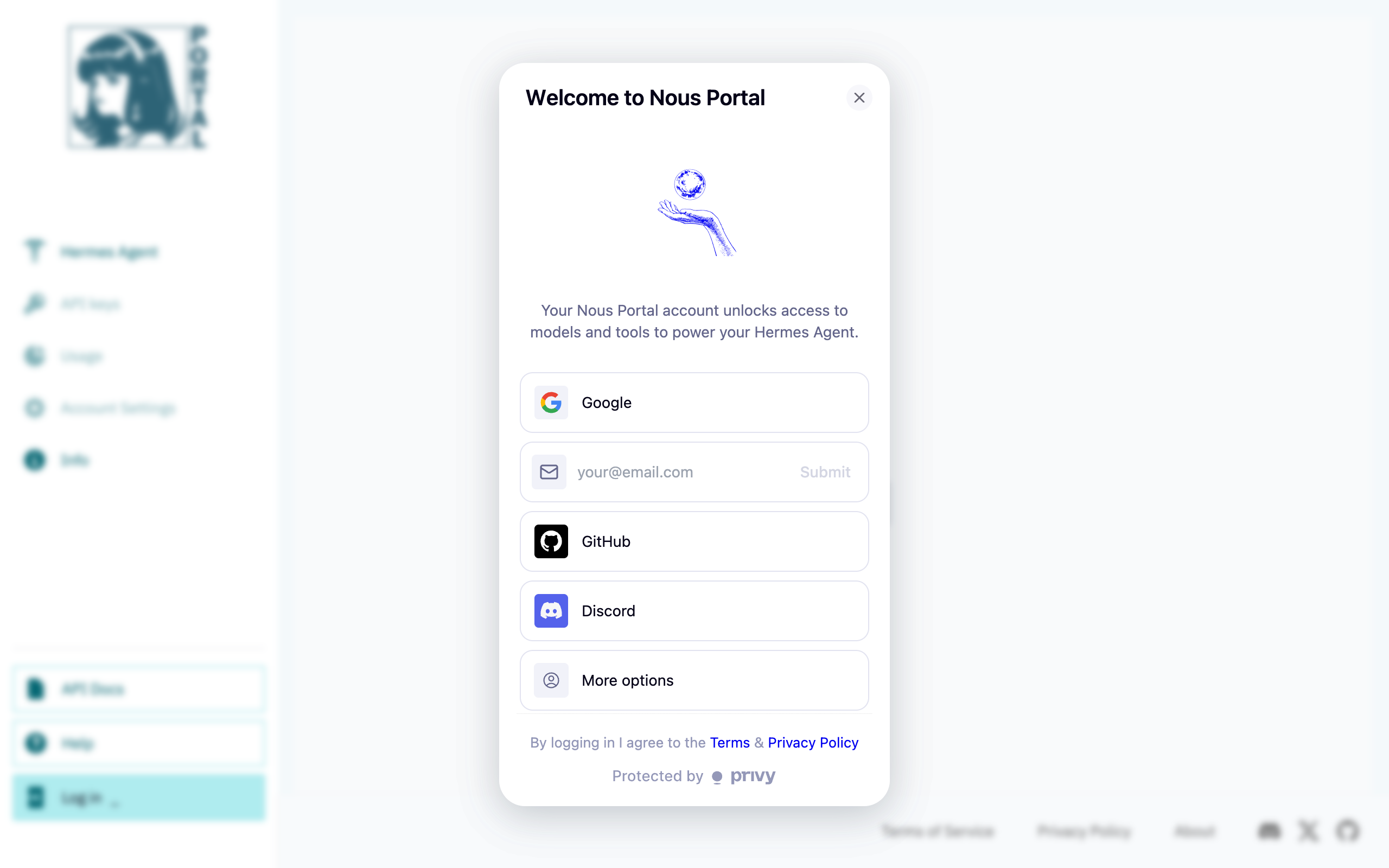
Portal pays for the model, the tools, and the server in one place. Hermes Agent stays the same software either way.
Known limits from Hermes' own docs
Hermes' documentation states its limits in plain terms. The table lists the ones that matter most for a new user, each with the page that says it.
| Limit | What the docs say | Page |
|---|---|---|
| Kanban is single-host | "Kanban is deliberately single-host." A shared board across two hosts "is not supported" | Kanban |
| Profiles are not sandboxes | "Profiles do not sandbox the agent." | Profiles |
| Memory is small | MEMORY.md 2,200 characters, USER.md 1,375 characters, no automatic compaction | Memory |
| Context minimum | At least 64,000 tokens, or the model is rejected at startup | Quickstart |
| Dashboard is local | Use it "only on a trusted network or behind a VPN, not for public-internet exposure" | Web dashboard |
| Cron needs the gateway | Agent jobs are skipped when the gateway is not running, and each run starts a fresh session | Cron |
| WhatsApp numbers | Each profile needs its own number | FAQ |
| Messaging and sudo | sudo cannot prompt for a password through the gateway | FAQ |
| Subagent cost | "There is no upper ceiling," and "cost is the practical limit" | Delegation |
| No stated hardware minimum | The install docs give no minimum RAM or disk | Installation |
| Budgets and approvals | Kanban leaves "budgets, governance gates, and org-chart views" to the user | Kanban |
None of these is a defect. They describe a single-user agent that runs on one machine. They matter when the use grows past one person or one machine.
Is Hermes Agent secure?
Hermes Agent is built as a single-user tool, and its security policy says so. SECURITY.md states: "Hermes Agent is a single-tenant personal agent." It also states: "The only security boundary against an adversarial LLM is the operating system." The policy treats the approval prompts, secret redaction, and pattern scanners as heuristics, not as boundaries.
The security docs describe eight protective layers. The main ones are below.
| Layer | What it does |
|---|---|
| Command approval | Matches commands against a danger list. Modes are smart, manual, and off. off is the same as --yolo |
| Hardline blocklist | Blocks commands such as rm -rf / in every mode, with no override |
| Gateway allowlist | Denies every user who is not allowlisted or paired |
| Container isolation | The Docker backend drops all but a few capabilities and limits processes |
| Secret handling | Strips provider keys from child processes by default |
| Skill scanning | Scans hub installs for exfiltration and prompt injection |
The same docs list what is not protected. The local backend has no isolation. Container backends skip the command approval checks because "the container itself is the security boundary." The code execution tool and MCP subprocesses run in the agent process, outside a terminal-backend sandbox. SECURITY.md says that running the default local backend with untrusted input is "outside the supported security posture." For untrusted input, it points to a whole-process wrapper, such as Hermes' Docker image or NVIDIA OpenShell.
Vulnerabilities have been reported. A keyword search of the US National Vulnerability Database for "hermes-agent" on 30 October 2026 returned 39 records published between 27 April and 3 September 2026. They cover the gateway, the approval logic, skill handling, and the dashboard. The project has no bug bounty program. This page did not check the fix status of each record. Run a current release, and read the NVD list before you expose any Hermes gateway to the internet.
Practical steps that follow from the docs:
- Use the Docker backend or a whole-process wrapper if the agent reads email, web pages, or group chats.
- Keep the dashboard on
127.0.0.1or behind a VPN. - Keep the gateway allowlist closed and use pairing codes for new users.
- Run
hermes updateon a schedule. - Keep
approvals.modeonsmartormanual.
Hermes Agent vs OpenClaw
Hermes Agent and OpenClaw are both free, MIT-licensed, self-hosted agent runtimes that work with many models. The table compares them on facts from each project's GitHub page on 30 October 2026.
| Hermes Agent | OpenClaw | |
|---|---|---|
| Maker | Nous Research, Inc. | OpenClaw Foundation, an independent 501(c)(3) |
| License | MIT | MIT |
| GitHub stars | 258,788 | 393,451 |
| Runtime | Python (the installer supplies Python 3.14) | Node.js 24.22.1+ or 26.12.1+ |
| Chat apps | Telegram, Discord, Slack, WhatsApp, Signal, email, and more through one gateway | Discord, iMessage, Slack, Teams, Telegram, WhatsApp, and 20+ more |
| Learning | Agent writes and patches its own skills | Skills and plugins extend the assistant |
| Multi-agent | Profiles, subagents, single-host Kanban | Several agents in one Gateway, per OpenClaw's docs as read on 10 September 2026 |
| Import | hermes import-agent openclaw brings over memories, skills, and settings | Not applicable |
OpenClaw is the larger project and has the foundation behind it. Hermes puts more weight on the agent improving its own skills and on a built-in task board. Both run on your hardware and both leave server upkeep and security to you. The README for Hermes documents a one-command import from OpenClaw, with --dry-run to preview. OpenClaw alternatives compares both with seven other options, and mission control for OpenClaw covers the OpenClaw side of the same question. The full comparison is in Hermes Agent vs OpenClaw.
Hermes Agent alternatives
People look for a Hermes Agent alternative for three reasons: they do not want to run a server, they want several agents to share work, or they want a different design. The options fall into three groups.
| Group | Examples | What changes |
|---|---|---|
| Other open-source runtimes | OpenClaw, ZeroClaw, NanoClaw, PicoClaw | Same self-hosting work, different design |
| Hosted single agents | Claude Cowork, Grok Bot, Manus, Kimi Claw | No server, tied to one vendor or credit meter |
| Hosted groups of agents | Covered in the hosted section below | Someone else runs the machine and the task board |
The OpenClaw alternatives page covers the open-source and hosted single-agent options in detail, with prices and limits. Grok Bot alternatives covers xAI's hosted option. Nous Portal's Cloud agent is a further option: it hosts one Hermes agent for you.
Who should use Hermes Agent, and who should not
Hermes Agent suits one technical person who wants a capable agent on hardware they control. It does not suit people who want to avoid server work or who need several people to see the work.
| Scenario | Best pick | Why |
|---|---|---|
| A developer who wants a personal agent on a VPS | Hermes Agent | Free, MIT, runs anywhere, and the agent keeps skills and memory. |
| Someone who wants to message an agent from Telegram or WhatsApp | Hermes Agent | One gateway covers the major chat apps. |
| A person who wants one login for models and tools | Hermes Agent with Nous Portal | Portal replaces several API signups and can host one agent. |
| A person who wants no server to run | Nous Portal Cloud agent or a hosted tool | The Cloud agent hosts one Hermes agent. Hosted tools remove the install. |
| A team that needs a shared view of what agents did | A hosted tool | The Hermes dashboard and Kanban board are local to one machine. |
| An agent that reads untrusted email or public chats | Hermes in Docker or a full sandbox | SECURITY.md names the OS as the only real boundary. |
| Per-agent spend limits and approvals across many agents | A tool built for that | Kanban leaves budgets and governance gates to the user. |
Who runs the machine?
- If you, and you are comfortable with a terminal→Hermes Agent
- If nobody, you want it hosted→Nous Portal Cloud agent or a hosted option
Who needs to see the work?
- If only you→Hermes Agent with the local dashboard
- If co-founders, staff, or clients→A hosted option with a shared view
When Hermes Agent alone is enough
Hermes Agent alone is enough when one person, on one machine, runs one or a few agents and does not need anyone else to see them. That covers a developer's personal assistant, a research agent that sends a morning summary to Telegram, and a set of scheduled reports. It also covers a person who enjoys running servers and wants every part of the system to be inspectable.
It stays enough as long as the single-host Kanban board holds the work, the Analytics tab is enough cost visibility, and you are happy to own updates and security. The signs that it is not enough are a second person who needs access, a client who needs to see progress, or a wish to cap spend by agent.
Where a hosted squad fits
A hosted squad fits when the work needs several AI teammates, a shared view, and someone else running the machine. A squad is a group of named AI teammates that share one task board, instead of one agent doing everything. Squad (formerly MissionControlHQ) is one hosted product built that way.
The facts below come from squad.so and its docs, checked on 30 October 2026.
- Squad costs $99 a month, with a 7-day money-back guarantee on the first payment. Extras are optional: email inboxes at $10 a month each, seats for people at $9 a month each, and research credits.
- You bring your own AI plan. Squad adds no per-task AI charges. It recommends a ChatGPT plan at $100 to $200 a month, so $99 plus that plan is $199-299 a month.
- Each squad has its own computer in the cloud, and the teammates run there. Self-hosted and isolated deployments are "handled case by case."
- A lead teammate called the chief of staff designs the squad with you and creates the other teammates.
- The docs describe a task board, a record of every run, and token usage for each run. People can be added with a role.
- Teammates are reachable from the dashboard, Telegram, Discord, and Slack.
Squad is a different kind of product from Hermes Agent. Hermes is software you run. Squad is a service you subscribe to. The Squad docs do not mention Hermes, and this page does not claim that Squad runs Hermes. The two compare on who runs the machine and how many agents share a board. Mission control for Hermes Agent makes that comparison in full.
A hosted squad is not needed if you are one technical person who wants a single agent on your own machine. Hermes Agent fits that case better and costs less.
Frequently asked questions
Basics
What is Hermes Agent? Hermes Agent is a free, open-source AI agent made by Nous Research and released under the MIT license. It runs on your own computer or server, keeps memory between sessions, writes its own reusable skills, runs scheduled jobs, and answers in chat apps such as Telegram, Discord, Slack, and WhatsApp. The software costs $0, and you pay for the server and the AI model. Its GitHub repository had 258,788 stars on 30 October 2026.
Who makes Hermes Agent? Nous Research, Inc. makes Hermes Agent. Nous Research describes its mission as creating and proliferating open access to intelligence. It also runs Nous Portal, a paid subscription for models, tools, and hosting that works with Hermes Agent. The agent itself does not require Portal.
Is Hermes Agent the same as the Hermes models? No. Hermes Agent is software that runs an agent. The Hermes models are language models that Nous Research also trains. The Nous Portal docs say the Hermes 4 models are available but not recommended for agent work. Hermes Agent works with any OpenAI-compatible model, including models from Anthropic, OpenAI, Google, and local servers.
Setup and use
How do you install Hermes Agent? On Linux, macOS, and WSL2, run curl -fsSL https://hermes-agent.nousresearch.com/install.sh | bash. On native Windows, run iex (irm https://hermes-agent.nousresearch.com/install.ps1) in PowerShell. Then run hermes setup to pick a provider and model, and run hermes to start a chat. The installer supplies its own Python 3.14. The docs give no minimum RAM or disk.
Can Hermes Agent run several agents? Yes, on one machine. Profiles give each agent its own configuration, memory, skills, scheduled jobs, and gateway, and the delegate_task tool starts up to 10 subagents at once by default. Kanban is a shared task board for named profiles. Hermes' docs state that Kanban is deliberately single-host and that profiles do not sandbox the agent.
Does Hermes Agent have a dashboard? Yes. Running hermes dashboard opens a local web page at 127.0.0.1:9119 with tabs for chat, sessions, analytics, scheduled jobs, profiles, skills, and settings. The Analytics tab shows token use and estimated cost by day and by model. The docs say to use the dashboard only on a trusted network or behind a VPN, and not on the public internet.
Cost and plans
How much does Hermes Agent cost? The software costs $0. Running it costs a server and a model. A DigitalOcean server costs $6 to $24 a month for 1 to 4 GiB of RAM. Model cost depends on use: with Claude Sonnet 5.5 at $2 per million input tokens and $10 per million output tokens, assumed light, daily, and heavy use come to about $9, $60, and $300 a month. Totals with a server range from $21 to $324 a month.
What is the difference between Nous Portal and Hermes Agent? Hermes Agent is the free software. Nous Portal is a paid account from Nous Research that supplies models, tools, and hosting for it. Portal plans are Free at $0, Plus at $20, Super at $100, and Ultra at $200 a month. Every paid plan includes hosting for one Cloud agent, up to the plan's size. You can run Hermes Agent without Portal.
How much does it cost to run Hermes Agent on a server? On 30 October 2026, DigitalOcean's Basic Droplets cost $6 a month for 1 GiB of RAM, $12 for 2 GiB, $18 for 2 GiB and 2 vCPUs, and $24 for 4 GiB and 2 vCPUs. Hermes' docs state no minimum RAM or disk, so these are price points and not a requirement. Nous Portal's included Cloud agent is sized at up to 4 GB of RAM on Plus and Super.
Limits, security, and alternatives
What are Hermes Agent's limits? Hermes' own docs state these limits: Kanban is deliberately single-host and a shared board across two hosts is not supported, profiles do not sandbox the agent, built-in memory is capped at 2,200 and 1,375 characters, models need at least 64,000 tokens of context, and the dashboard is not for public internet use. Budgets and governance gates on Kanban are left to the user.
Is Hermes Agent safe to run? Its security depends on how you run it. SECURITY.md calls Hermes Agent a single-tenant personal agent and says the only security boundary against an adversarial model is the operating system. The default local backend has no isolation, so an agent that reads untrusted email, web pages, or group chats should run in Docker or a whole-process sandbox. The National Vulnerability Database listed 39 records for hermes-agent on 30 October 2026, so keep it updated.
What is the difference between Hermes Agent and OpenClaw? Both are free, MIT-licensed, self-hosted agent runtimes. OpenClaw has more GitHub stars (393,451 against 258,788 on 30 October 2026), runs on Node.js, and is stewarded by the OpenClaw Foundation, a non-profit. Hermes Agent runs on Python, writes and patches its own skills, and includes a single-host Kanban board. Both leave the server, updates, and security to you.
When does a hosted squad make sense instead of Hermes Agent? A squad is a group of named AI teammates that share one task board, instead of one agent doing everything. It makes sense when several teammates, a shared view for other people, and a vendor-run machine matter more than owning the server. Squad (formerly MissionControlHQ) costs $99 a month plus your own AI plan, and each squad has its own cloud computer. Hermes Agent alone is enough for one technical person on one machine.
Sources
- Nous Research: Hermes Agent on GitHub (258,788 stars, MIT; fetched via the GitHub API on 30 October 2026), SECURITY.md, homepage, Nous Research, Nous Portal.
- Hermes docs, all fetched 30 October 2026: quickstart, installation, FAQ, memory, skills, scheduled jobs, messaging gateway, configuration, delegation, MCP, web dashboard, Kanban, profiles, security, Nous Portal integration.
- Vulnerability records: NVD keyword search for hermes-agent, queried through the NVD API on 30 October 2026.
- Prices: DigitalOcean Droplet pricing and Anthropic model pricing, both on 30 October 2026.
- OpenClaw: GitHub repository (393,451 stars, MIT), 30 October 2026.
- Squad (formerly MissionControlHQ): homepage, what Squad is, costs, full docs text, and get started.
- Related on this site: mission control for Hermes Agent, OpenClaw alternatives, mission control for OpenClaw, how much AI agents cost to run, AI agent cost control, and Grok Bot alternatives.
Last updated: October 2026. Pricing and features verified as of October 2026.