
Hermes Agent is better than OpenClaw for a person who wants a free agent that writes its own skills, runs scheduled jobs from plain language, and has a built-in Kanban board. OpenClaw is better for a person who wants the larger project, wider chat-app and device reach, and a non-profit foundation behind it. Both are free, MIT-licensed, self-hosted, and run on any major AI model.
Both also share one limit. You run the machine, and each project's own docs describe a single trusted operator on one host. This page compares them on official docs and repositories checked October 30, 2026, then covers a third option, a squad, after the comparison.
393k vs 259k
GitHub stars on OpenClaw and Hermes Agent on October 30, 2026. Since an earlier check on September 10, Hermes added about 15k stars and OpenClaw about 4.5k.
Source: GitHub, openclaw/openclaw and NousResearch/hermes-agentiShort answer
Hermes Agent wins 3 of 13 dimensions (scheduling, multi-agent support, default security settings), OpenClaw wins 4 (memory, chat and device reach, governance, community size), and 6 are ties. Both cost $0 for the software, so the bill is the host plus the AI model. Both stop at one machine you manage. A squad (a team of AI agents, each with its own job, working together, not just one assistant) is the third option when you do not want to run that machine.
Key takeaways
| Question | Answer | Key fact |
|---|---|---|
| Which should you run? | Hermes for a learning agent with schedules and a Kanban board. OpenClaw for the widest chat and device reach. | Hermes wins 3 dimensions, OpenClaw wins 4, 6 are ties |
| Is Hermes better than OpenClaw? | Better on scheduling, multi-agent boards, and default security. Not better on memory, reach, governance, or size. | OpenClaw has 393k stars, Hermes has 259k |
| Is Hermes cheaper? | Not by much. The software is $0 for both. | Lowest documented Hermes path is Nous Portal Plus at $20 a month |
| Can they work together? | Yes, as separate programs. Both import from the other. | No official bridge is documented |
| How secure are they? | Neither is safe against a hostile agent or user by default. | OpenClaw lists 722 repo advisories, Hermes lists none in its repo |
| What do both share? | You run one host for one trusted operator. | Hermes Kanban is single-host by design |
Verdicts from each project's own docs and repository, checked October 30, 2026.
Hermes Agent
Self-improving agent, plain-language cron, Kanban, smart command approval on by default
OpenClaw
Gateway for chat apps and devices, deeper memory, non-profit foundation, larger community
Cost
$0 software for both. Pay for the host and the model
Shared limit
One machine you run, one trust domain
Third option
A squad: hosted AI teammates, $99 a month plus your AI plan
Hermes Agent vs OpenClaw at a glance
Hermes Agent and OpenClaw match on license, price, and model choice, and differ on memory design, chat reach, scheduling, and who stands behind the project. The table below sets each fact side by side. Each row is covered in its own section after this one.
| Hermes Agent | OpenClaw | |
|---|---|---|
| Maker | Nous Research, a private company | OpenClaw Foundation, a 501(c)(3) non-profit |
| License and price | MIT, free | MIT, free, no paid tier |
| GitHub stars (Oct 30, 2026) | 258,789 | 393,453 |
| Latest release seen | v0.22.5 (Oct 23, 2026) | v2026.10.9 (Oct 29, 2026) |
| Memory | Two small files (3,575 characters in total) plus full-text search of past sessions | Memory file, daily notes, hybrid search, default-on consolidation job |
| Skills | Agent writes skills, hub with scanning and trust levels | Skill Workshop, ClawHub registry with VirusTotal scanning |
| Chat apps | 20+ platforms through one gateway | Six named channels plus 20+ more, and iOS and Android nodes |
| Models | Any OpenAI-compatible endpoint, ChatGPT or Codex sign-in, Nous Portal | About 75 providers listed, ChatGPT or Codex sign-in, local runtimes |
| Scheduling | Plain-language cron, script-only jobs with no model call | Cron, intervals, webhooks, active hours, email trigger |
| Sandbox by default | None on the local backend, smart command approval on | Off |
| Several agents | Profiles, Kanban board, Bot Mode rooms of 2 to 6 | Isolated agents in one Gateway, Workboard cards |
| Dashboard | hermes dashboard on port 9119 | Control UI on port 18789 |
| Setup | One install command, hermes setup | One install command, openclaw onboard, Node required |
| Paid layer | Nous Portal at $20, $100, or $200 a month | None |
What is OpenClaw?
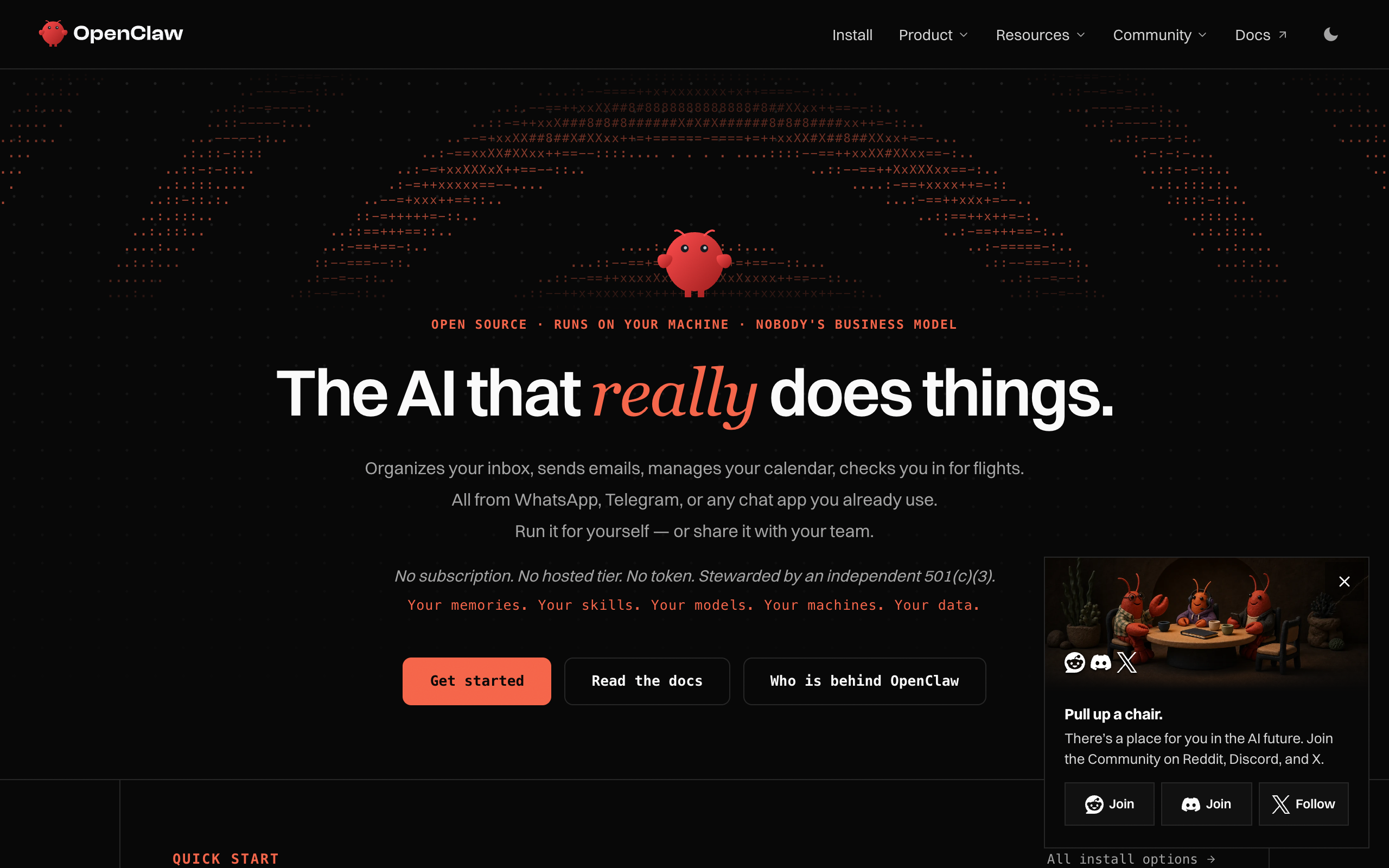
OpenClaw is a free, MIT-licensed Gateway that you run on your own machine and that connects chat apps to an AI agent. Its docs call it an extensible, proactive, open-source AI agent that works everywhere you work. The project was earlier named Clawdbot and Moltbot, and its legacy folders still appear in Hermes's importer docs.
One Gateway process owns every chat channel, and one Gateway runs per host. The Control UI, command line, and companion apps connect to it. Companion nodes on macOS, iOS, and Android add camera, screen, and voice features. The OpenClaw Foundation, a 501(c)(3), develops the project, and the site states there is no subscription, no hosted tier, and no token.
Pros
- Largest community: 393,453 GitHub stars
- Chat apps, iOS and Android nodes, and a Control UI in one Gateway
- Non-profit foundation with OpenAI, NVIDIA, and Microsoft among its named partners
Cons
- Sandboxing is off by default
- 722 published security advisories in its own repository
- A ClawHub skill campaign delivered malware in early 2026
Pricing: free software, plus your host and your model. See OpenClaw on GitHub.
People who want one personal assistant across many chat apps and devices, with the largest community behind it.
What is Hermes Agent?
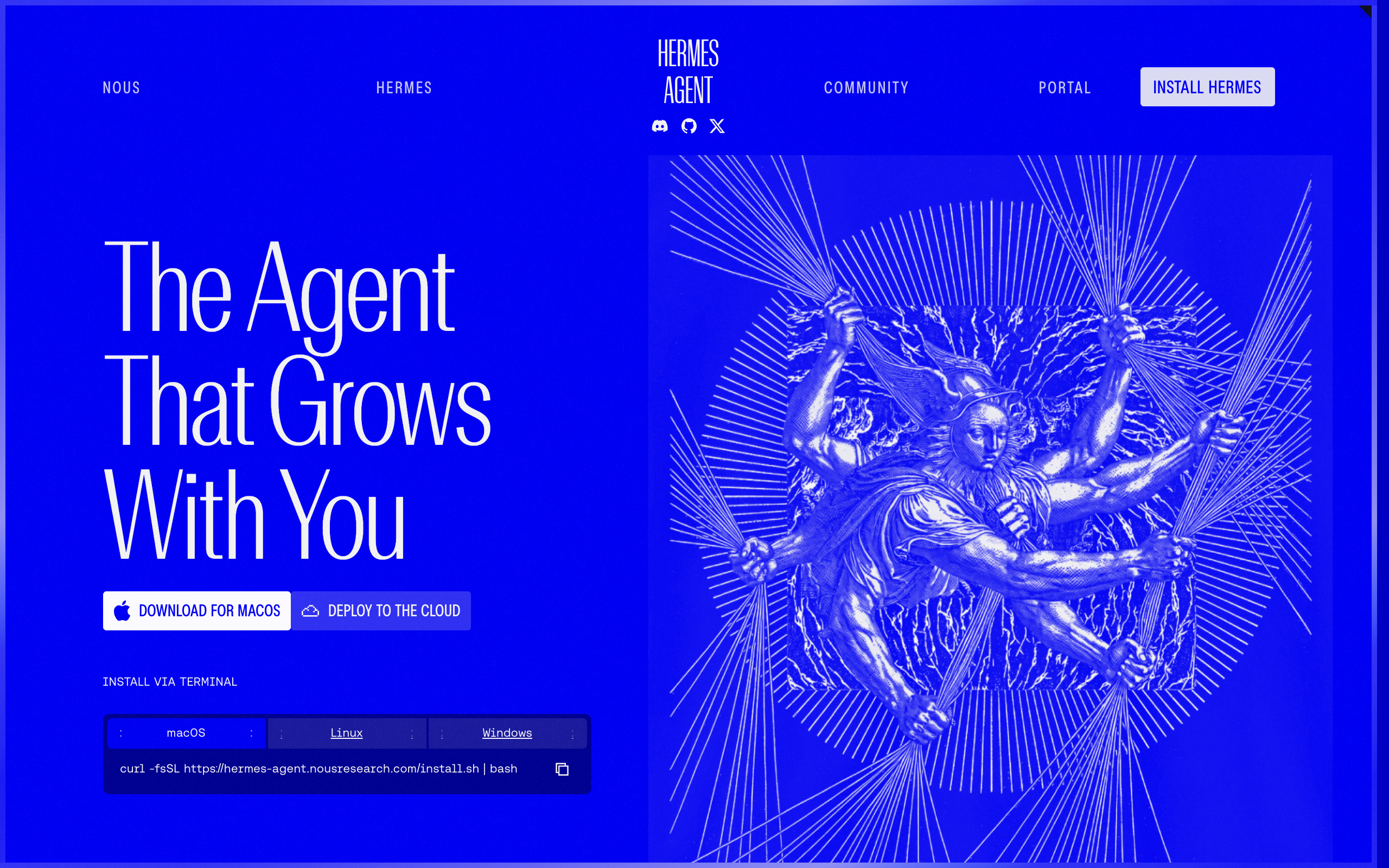
Hermes Agent is a free, MIT-licensed agent from Nous Research that you run yourself and that is built around a learning loop. Its README calls it a self-improving agent. It keeps memory across sessions, writes reusable skills after complex tasks, runs a built-in cron scheduler, and delegates to subagents.
It runs from a terminal, a desktop app for macOS, Windows, and Linux, or a web dashboard. One gateway process connects it to chat apps. Nous Research also sells Nous Portal, a paid subscription with models, tools, and a cloud agent, but the agent itself works without it.
Pros
- Agent writes and reuses its own skills
- Plain-language cron and script-only jobs that need no model call
- Kanban board, Bot Mode, and a dashboard with token and cost analytics
Cons
- Core memory is capped at 3,575 characters
- Kanban is single-host by design
- Venture-backed company with a paid Portal product
Pricing: free software, plus your host and your model. Optional Nous Portal plans cost $20, $100, or $200 a month. See Hermes Agent on GitHub and the page on what Hermes Agent is.
People who want an agent that improves at recurring jobs, with schedules and a task board on one machine.
How do memory and skills compare?
OpenClaw has the deeper memory system, and the two projects tie on skills. Hermes loads two small files into every session and searches old sessions on demand. OpenClaw keeps a long-term file, daily notes, and a search index.
In Hermes, MEMORY.md holds 2,200 characters and USER.md holds 1,375 characters. Both load as a frozen snapshot at session start. Memory does not compact itself, so the agent must remove entries before adding more once a file is full. Past sessions sit in a SQLite database with full-text search, with no limit and no model call. Providers such as Honcho, Mem0, and Supermemory can run alongside the built-in files.
In OpenClaw, MEMORY.md holds durable facts, and daily files named by date hold detailed notes. Search combines vector similarity with keyword matching, and the default embedding provider is OpenAI. A consolidation job called dreaming is on by default and promotes notes to MEMORY.md only when they pass score, frequency, and diversity checks. Its docs add that memory stores notes but does not enforce policy.
Winner: OpenClaw, because its docs describe more memory machinery (daily notes, hybrid search, consolidation) than Hermes's two capped files. Hermes closes part of the gap with unlimited session search.
On skills, both projects use a folder with a SKILL.md file, and both let the agent write its own. Hermes creates skills through a skill_manage tool and a background review after a turn, and writes are not gated unless you set skills.write_approval to true. OpenClaw's Skill Workshop saves the previous version so a change can be undone, and a learned skill is visible only to the agent that made it.
Winner: tie, because both agents write skills in the same open format and each gives a way to review or undo them. Registry security is covered in the security section.
Which chat apps does each support?
OpenClaw and Hermes Agent both connect to 20+ chat platforms, and OpenClaw adds mobile device nodes. Hermes runs one gateway for Telegram, Discord, Slack, WhatsApp, Signal, Matrix, email, SMS, Microsoft Teams, Google Chat, and others. Its messaging page also lists Mattermost, LINE, and several Chinese platforms.
OpenClaw names Discord, iMessage, Slack, Teams, Telegram, and WhatsApp, and adds 20+ more through plugins. It also pairs iOS and Android nodes for camera, screen, and voice. Hermes lists iMessage only through BlueBubbles or Photon.
Both default to refusing strangers. Hermes denies anyone not on an allowlist or paired by a one-time code that expires after one hour. OpenClaw replies to unknown direct-message senders with a pairing code on most channels.
Winner: OpenClaw, narrowly, because of the mobile nodes and iMessage as a named channel. Hermes matches it on the count of chat platforms.
Which AI models can each one use?
Both run any major model, so this dimension is a tie. OpenClaw's provider page lists about 75 providers, including Anthropic, OpenAI, Google, xAI, Mistral, DeepSeek, and OpenRouter, plus local runtimes such as Ollama, LM Studio, and vLLM. Hermes works with any OpenAI-compatible endpoint and lists OpenRouter, OpenAI, Anthropic, Google, z.ai, Kimi, MiniMax, Ollama, and vLLM.
Both support a ChatGPT or Codex subscription sign-in. Hermes also lists sign-in for Grok, Qwen, and MiniMax. Its docs say Anthropic sign-in needs a Claude Max plan with purchased extra usage, and that Claude Pro subscribers cannot use that path. OpenClaw's docs say Claude CLI use is limited by a quota window.
Hermes adds Nous Portal, which bills 300+ models to one subscription.
Winner: tie, because both cover the main providers and a ChatGPT sign-in. OpenClaw lists more providers, and Hermes has the optional Portal.
How do scheduling and automation compare?
Hermes is narrowly better at scheduling because jobs take plain language and can run a script with no model call. A Hermes job can say "every 2h" or "every monday 9am", or use a cron expression, and can attach skills. A script-only job delivers its output as written, so it spends no tokens.
OpenClaw schedules one-shot reminders, fixed intervals, and cron expressions. It adds inbound webhooks, event hooks, an email trigger, and activeHours and idleOnly settings that keep checks out of quiet periods. A job can return NO_REPLY when nothing needs attention.
Both run jobs inside a gateway process, so the gateway must stay up. Hermes ticks about once a minute.
Winner: Hermes, narrowly, because script-only jobs cost nothing in tokens and schedules take plain language. OpenClaw leads on triggers and quiet hours.
How do sandboxing and security compare?
Neither project is safe against a hostile agent or hostile users by default, and each project's own docs say so. Hermes turns on smart command approval by default. OpenClaw leaves its sandbox off by default.
| Hermes Agent | OpenClaw | |
|---|---|---|
| Stated trust model | Single-tenant personal agent. The only boundary against an adversarial model is the operating system. | One trusted operator per gateway. Not a boundary between mutually adversarial users. |
| Default isolation | Local backend, no isolation | Sandbox off |
| Sandbox options | Docker, SSH, Modal, Daytona, Vercel Sandbox, plugin backends | Docker (default local), Podman, SSH, OpenShell, Crabbox |
| Command control | Approval mode smart by default, a hardline blocklist, fail-closed on timeout | Tool policy in code, optional approvals, openclaw security audit |
| Network default | Gateway denies users not on an allowlist | Host install binds to loopback |
| Skill registry | Hub scans installs and sets trust levels | ClawHub scans with VirusTotal and re-scans daily |
Hermes states that its denylist does not sandbox a hostile or compromised agent, and that profiles do not sandbox the agent either. Docker, Modal, Daytona, and Vercel backends skip the dangerous-command check because the container is the boundary. OpenClaw states that its Gateway process always stays on the host, and that tools.elevated runs commands outside the sandbox by default.
Reported incidents and records follow.
- CVE-2026-25253 is a one-click remote code execution flaw in OpenClaw through token exfiltration from the gateway URL. It was rated high (CVSS 8.8), published February 2, 2026, and patched in version 2026.1.29. See the GitHub advisory.
- SecurityScorecard's STRIKE team reported just over 40,000 exposed OpenClaw instances on February 9, 2026. The Register reported more than 135,000 later that day and said the default bind was
0.0.0.0:18789at the time. Current OpenClaw docs say a host install binds to loopback. - Koi Security audited 2,857 ClawHub skills and found 341 malicious, with 335 tied to one campaign that installed the Atomic Stealer malware. The Hacker News reported it on February 2, 2026. OpenClaw then added VirusTotal scanning and states it is not a silver bullet.
- The GitHub Advisory Database lists 10 advisories for the hermes-agent package: 1 high, 6 medium, 3 low. One is a high-severity DNS rebinding flaw in WebSocket endpoints (CVE-2026-53869, June 17, 2026).
OpenClaw's repository lists 722 published advisories as of October 30, 2026: 14 critical, 249 high, 390 medium, and 69 low. Hermes's repository lists none, and its flaws appear mainly in outside CVE records. OpenClaw's own comparison page says these counts are not a safety score. A project that publishes more advisories in its own repository is also a project that discloses more.
The Hermes claims in this section come from Hermes's docs and security policy. OpenClaw's page about Hermes is a vendor view of a competitor, so this page uses it only for the advisory-count caveat.
Winner: Hermes, narrowly, because command approval is on by default and its public advisory count is far lower. The weight of that win is small, since both projects tell you to treat the host as the boundary.
How does multi-agent support compare?
Hermes is better at running several agents because its Kanban board has dependencies, comments, and a dispatcher. Both projects run several agents on one host, and neither shares state across hosts.
Each Hermes profile has its own config, memory, skills, and sessions, and profiles can run at once with their own bot tokens. The Kanban board is a SQLite file shared across profiles. A dispatcher checks about every 60 seconds, starts the assigned profile as a worker, and blocks a task after repeated start failures. Tasks move through triage, todo, ready, running, blocked, review, done, and archived. A dashboard tab adds drag-and-drop, comments, and dependencies.
Hermes's docs state that Kanban is single-host by design and that budgets, governance gates, and org-chart views stay in user space. Bot Mode in the desktop app turns profiles into named Bots that can talk in group rooms of 2 to 6 Bots.
In OpenClaw, one Gateway can run several isolated agents, each with its own workspace and session store. Bindings route a chat account to an agent. Agent-to-agent messaging is on by default, and an empty allow list permits every pair. The Workboard plugin adds task cards in one SQLite database. A dispatch pass starts at most three workers by default and one card per agent.
OpenClaw's docs warn that everyone who can message a tool-enabled agent shares that agent's tool authority. They say to use separate gateways for people who do not trust each other.
Winner: Hermes, because Kanban adds dependencies, comments, a dispatcher loop, and a drag-and-drop board, and OpenClaw's Workboard is a smaller card system. Both stop at one host.
How do the dashboards compare?
The two dashboards tie. Both start on the local machine, and both ask for authentication when exposed to a network.
Hermes's hermes dashboard runs on port 9119 with Status, Chat, Sessions, Cron, Config, API Keys, Analytics, Logs, Skills, MCP, Webhooks, Channels, and System pages. Analytics shows token use, cache hit rate, and cost over 7, 30, or 90 days with a per-model breakdown. On loopback there is no login, and the page can read and write the .env file that holds API keys. A non-loopback bind turns on an auth gate.
OpenClaw's Control UI runs on port 18789 with chat, automations, dashboards, sessions, and a usage page. The usage page has date ranges up to one year, charts, and JSON export. It shows estimated cost for API-key models only, and plan-billed sessions hide per-token dollars. The UI also has a file browser, diffs, and a browser panel.
Winner: tie, because Hermes shows cost by model for every session and OpenClaw shows broader workspace tools, and neither shows a shared view across hosts.
How much effort is setup?
Setup is about the same effort for both, with one install command each. OpenClaw needs Node 24.22.1 or later, or Node 26 (the installer provisions a supported version), and its docs estimate about 5 minutes. Run openclaw onboard --install-daemon to start the setup wizard and install the background service.
Hermes installs with curl -fsSL https://hermes-agent.nousresearch.com/install.sh | bash on Linux, macOS, and WSL2, or a PowerShell command on Windows. The installer supplies its own Python 3.14 runtime. Run hermes setup for the wizard, and hermes gateway setup to connect chat apps. The macOS desktop installer supports Apple Silicon only.
OpenClaw documents a minimum host of 1 vCPU, 1 GB of RAM, and about 500 MB of disk, and recommends 2 GB or more. Hermes documents no RAM minimum, and its README says a $5 VPS can run it.
Winner: tie, because both install with one command and a setup wizard.
What do Hermes Agent and OpenClaw cost to run?
Both projects cost $0 for the software, so the monthly cost is the host plus the AI model. The tables below use example volumes and listed prices. They are arithmetic for planning, not measured usage from either project.
The cost examples use these assumptions.
- The host is a DigitalOcean droplet with 1 vCPU and 2 GiB of RAM at $12 a month, which matches OpenClaw's 2 GB recommendation (DigitalOcean pricing, October 30, 2026).
- API prices come from the OpenAI API pricing page on the same date, uncached.
- Light use is 10M input and 1M output tokens a month on gpt-6.1-terra ($1 in, $5 out per 1M tokens).
- Moderate use is 20M input and 2M output tokens on gpt-6.1-sol ($2 in, $10 out).
- Heavy use is 100M input and 10M output tokens on gpt-6.1-sol.
| Setup | Host | Model | Monthly | 3-year total |
|---|---|---|---|---|
| Hermes on Nous Portal Plus (cloud agent included) | $0 | $20 plan | $20 | $720 |
| Either, light API use | $12 | $15 | $27 | $972 |
| Either, moderate API use | $12 | $60 | $72 | $2,592 |
| Either, ChatGPT plan at $100 | $12 | $100 | $112 | $4,032 |
| Either, ChatGPT plan at $200 | $12 | $200 | $212 | $7,632 |
| Either, heavy API use | $12 | $300 | $312 | $11,232 |
The $100 to $200 ChatGPT range is the plan range quoted on Squad's homepage. The Portal Plus row uses Nous's statement that every Portal plan includes a cloud agent, and its usage limits reset daily, weekly, and monthly.
The model plan sets the bill, not the agent
Moving from light API use ($27 a month) to a ChatGPT $100 plan ($112 a month) adds $85 a month: $1,020 a year, or $3,060 over three years. Switching between Hermes and OpenClaw changes the host bill by at most a few dollars.
On the host, the Hermes README says a $5 VPS can run it, and OpenClaw recommends 2 GB of RAM or more. On DigitalOcean's list the 1 GiB droplet costs $6 and the 2 GiB droplet costs $12, a $6 gap: $72 a year, $216 over three years. Hermes documents no RAM minimum, so test the smaller size before relying on it.
OpenClaw's usage page hides per-token dollars for plan-billed sessions, and Hermes's Kanban page has no cost tracking. Neither project enforces a spending cap in its docs. For a wider view of agent costs, see how much AI agents cost to run.
Winner: tie, because the software and host costs are equal and the model plan sets the bill. Hermes has the one documented lower-cost route, Nous Portal Plus, which is a paid Nous product.
Who stands behind each project?
OpenClaw has the more neutral governance, and Hermes has a commercial company behind it. This is a difference in incentives, and each has costs.
The OpenClaw Foundation is a 501(c)(3) American non-profit. Its July 8, 2026 post names Offline Holdings, Lobster Computer Company, the University of Michigan (the largest donor), and OpenAI as donors. It lists partners including NVIDIA, Microsoft, Red Hat, Atlassian, Vercel, Cloudflare, and GitHub. The creator, Peter Steinberger, keeps technical decisions, and he leads Claw Labs, a team inside OpenAI. The foundation says it aims to keep OpenClaw MIT-licensed and independent.
Nous Research is a private company. The Block reported a $50 million Series A led by Paradigm on April 25, 2025, at a $1 billion valuation. The company sells Nous Portal. The Hermes docs state the agent collects no telemetry, and the code is MIT-licensed.
Winner: OpenClaw, because a non-profit foundation with a stated independence goal is a more neutral steward than a venture-backed company. The creator's role at OpenAI is a fact to weigh, and the foundation states OpenAI is a donor and not an owner.
How big is each community?
OpenClaw has the larger community, and Hermes is growing faster. GitHub showed 393,453 stars for OpenClaw and 258,789 for Hermes Agent on October 30, 2026.
| Date | OpenClaw stars | Hermes Agent stars |
|---|---|---|
| September 10, 2026 (earlier check on this site, rounded) | about 389k | about 244k |
| October 30, 2026 | 393,453 | 258,789 |
| Change | about +4.5k | about +14.8k |
OpenClaw has 82,699 forks and Hermes has 56,872. The Hermes repository was created July 22, 2025, and the OpenClaw repository on November 24, 2025, so Hermes is the older repository with fewer stars. OpenClaw's latest release seen was v2026.10.9 on October 29, and Hermes's was v0.22.5 on October 23. Stars measure interest, not quality or safety.
Winner: OpenClaw, because of the larger star and fork counts. Hermes gained about three times as many stars over the last seven weeks.
How do you migrate from OpenClaw to Hermes?
Hermes ships an importer plugin that previews every change before it writes anything. Install it once per profile with hermes plugins install agent-importers. On a fresh install, hermes setup detects an ~/.openclaw folder and offers the import.
- Run
hermes import-agent openclaw --dry-runto see the plan. - Run
hermes import-agent openclawand confirm. A backup zip is written first. - Add
--migrate-secretsto carry API keys, and--workspace-target <path>to placeAGENTS.md. - Start a new session, run
hermes status, and restart the gateway if tokens moved. - Pair WhatsApp again with
hermes whatsapp. - Run
hermes claw cleanupto rename the old OpenClaw folder to.pre-migration.
The importer carries over the persona file, memory, user profile, skills, default model and providers, MCP servers, messaging tokens and allowlists, and approval settings. Skills land in ~/.hermes/skills/openclaw-imports/. Cron jobs, plugins, hooks, the multi-agent list, and channel bindings are archived for manual work. Session reset timers are not imported.
To move the other way, stop the OpenClaw Gateway and run openclaw migrate hermes --dry-run, then openclaw migrate apply hermes --yes. OpenClaw imports model config, providers, MCP servers, SOUL.md, AGENTS.md, memory files, and skills. Sessions, logs, cron jobs, plugins, and Kanban data are archived for review. The import expects a fresh OpenClaw setup unless you pass --overwrite.
For other options besides these two, see OpenClaw alternatives.
Can Hermes work with OpenClaw?
Yes, Hermes and OpenClaw can run side by side as separate programs, and each can import the other's memory and skills. Neither project documents an official bridge that lets one agent call the other. The practical limits are below.
- Each keeps its own folder, memory, and sessions. The OpenClaw docs warn not to let both share one OAuth refresh grant, so sign in again on one side.
- OpenClaw's Control UI uses port 18789 and the Hermes dashboard uses 9119. One chat bot token can belong to only one program, so give each its own bot.
- Both can use MCP servers, so one MCP server can serve both. That is a general property of MCP and not a documented pairing.
- Hermes Kanban and OpenClaw Workboard each live in their own SQLite file.
A common split is OpenClaw for chat-app reach and Hermes for scheduled jobs on the same machine. Docs for neither project describe this split, so treat it as a setup you design yourself.
What is the winner on each dimension?
Hermes wins 3 of 13 dimensions, OpenClaw wins 4, and 6 are ties. Every verdict above rests on each project's own documentation and repository.
| Dimension | Winner | Reason in one line |
|---|---|---|
| Memory | OpenClaw | Daily notes, hybrid search, consolidation |
| Skills | Tie | Same format, both reviewable |
| Chat apps | OpenClaw | Mobile nodes, iMessage as a channel |
| Models | Tie | Both cover the main providers and ChatGPT sign-in |
| Scheduling | Hermes | Script-only jobs, plain-language schedules |
| Sandboxing and security | Hermes | Approvals on by default, fewer advisories |
| Multi-agent support | Hermes | Kanban with dependencies and a dispatcher |
| Dashboards | Tie | Each has strengths the other lacks |
| Setup effort | Tie | One install command each |
| Running cost | Tie | Model plan sets the bill |
| Governance | OpenClaw | Non-profit foundation |
| Community size | OpenClaw | 393k stars against 259k |
| Migration | Tie | Official importers in both directions |
Based on the 13 dimensions above, checked October 30, 2026.
Hermes Agent
- Plain-language cron and script-only jobs
- Kanban board with dependencies and a dispatcher
- Smart command approval on by default
- Optional Nous Portal with a cloud agent
OpenClaw
- Deeper memory with hybrid search
- Mobile nodes and iMessage as a channel
- Non-profit foundation and larger community
- About 75 listed model providers
Is Hermes better than OpenClaw?
Hermes is better than OpenClaw for scheduled work, several agents, and safer defaults, and it is not better for memory depth, chat reach, governance, or community size. The scorecard gives Hermes 3 wins and OpenClaw 4, so neither project is the better choice for every job.
Hermes fits a person who wants an agent that improves at recurring jobs and a Kanban board on one machine. OpenClaw fits a person who wants one assistant across many chat apps and phones. Because both import from each other, a wrong first choice costs a migration command and not a rebuild.
Is Hermes cheaper than OpenClaw?
Hermes is not meaningfully cheaper than OpenClaw, because both cost $0 for the software and the model plan sets the bill. Moving between them changes the host bill by a few dollars at most. A $100 ChatGPT plan on a $12 server costs $112 a month with either.
Hermes has one lower documented route. Nous Portal Plus costs $20 a month and includes a cloud agent, which is $720 over three years. That route uses a paid Nous product and has daily, weekly, and monthly usage limits.
Who should pick Hermes and who should pick OpenClaw?
Pick Hermes if the agent should learn recurring jobs, run on a schedule, and coordinate with other agents on one machine. Pick OpenClaw if the agent should live in many chat apps and on your phone, and you want the largest community.
Where do you want to talk to the agent?
- If Many chat apps and a phone, including iMessage→OpenClaw, which adds iOS and Android nodes
- If A few chat apps and a terminal or dashboard→Either. Hermes also has a desktop app and web dashboard
What is the main job?
- If Recurring scheduled work→Hermes, with plain-language cron and no-token script jobs
- If A personal assistant that reacts to messages→OpenClaw
- If Several agents sharing a task board→Hermes, or a squad if you do not want to run a server
Who else will use it?
- If Only me→Either
- If A team that does not fully trust each other→Neither on one host. Both docs say to separate trust boundaries
| Scenario | Best pick | Why |
|---|---|---|
| One assistant across WhatsApp, iMessage, and Telegram | OpenClaw | Mobile nodes and a large channel catalog |
| A weekly report built by a script with no model call | Hermes | Script-only cron jobs spend no tokens |
| An agent that improves at a repeated task | Hermes | Learning loop and background skill review |
| Long-term memory across months of notes | OpenClaw | Daily notes, hybrid search, consolidation |
| Three named agents sharing a task board | Hermes | Kanban with dependencies and a dispatcher |
| A neutral, non-profit steward | OpenClaw | 501(c)(3) foundation |
| Lowest documented monthly cost | Hermes | Nous Portal Plus at $20 a month, cloud agent included |
| The largest community and release pace | OpenClaw | 393k stars, release v2026.10.9 on October 29 |
| Switching later without a rebuild | Either | Official importers in both directions |
| A team of agents without a server to run | Squad | Hosted, $99 a month plus your AI plan |
What limit do both projects share?
Both projects run on one machine that you manage, and each project's docs describe a single trusted operator on that machine. You apply updates, set up backups, secure the host, and answer for what the agent does there. Neither free project hosts anything for you.
- Hermes states Kanban is single-host by design. OpenClaw runs one Gateway per host.
- OpenClaw says everyone who can message a tool-enabled agent shares its tool authority. Hermes says profiles do not sandbox the agent.
- Each host keeps its own SQLite files. A second machine starts a second, separate record.
- The exposed gateways reported in 2026 were instances that operators ran, and the malicious skills ran on operators' machines.
Hermes has a hosted route through Nous Portal's cloud agent, which is a paid product with usage limits. OpenClaw states it has no hosted tier. For guides to running either project with a management layer, see mission control for Hermes Agent and mission control for OpenClaw.
What is a third option besides Hermes and OpenClaw?
A third option is Squad (formerly MissionControlHQ), a hosted product that runs a team of AI teammates for you. A squad is a team of AI agents, each with its own job, working together, not just one assistant. It is a different kind of product from Hermes or OpenClaw, so it fits some jobs and not others.
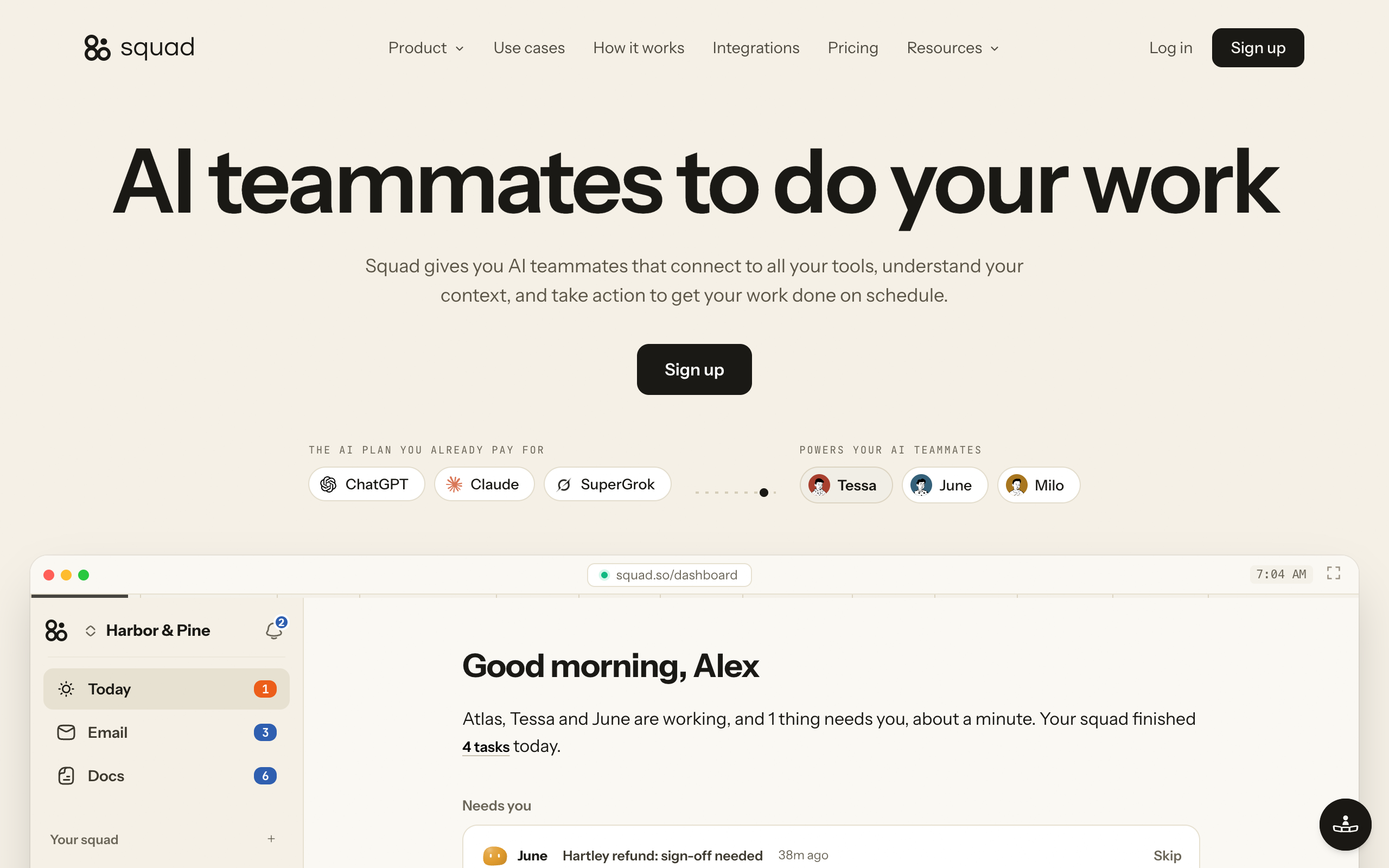
Squad's docs describe a team of AI teammates that you run from a web dashboard. They work on their own computer, with your AI subscription and the apps that you connect, and they stop and ask when a decision needs you.
- Squad has one plan at $99 a month. You bring the AI plan, and Squad adds no per-task AI charges. The homepage recommends a ChatGPT plan at $100 to $200 a month, so the all-in cost is $199 to $299 a month, or $7,164 to $10,764 over three years.
- Squad builds and runs a dedicated cloud computer for your squad. You do not run a server. Self-hosted deployments are handled case by case.
- Squad does not limit how many teammates the chief of staff creates. Each teammate has its own browser on your cloud computer, its own model if you set one, and its own access level for each connected app.
- It connects to 13 AI providers, with several accounts per provider and fallbacks.
- You reach it through dashboard chat, Telegram, Discord, and Slack. That is fewer chat channels than either free project.
- Access levels, send caps, and allowed models are settings. Questions and draft-first email are instructions the teammates follow. For anything that must not happen, set the access level.
- There is no free trial, and a 7-day money-back guarantee on the first payment.
Pros
- No server, updates, or host security to manage
- Several teammates with separate access and models
- Runs on the AI plan you already pay for
Cons
- $99 a month on top of your AI plan, where Hermes and OpenClaw cost $0 for software
- Chat channels are Telegram, Discord, and Slack, plus dashboard chat
- Not self-hosted by default, and the computer is shared by the whole squad
People who want several AI teammates with their own jobs and access, without running a server.
When do you not need Squad?
You do not need Squad when one agent on your own machine covers the work, and Hermes or OpenClaw is the better fit in that case. Squad's $99 a month buys hosting, several teammates, and per-teammate access. If you need none of those, it is an extra cost.
- If you are the only user and you are comfortable with server work, run OpenClaw or Hermes.
- If you need iMessage or phone nodes, OpenClaw covers them. Squad's chat channels are Telegram, Discord, and Slack.
- If $0 for software matters more than managed hosting, stay self-hosted.
- If the agent must run on hardware you control, Squad handles that case by case, and the free projects handle it by default.
- For work inside a code repository, a coding agent is the usual tool.
Squad fits when you run recurring work across several jobs, you want each job to have its own access, and you do not want to maintain the machine.
Frequently asked questions
Basics
What is the difference between Hermes Agent and OpenClaw? Hermes Agent is a self-improving agent from Nous Research that writes its own skills, runs cron jobs from plain language, and ships a Kanban board for several named agents. OpenClaw is a self-hosted Gateway from the OpenClaw Foundation that connects chat apps such as WhatsApp, Telegram, Slack, Discord, and iMessage, plus mobile devices, to an AI agent. Both are free, MIT-licensed, and run on any major AI model.
Is Hermes better than OpenClaw? Hermes is better on scheduling, multi-agent boards, and default security settings, and OpenClaw is better on memory depth, chat and device reach, neutral governance, and community size. Across 13 dimensions compared on official docs, Hermes wins 3, OpenClaw wins 4, and 6 are ties. Pick Hermes for an agent that learns recurring jobs, and OpenClaw for the widest reach.
Are Hermes Agent and OpenClaw free? Yes. Both are MIT-licensed and free to download. You pay for the host machine and for the AI model. Nous Research also sells optional Nous Portal plans for Hermes at $20, $100, and $200 a month, and OpenClaw states it has no paid tier and no hosted service.
Cost
Is Hermes cheaper than OpenClaw? Not by much. The software costs $0 for both, so the bill is the host plus the model. The lowest documented Hermes path is Nous Portal Plus at $20 a month, which includes a cloud agent. A self-hosted setup of either project on a $12 server with a $100 ChatGPT plan costs $112 a month, or $4,032 over three years.
Can I use my ChatGPT subscription with Hermes or OpenClaw? Yes. Hermes lists a ChatGPT or Codex subscription sign-in in its provider docs, and OpenClaw's FAQ says OpenAI allows subscription OAuth in external tools like OpenClaw. Quota windows follow your ChatGPT plan, so heavy agent use can reach plan limits.
Setup and migration
Can Hermes work with OpenClaw? Yes, as two separate programs on the same machine or on different machines. Both projects ship importers, so you can copy memory, skills, and settings in either direction. Neither project documents an official bridge that lets one agent call the other, and the two should not share one OAuth login.
How do I migrate from OpenClaw to Hermes Agent? Install the importer with hermes plugins install agent-importers, then run hermes import-agent openclaw --dry-run to preview the plan. Run it again without --dry-run to apply, and add --migrate-secrets to carry API keys. Cron jobs, plugins, hooks, and channel bindings are archived for manual work, and WhatsApp must be paired again.
Can I move from Hermes back to OpenClaw? Yes. Stop the OpenClaw Gateway, run openclaw migrate hermes --dry-run, then openclaw migrate apply hermes --yes. OpenClaw imports model config, providers, MCP servers, SOUL.md, AGENTS.md, memory files, and skills. Sessions, logs, cron jobs, plugins, and Kanban data are archived for manual review.
Security and teams
Which is more secure, Hermes or OpenClaw? Neither is secure by default against a hostile agent or user. OpenClaw's sandbox is off by default and its docs say a gateway is not a boundary between adversarial users. Hermes turns on smart command approval by default and says the only boundary against an adversarial model is the operating system. OpenClaw lists 722 repository advisories and Hermes lists none in its repository, but the counts are not comparable.
Which one supports several agents? Both do, on one host. Hermes runs named profiles with a shared Kanban board and a Bot Mode with group rooms of 2 to 6 Bots. OpenClaw runs several isolated agents in one Gateway with channel bindings and a Workboard task board. Hermes documents its Kanban as single-host by design.
Do I need a server to run Hermes or OpenClaw? You need a machine that stays on. OpenClaw's docs list 1 vCPU and 1 GB of RAM as the minimum and recommend 2 GB or more. Hermes documents no RAM minimum. A laptop works until it sleeps, so a small VPS or a spare computer is the usual choice. Hermes also offers a paid cloud agent through Nous Portal.
Do I need Squad if I already run Hermes or OpenClaw? No, not if one agent on your own machine covers the work. Squad (formerly MissionControlHQ) is a hosted option for running several AI teammates, each with its own job and access, for $99 a month plus the AI plan you bring. It fits when you do not want to manage a server or share one gateway between people.
Sources
Official pages, all read October 30, 2026:
- Hermes Agent: GitHub repository, documentation, security model, Kanban, Bot Mode, memory, skills, cron, web dashboard, messaging, providers, installation, OpenClaw migration guide, and FAQ.
- Nous Research: Nous Portal plans and Nous Research.
- OpenClaw: GitHub repository, documentation, security, sandboxing, multi-agent routing, Workboard, memory, skills, automation, Control UI, usage tracking, providers, install, hosting FAQ, migrate command, migrating from Hermes, and OpenClaw and Hermes Agent (a vendor page about a competitor).
- OpenClaw Foundation: foundation post and the VirusTotal partnership post.
- Prices: DigitalOcean Droplets and OpenAI API pricing.
- Squad: the homepage and the docs pages What Squad is, What Squad costs, Connect your AI subscription, Chat channels, Watch or take over a teammate's computer, and What teammates can do on their own.
Security records and press:
- GitHub Advisory Database: CVE-2026-25253 (GHSA-g8p2-7wf7-98mq), and the advisory lists for the openclaw/openclaw repository and the hermes-agent package, read through the GitHub API.
- The Register, OpenClaw instances exposed (February 9, 2026).
- The Hacker News, Researchers find 341 malicious ClawHub skills (February 2, 2026).
- The Block, Paradigm leads $50 million round for Nous Research (April 25, 2025).
Related on this site: OpenClaw alternatives, what Hermes Agent is, mission control for Hermes Agent, mission control for OpenClaw, and how much AI agents cost to run.
Last updated: October 2026. Features, prices, and star counts verified as of October 30, 2026.