
Claude agents is not one product. Anthropic ships six: Claude Cowork, Claude Code, Claude Code subagents, Claude Code agent teams, Claude Managed Agents, and the Claude Agent SDK. This page compares them as of November 4, 2026.
7x
more tokens than a standard session when Claude Code agent team teammates run in plan mode, according to Anthropic's cost documentation.
Source: Anthropic, Claude Code docs: Manage costsiShort answer
Use Cowork for non-coding tasks you describe as a goal. Use Claude Code for software work, with subagents for side tasks. Treat agent teams as an experiment. Use Managed Agents or the Agent SDK only if you are building an agent into a product. None of the six is a task board for several specialist roles. Squad (formerly MissionControlHQ) fills that gap. It runs a squad, which is a group of AI teammates that each hold their own job, where most tools give you one agent.
Key takeaways
| Question | Short answer |
|---|---|
| What does Claude agents mean? | Six Anthropic products: Cowork, Claude Code, subagents, agent teams, Managed Agents, and the Agent SDK |
| Cowork or Claude Code? | Claude Code for work in a code repository. Cowork for documents, files, and research. Pro at $20 a month includes both |
| Subagents or agent teams? | Subagents for focused side tasks. Agent teams are experimental, disabled by default, and cost about 7x the tokens in plan mode |
| What do Managed Agents cost? | Standard token rates plus $0.08 per session-hour of running time. Beta, API only |
| Which Claude plan? | Pro at $20 for light use, Max at $100 or Ultra at $200 for daily agent work. Managed Agents and the SDK bill through the API instead |
| What is missing for a business? | A shared task board, schedules, per-role access, approvals, and a dashboard across several agents |
Two products you use, two ways to run several agents inside Claude Code, and two ways to build your own.
Use it as a person
Claude Cowork for non-coding goals. Claude Code for software work. Both are included in paid Claude plans.
Run several agents in Claude Code
Subagents report back to one main agent inside a session. Agent teams are separate instances that message each other. Teams are experimental.
Build your own agent
Managed Agents is hosted by Anthropic and billed per token plus session-hour. The Agent SDK runs in your own process.
Run several business roles
None of the six is built as a standing task board for specialist roles. That layer is separate.
What Claude agents means
Claude agents means any of six Anthropic products that let Claude work toward a goal by using tools. They are built for different people and run in different places. Picking the wrong one is the most common mistake, because the names overlap.
Here is the short version of each.
- Claude Cowork does non-coding work from a goal you describe, on your files and tools.
- Claude Code is a coding agent for terminals, IDEs, a desktop app, and the web.
- Subagents are helper agents that Claude Code starts inside one session.
- Agent teams are several Claude Code instances that message each other.
- Claude Managed Agents is a hosted agent service on the Claude API.
- The Claude Agent SDK is a library for building agents in your own code.
The first four are included in a Claude subscription. The last two are for developers and bill through the Claude API.
Claude agents compared in one table
The table below compares all six on who each is for, where it runs, what it costs, and its main limit. Prices come from Anthropic's pricing pages on November 4, 2026.
| Option | Who it is for | Where it runs | Price | Main limit |
|---|---|---|---|---|
| Claude Cowork | Non-coders and knowledge workers | Claude app on desktop, web, and mobile; sessions and scheduled tasks run in the cloud | Included in Pro ($20/mo), Max ($100/mo), Ultra ($200/mo), Team, Enterprise | Sessions cannot be shared; uses limits faster than chat |
| Claude Code | Developers | Terminal, IDE, desktop app, web | Included in Pro and above; not on Free | Shares plan usage limits; built for software work |
| Subagents | Claude Code users | Inside one Claude Code session | No extra fee; counts toward the same plan usage | One session; results return to the main agent |
| Agent teams | Developers who want parallel agents | Locally, inside the lead's Claude Code session | No extra fee; about 7x tokens in plan mode | Experimental; one team per session |
| Managed Agents | Developers building agent products | Anthropic-managed cloud sandbox, or a self-hosted sandbox | API tokens plus $0.08 per session-hour | Beta; you build the app around it |
| Agent SDK | Developers building agents in their own code | A process you operate | Model use on an API key; no SDK fee listed in the overview | You build and host everything else |
Claude Cowork
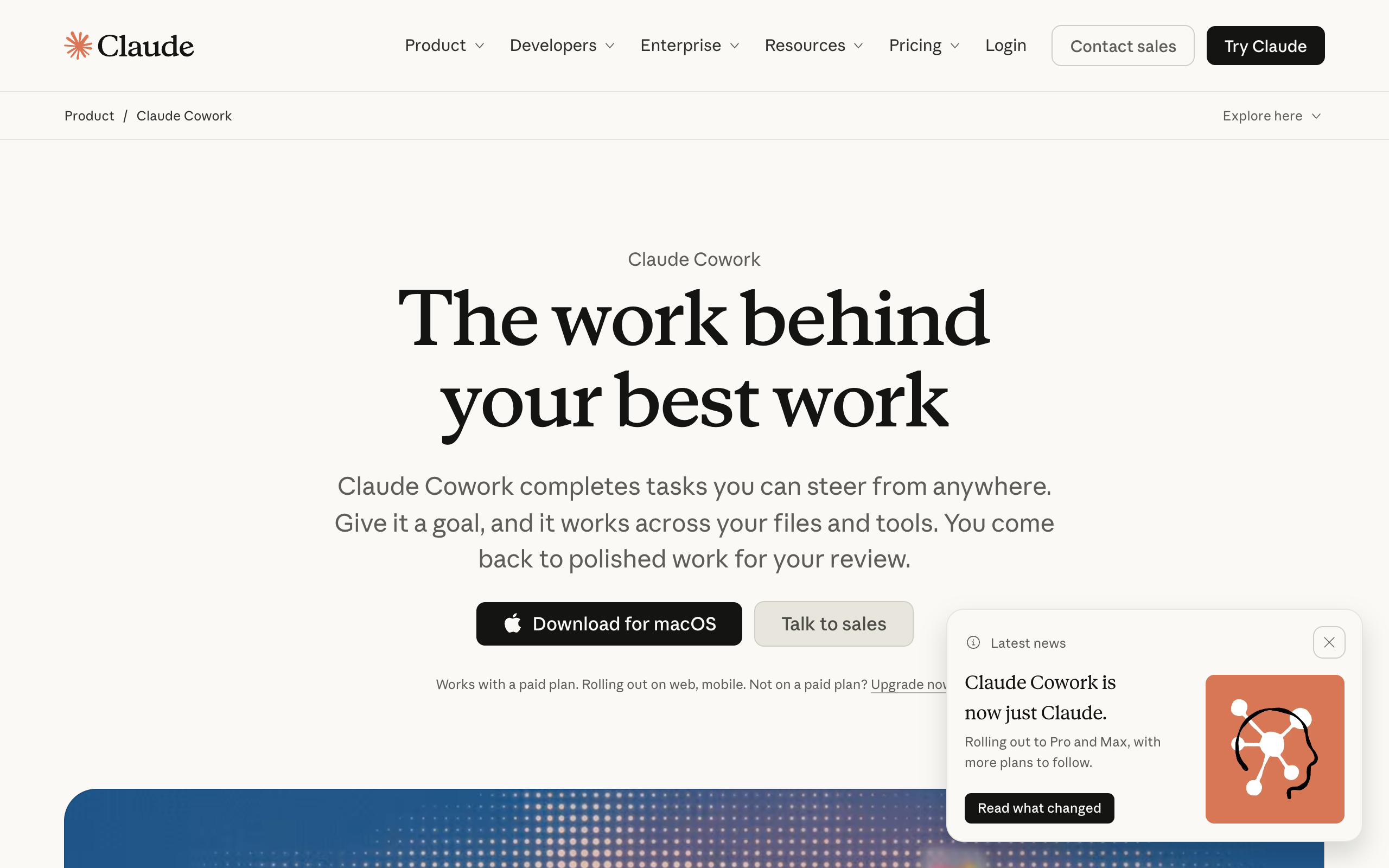
Claude Cowork is Anthropic's agent for non-coding work. Anthropic's product page says you give it a goal, it works across your files and tools, and you come back to finished work for review. It uses the same underlying design as Claude Code, without a terminal.
Cowork runs on the Claude desktop app, on the web, and on mobile. Anthropic's support page says sessions run in the cloud on Anthropic's servers, so work continues when you close your laptop. Scheduled tasks run in the cloud with no device online, and Anthropic's page says they can run daily, weekly, or monthly. Cowork is available on paid plans only: Pro, Max, Ultra, Team, and Enterprise.
Three limits matter. Sessions cannot be shared with other people, though you can share individual artifacts. Cowork uses limits faster than chat, and Anthropic says so on its product page. Computer use inside Cowork is in research preview.
Cowork is also changing shape. On September 16, 2026, Anthropic announced that Cowork and chat are merging into one Claude, rolling out to Pro, Max, and Ultra first, with Team and Free to follow. An October 23 update says the merged experience is generally available on Claude Enterprise. The announcement says existing Cowork chats, projects, connectors, and skills carry over. The Cowork product page now opens with "Claude Cowork is now just Claude." In the merged app, you pick Cowork or Chat from the same message box.
For a longer look at how Cowork fits with a standing team of agents, see mission control for Claude Cowork.
Claude Code
Claude Code is Anthropic's coding agent. Anthropic's documentation says it reads your codebase, edits files, runs commands, and connects to development tools. It runs in a terminal, in VS Code and JetBrains, in a desktop app, and on the web and mobile.
Claude Code is included in Pro, Max, Ultra, Team, and Enterprise. The Free plan does not include it. You can also use it with an Anthropic Console account billed per token.
It has several ways to run work without you at the keyboard. Cloud scheduled tasks, which Anthropic used to call routines, run in the cloud with your computer off. They can start on a schedule, an API call, or a GitHub event. Desktop scheduled tasks run on your machine, and /loop repeats a prompt inside a session.
Claude Code also has the parallel options covered below: subagents, agent teams, and background agents that run several full sessions on one screen. For how a hosted squad sits next to it, see mission control for Claude Code.
Claude Cowork vs Claude Code
Claude Code is the better choice when the work lives in a code repository, and Cowork is the better choice for everything else. The deciding question is where the result ends up. If it ends up as a commit or a pull request, use Claude Code. If it ends up as a document, a cleaned folder, a spreadsheet, or a research summary, use Cowork.
The two share one engine. Anthropic's support page says Cowork uses the same underlying architecture as Claude Code and does not need a terminal. A person who writes code and also drafts reports can use both under one paid plan.
| Question | Claude Cowork | Claude Code |
|---|---|---|
| Main job | Documents, files, research, recurring personal tasks | Building features, fixing bugs, commits, pull requests |
| Interface | Claude app on desktop, web, mobile | Terminal, IDE, desktop app, web |
| Needs a terminal | No | No, but the CLI is the full-featured surface |
| Scheduled work | Yes, runs in the cloud | Yes, cloud and desktop scheduled tasks |
| Parallel agents | Plugins can bundle sub-agents | Subagents, agent teams, background agents |
| Plans | Pro, Max, Ultra, Team, Enterprise | Pro, Max, Ultra, Team, Enterprise |
| Sharing sessions | Not possible | Not a listed feature |
Winner for coding: Claude Code, because it is built around repositories, git, tests, and IDEs. Winner for non-coding work: Cowork, because it needs no terminal and works on files, connectors, and a schedule.
The usage pool is a small catch. Anthropic's usage page says claude.ai, Claude Code, and Claude Desktop count toward the same limit. For Team and Enterprise seats, Anthropic's cost documentation says the allowance is shared with chat and Cowork. The usage page does not say how Cowork counts on Pro, Max, and Ultra.
Claude Code subagents
Subagents are helper agents that Claude Code starts inside one session. Each has its own context window, system prompt, tool access, and permissions. Anthropic says a subagent keeps side work, such as searches and logs, out of your main conversation and returns only a summary.
You define a subagent as a Markdown file with YAML frontmatter in .claude/agents/ or ~/.claude/agents/. Only the name and description are required. A subagent can run on sonnet, opus, haiku, fable, a full model ID, or inherit.
Anthropic lists these limits:
- By default, a subagent can start subagents of its own, up to three layers below the main conversation.
- Twenty subagents can run at once by default.
- Subagent transcripts are deleted after 30 days by default.
- Subagent requests count toward the same usage limits as your main conversation.
Subagents work inside a single session. When the session ends, they end with it.
Claude Code agent teams
Agent teams let one Claude Code session act as a lead and coordinate other Claude Code instances called teammates. Each teammate has its own context window. Teammates message each other directly, and they share a task list where they claim work.
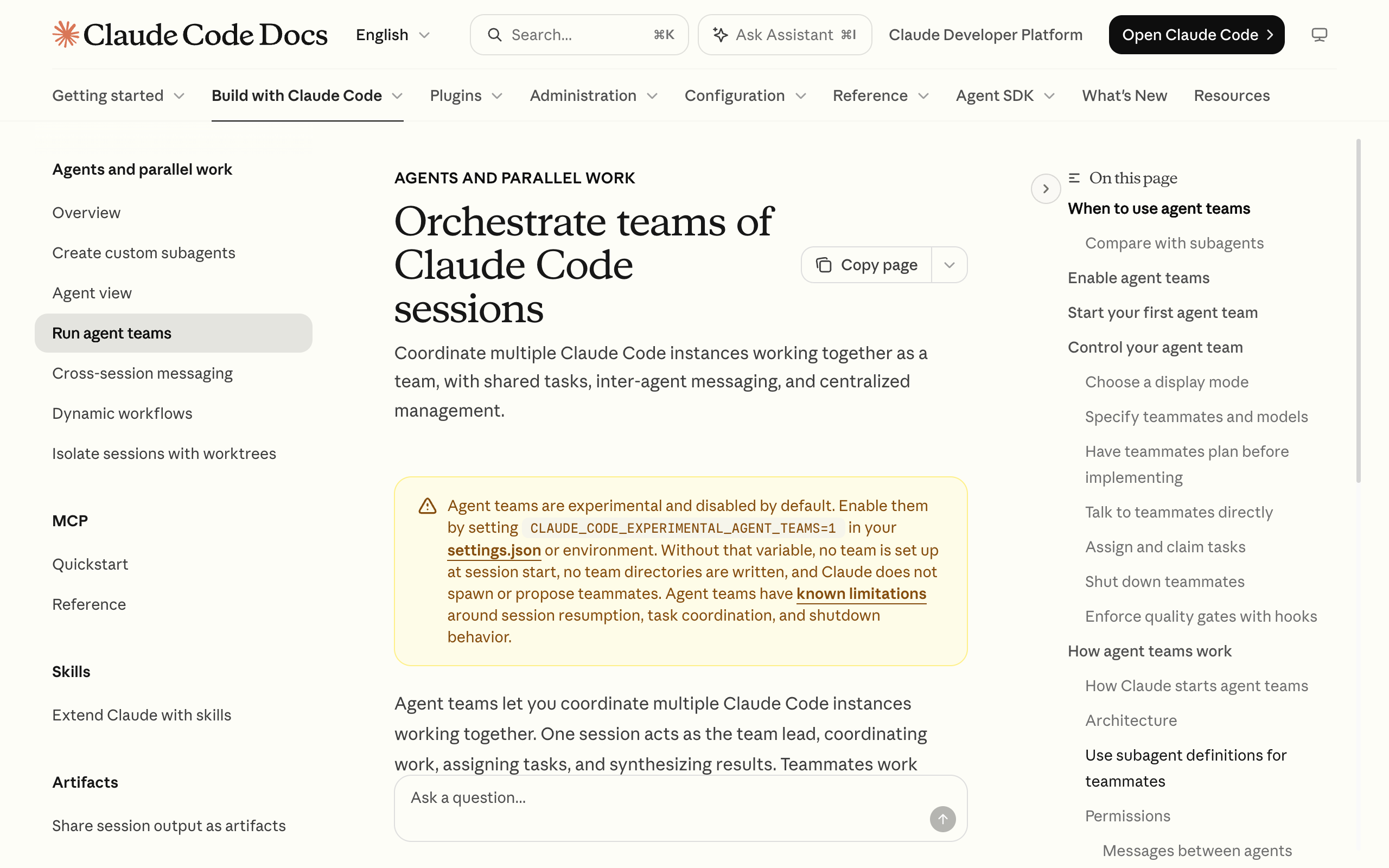
Anthropic's documentation says agent teams are "experimental and disabled by default." You turn them on with this environment variable:
CLAUDE_CODE_EXPERIMENTAL_AGENT_TEAMS=1
Teams do not start in non-interactive mode.
The documentation lists these limits:
- No session resumption with in-process teammates. After a resume, the lead may try to message teammates that no longer exist.
- Task status can lag, which can block dependent tasks.
- One team per session. You cannot create more teams or share a team across sessions.
- No nested teams. Teammates cannot start their own teammates.
- The lead is fixed for the session.
- Split panes need tmux or iTerm2.
Teams and tasks are stored locally under the session. Claude Code removes the team config when the session ends, and the task list stays on disk. Anthropic suggests starting with 3-5 teammates and with research or review tasks, where teammates do not edit the same files.
Agent teams vs subagents
Use subagents when the work is a focused side task and only the result matters. Use agent teams when several agents need to share findings, challenge each other, and coordinate on their own. Anthropic's documentation makes the same split.
| Subagents | Agent teams | |
|---|---|---|
| Communication | Return a result to the caller; subagents that Claude named can also message each other | Teammates message each other directly |
| Coordination | The main agent manages the work | Shared task list and messages |
| Context | Own window; results come back to the caller | Own window; fully independent |
| Token cost | Lower | Higher; about 7x in plan mode |
| Status | Documented feature | Experimental, disabled by default |
| Lifespan | One session | One session |
Winner for most work: subagents, because they cost less and are not experimental. Winner for competing-hypothesis debugging and parallel review: agent teams, because Anthropic's examples show teammates testing different theories and arguing with each other.
Anthropic also warns that turning agent teams on changes ordinary delegation. While teams are enabled, a subagent that Claude names launches as a teammate.
Claude Managed Agents
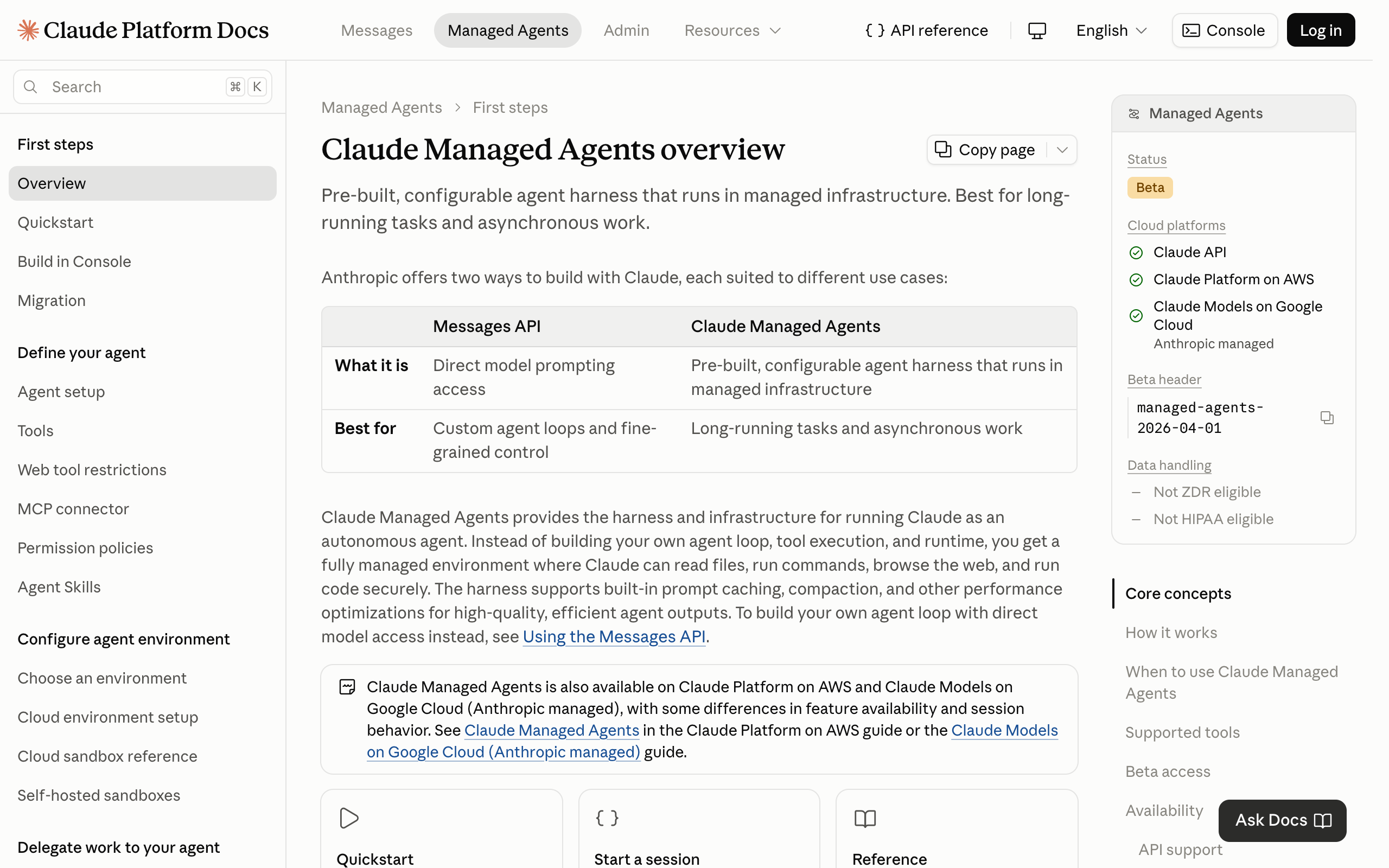
Claude Managed Agents is a hosted agent service on the Claude API. Anthropic describes it as a pre-built, configurable agent harness that runs in managed infrastructure. Instead of writing your own agent loop and sandbox, you create an agent, an environment, and a session, and send events to it.
The four concepts are agent, environment, session, and events. An agent is the model, system prompt, tools, MCP servers, and skills. An environment is where sessions run, either an Anthropic-managed cloud sandbox or a self-hosted sandbox on your own infrastructure. A session is a running agent in an environment.
Built-in tools include bash, file operations, web search and fetch, and MCP servers. Sessions can run for minutes or hours, keep their state, and resume after pauses.
Managed Agents is in beta on every model, and every request needs the managed-agents-2026-04-01 beta header. It is available on the Claude API, Claude Platform on AWS, and Claude Models on Google Cloud (Anthropic managed). Access needs a Claude API key from the Claude Console. Anthropic says sessions are stateful, so Managed Agents is not currently eligible for Zero Data Retention or HIPAA coverage.
Two newer pieces matter for scale. Scheduled deployments run an agent on a cron schedule, with up to 1,000 deployments per organization. Multiagent orchestration, also in beta, lets an agent delegate to subagents one level deep, with at most 25 child threads at a time. It also offers dynamic workflows, where the agent writes a program that runs many agents in phases and combines their results.
Claude Managed Agents pricing and what you still build
Managed Agents bills on two lines: tokens and session runtime. Tokens are billed at the standard rates on Anthropic's model pricing page. Session runtime is $0.08 per session-hour, and it counts only while the session status is running. Idle time, rescheduling, and terminated time do not count.
Web search inside a session costs $10 per 1,000 searches. The Batch API discount does not apply. Managed Agents endpoints are rate limited per organization to 300 create requests and 1,200 read requests per minute.
Runtime on its own is small. A session that ran for 8 hours a day over 30 days would add 240 hours, or $19.20, in runtime. The token bill is the larger number, and it depends on the model you pick.
Managed Agents provides the agent engine. It does not provide the product around it. The overview lists the agent, environment, session, and events. You still build:
- The application that creates sessions and sends events.
- The code that reads the event stream and shows progress to people.
- Any custom tools the agent needs.
- A way to give each person or role the right access.
- A task board, inbox, and approval flow if the agent will serve a team.
Anthropic's Console offers a way to build in the browser, and the Console has a form for deployments. The overview lists no business task board, shared inbox, or approval queue.
Claude Agent SDK
The Claude Agent SDK is a library that gives you Claude Code's tools, agent loop, and context management in Python and TypeScript. Anthropic's overview says to use it when you want to embed Claude Code's agent in your own application, in a process you operate.
It includes built-in tools, hooks, subagents, MCP, permissions, sessions, skills, and plugins. You write the application. You host it. You pay for model use through an API key.
Anthropic adds one rule for products. Its overview says that, unless previously approved, Anthropic does not allow third party developers to offer claude.ai login or rate limits for their products, including agents built on the Agent SDK. It tells developers to use API key authentication.
The difference between the SDK and Managed Agents is who runs the agent. With the SDK, you run it. With Managed Agents, Anthropic hosts the agent loop and sandbox.
Which Claude plan you need
Pro at $20 a month covers Claude Code and Cowork for light use. Max at $100 a month and Ultra at $200 a month are for daily agent work. Developers building on Managed Agents or the SDK need an API account instead, because those products bill through the Claude API.
| Plan | Price | Claude Code | Cowork | Usage |
|---|---|---|---|---|
| Free | $0 | No | No | Limited |
| Pro | $20/mo, or $17/mo billed annually | Yes | Yes | Baseline, every 5 hours and every week |
| Max | $100/mo | Yes | Yes | 5x Pro, every 5 hours and every week |
| Ultra | $200/mo | Yes | Yes | 10x Pro every week; no 5-hour limit on verified accounts |
| Team Standard | $25/seat monthly, $20/seat annual | Yes | Yes | More than Pro |
| Team Premium | $125/seat monthly, $100/seat annual | Yes | Yes | 5x Standard |
| Enterprise | $20/seat/mo billed annually, 20-seat minimum | Yes | Yes | Usage billed at API rates |
| API (Console) | Per token | Yes, by Console account | No | Managed Agents and SDK |
Team plans cover 2 to 150 seats. Anthropic's pricing page also lists monthly API credits for building on the Claude Platform: $100 a month with Max, $200 a month with Ultra, and up to $500 a month pooled on Team. Anthropic says these API credits do not apply to usage in Claude, Claude Code, or Cowork, and they are separate from the usage credits described in the next section.
For a comparison of what a flat subscription and an API key each cost for agent work, see ChatGPT subscription vs API for agents. For the wider cost picture, see AI agent running costs.
Claude usage limits for agents
Claude plans limit use in two windows. Anthropic's usage page says paid plans have a session limit that resets every five hours and weekly limits that reset once a week. Verified Ultra accounts have no five-hour limit. Conversation length, features used, model, and effort level all change how fast you reach them.
Agents use limits faster than chat. Anthropic's Cowork page says Cowork consumes limits faster than chat. Its Claude Code documentation says subagent requests count toward the same limits as the main conversation, and that agent teams use about 7x the tokens of a standard session when teammates run in plan mode. Anthropic recommends Sonnet for teammates and small teams to control cost.
When you reach a limit, usage credits let you keep working. Anthropic's support page says Pro, Max, and Ultra subscribers can turn them on, and usage beyond the plan is billed at standard API rates. Credits are prepaid, with an optional monthly cap and optional auto-reload. The page says credits apply to Claude conversations and Claude Code. It does not say whether they apply to Cowork.
For a sense of API-billed cost, Anthropic's cost documentation says enterprise deployments average about $13 per developer per active day and $150-250 per developer per month. Costs stay under $30 per active day for 90% of users.
Managed Agents and the SDK sit outside the plan limits. They bill per token on an API account, plus session runtime for Managed Agents.
How to choose a Claude agent by job
Start with who does the work and where the result lands. The decision tree below covers the common cases.
What are you building or doing?
- If software work in a code repository→Claude Code, with subagents for side tasks
- If documents, files, research, or recurring personal tasks→Claude Cowork
- If an agent inside your own product→Managed Agents or the Agent SDK
- If several business roles that run on schedules→A layer above these tools, such as a hosted squad
If you build your own agent, who should run it?
- If Anthropic hosts the agent loop and sandbox→Claude Managed Agents (beta)
- If you run it in your own process→Claude Agent SDK
If you use Claude Code, do you need parallel agents?
- If focused side tasks where only the result matters→Subagents
- If agents that must debate or share findings, and you accept experimental→Agent teams
| Scenario | Best pick | Why |
|---|---|---|
| Fix a bug and open a pull request | Claude Code | Built for repositories, git, and tests. |
| Turn a messy folder into a formatted report | Claude Cowork | Works on files and tools with no terminal. |
| Search a large codebase without flooding the chat | Subagents | Own context window; only a summary returns. |
| Review a pull request from security, speed, and test angles | Agent teams | Teammates review in parallel and share findings. Experimental. |
| Run a long agent task in a hosted sandbox from your app | Managed Agents | Anthropic hosts the loop and sandbox. Beta. |
| Embed a Claude Code style agent in your own service | Agent SDK | A library you run in your own process. |
| A weekly personal report from your own files | Cowork scheduled tasks | Runs in the cloud with no device online. |
| Support, content, and finance follow-ups running every day | A hosted squad | Needs standing owners, schedules, and shared visibility. |
What Claude agents do not cover for a business
A business that runs several specialist roles needs more than one capable agent. It needs a named owner per role, schedules, separate access per role, a place for approvals, and one view of what every role did. The six Claude products each cover a piece.
- Cowork: sessions are personal and cannot be shared. Everything draws from one person's usage.
- Claude Code: built for software work, and its parallel features live inside a session on your machine.
- Subagents: they last one session and report to one main agent.
- Agent teams: experimental, with one team per session. A team cannot be shared across sessions and does not resume.
- Managed Agents: it hosts the agent. The task board, inboxes, approvals, and dashboard are yours to build.
- Agent SDK: a library. You build and host the whole application.
The pattern is the same across all six. Each gives you an agent or a way to run a few agents for a while. None is listed as a standing team with a shared board that keeps working for months.
That is a fair design. Anthropic builds the agent engine, and customers build around it. The question for a business owner is who builds the layer around it. Hiring a developer to build it on Managed Agents or the SDK is one answer. Buying it hosted is another. Teams that prefer to self-host an open-source runtime can see the options in Paperclip alternatives and in what Hermes Agent is.
Where a hosted squad fits
A hosted squad fits after you have chosen your Claude tools, when the work becomes several recurring roles. Squad (formerly MissionControlHQ) gives you AI teammates that connect to your tools, understand your context, and do work on a schedule. A squad is that group of teammates. Most agent tools give you one.
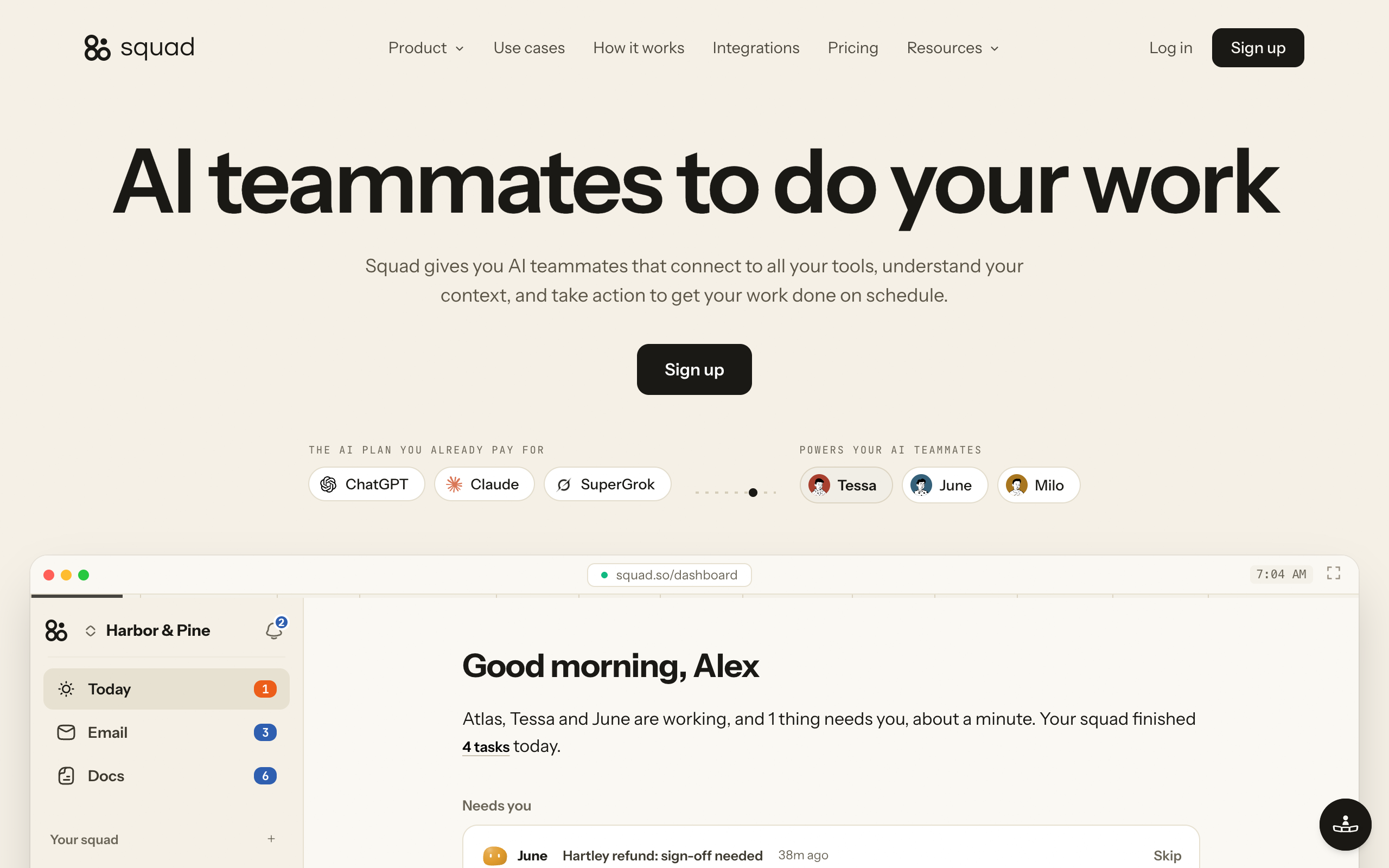
These facts come from the Squad homepage and docs, checked on November 4, 2026:
- Each AI teammate has a name, a job, a schedule, permissions, and a log you can read.
- Every squad starts with a lead teammate, the Chief of Staff. It interviews you, proposes 4 or 5 teammates for you to approve, and coordinates work across areas.
- Squad allows unlimited AI teammates. You can pick a different model per teammate.
- Each squad has its own cloud computer, shared across the squad, and each teammate has its own browser on it.
- Teammates connect to 70+ integrations. Each connection has an access level, and you can narrow or block any single teammate.
- When a teammate needs a decision, it asks you a question and the task waits in a Needs you column.
- Teammates work when something wakes them: a message, an @mention, an assigned task, a routine, an email, or a trigger.
Squad costs $99 a month. It includes no AI model usage, so you bring your own AI plan and your provider bills you. Squad adds no per-task AI charges. The docs list 13 providers. Squad recommends Claude Code on a Claude Max or Ultra plan, with Claude Opus 5.5 as the model.
Claude connects in two ways, and they bill differently. The Claude Code option, which the setup page marks Recommended, takes a setup token and, per the card, uses plan limits only and never bills extra usage. The older Claude option is marked Deprecated. It also takes a setup token, and Anthropic bills it as Extra Usage at API prices. Its setup page points you to Claude Code instead.
With Claude Code connected on Max at $100 a month, the arithmetic is $99 plus $100, or $199 a month in two separate bills. On Ultra at $200 a month, it is $299 a month. Claude Code accounts take turns: Squad uses one at a time and moves to the next when the active one reaches its usage limit.
Squad also keeps the human side visible. Everything the squad does is recorded in a run log. You can invite people on paid seats at $9 a month each, and each person gets a role. Teammates can draft for your approval, and you set access levels for anything that must not happen without you.
Squad has a 7-day money-back guarantee on the first payment. It has no free trial. For a comparison of the tools in this space, see why Squad.
When you do not need Squad
You do not need Squad when one person does the work and a single Claude tool covers it. Several cases fit that description.
- You write code in a repository. Claude Code alone is the right tool, with subagents for side tasks.
- You want a document, a deck, or a research summary now. Cowork does that in one session.
- You are building an agent into your own product. Managed Agents or the Agent SDK is the right base.
- You enjoy running a server and want one personal agent on your own hardware. A self-hosted runtime such as the ones in Hermes Agent vs OpenClaw fits.
- Your agent work fits inside one Claude plan and one person reviews it.
Squad earns its $99 when several specialist roles need to run continuously, with their own access, and you want one place to see all of it. Squad does not replace Claude Code. Founders keep a coding agent for coding.
Frequently asked questions
Basics
What are Claude agents? Claude agents is a name for several separate Anthropic products. Claude Cowork does non-coding work from a goal you describe. Claude Code is a coding agent. Subagents and agent teams are ways to run several Claude Code agents. Claude Managed Agents is a hosted agent service on the Claude API. The Claude Agent SDK is a library for building your own agents.
What is the difference between Claude Cowork and Claude Code? Claude Code is built for software work in a repository, and it runs in a terminal, an IDE, a desktop app, or the web. Cowork brings the same agentic design to non-coding work such as documents, files, and research, with no terminal. Both are included in paid Claude plans.
Are Claude agent teams ready for production? Not yet. Anthropic labels agent teams experimental and disabled by default, and lists known limits around session resumption, task coordination, and shutdown. Each session can have one team, and a team cannot be shared across sessions.
What is the difference between subagents and agent teams? A subagent works inside one Claude Code session and reports its result back to the main agent. In an agent team, each teammate is a separate Claude Code instance with its own context window, and teammates message each other and share a task list. Teams use more tokens.
Managed Agents and the SDK
What are Claude Managed Agents? Claude Managed Agents is a hosted agent service on the Claude API. Anthropic runs the agent loop, tool execution, and a cloud sandbox, and you create agents, environments, and sessions through the API. It is in beta and needs the managed-agents-2026-04-01 beta header.
How much do Claude Managed Agents cost? Managed Agents bills tokens at the standard model rates plus $0.08 per session-hour while a session is running. Idle time does not count toward runtime. Web search inside a session costs $10 per 1,000 searches.
What is the Claude Agent SDK? The Claude Agent SDK is a Python and TypeScript library that gives you Claude Code's tools, agent loop, and context management inside your own application. You run it in a process you operate and authenticate with an API key.
Plans and limits
Which Claude plan do I need for Claude Code and Cowork? Pro at $20 a month includes both Claude Code and Cowork. Max at $100 a month gives 5x the usage of Pro. Ultra at $200 a month gives 10x the weekly usage of Pro and no 5-hour limit on verified accounts. Team seats and Enterprise include both. The Free plan includes neither.
Do Claude Code and Cowork share usage limits? Usage across claude.ai, Claude Code, and Claude Desktop counts toward the same limit, with a five-hour session window and weekly limits. For Team and Enterprise seats, Anthropic says the allowance is shared with chat and Cowork. Anthropic's usage page does not say how Cowork counts on Pro, Max, and Ultra.
Business use and Squad
Can Claude agents run a business with several specialist roles? Each Claude product covers part of it. Cowork sessions are personal and cannot be shared. Claude Code is built for coding. Agent teams last for one session. Managed Agents and the Agent SDK give you the agent engine, and you build the task board, schedules, approvals, and dashboard yourself.
What is Squad, and how does it relate to Claude agents? Squad (formerly MissionControlHQ) is a hosted service that runs a group of AI teammates, each with its own job, schedule, and permissions, for $99 a month. It uses the AI plan you bring, and it recommends Claude Code on a Claude Max or Ultra plan. Its Claude Code option runs on your Claude plan limits through a setup token.
Do I need Squad if I already use Claude Code or Cowork? No, not if one person does the work in a repository or in personal sessions. Claude Code and Cowork cover those jobs well. Squad fits when several specialist roles need to run on schedules, with their own access and a shared view of the work.
Sources
- Anthropic: Claude pricing, Claude Cowork product page, Cowork is now Claude, Getting started with Cowork, How usage and length limits work, Manage usage credits for paid Claude plans
- Claude Code docs: Overview, Subagents, Agent teams, Manage costs, Agent SDK overview
- Claude Platform docs: Managed Agents overview, Managed Agents reference, Scheduled deployments, Multiagent orchestration, Session threads, API pricing
- Squad: homepage, what Squad is, connect your AI subscription, what Squad costs, docs as one file, get started
- Related on this site: Mission Control for Claude Cowork, Mission Control for Claude Code, Why Squad, Paperclip alternatives, AI agent running costs, ChatGPT subscription vs API for agents
Last updated: November 4, 2026. Pricing and features verified as of November 4, 2026.