
A basic enriched lead costs 121 credits on an AI agent. That is about $0.12 at the purchased-pack rate. A deep-enriched lead costs 481 credits, about $0.48. A LinkedIn-sourced lead costs about 140 credits, about $0.14. Eight basic leads fit inside the 1,000 credits the plan includes each month. Every lead past that costs the credit price above, at any volume.
Those numbers come from the per-call credit menu on Squad (formerly MissionControlHQ), where a squad means a coordinated set of specialist AI agents sharing one task board, not one generalist agent. This page works out the cost per lead for each route, then compares it with Apollo, Clay, 11x, AiSDR, and an SDR hire. The prospect-list guide covers how to build the list. This page covers the cost.
60%
of a sales rep's time goes to non-selling tasks, per the seventh edition of Salesforce's State of Sales research. Prospect research and enrichment sit inside that share, and they are the part an agent can price per lead.
Source: Salesforce, State of Sales (seventh edition), sales statisticsiShort answer
On Squad, a basic enriched lead (search, person enrich, company enrich) is 121 credits, about $0.12 on $5-per-5,000 packs. Deep enrichment is 481 credits, about $0.48. Eight basic leads fit in the included 1,000 credits a month. 500 basic leads a month cost $59.50 in purchased credits, and $258.50 to $358.50 all in with the $99 platform and a $100 to $200 AI plan, or $0.52 to $0.72 per lead. Apollo works out to about $0.02 per credit, Clay $0.02 to $0.07, 11x $1.88 per contact touched, AiSDR $1.00 to $1.25 per contact, and a loaded SDR about $9,900 a month. Cached and failed calls cost 0, and a mission budget caps a mission's research. Per-call credit costs are from the Squad research tools reference and the dashboard's Billing screen as of September 2026.
Key takeaways
| Question | Answer |
|---|---|
| What one basic enriched lead costs | 121 credits: People Search 1 + Person Enrich 60 + Company Enrich 60. About $0.12 at $0.001 per purchased credit |
| What a deep-enriched lead costs | 481 credits: People Search 1 + Person Enrich Deep 360 + Company Enrich Deep 120. About $0.48 |
| What a LinkedIn-sourced lead costs | About 140 credits with one 145-credit LinkedIn Search spread over 10 profiles, plus LinkedIn Profile 5, Person Enrich 60, Company Enrich 60. About $0.14 |
| What fits in the included 1,000 credits | 8 basic leads, 2 deep leads, or 7 LinkedIn leads. The allowance resets each calendar month and does not accumulate; purchased packs carry over while the subscription is active |
| What 100 / 500 / 1,000 basic leads a month cost in credits | $11.10 / $59.50 / $120 a month after the included allowance; $133.20 / $714 / $1,440 a year |
| The all-in bill | $99 platform + $100-200 AI plan + credits: $0.32-3.10 per lead across 100-1,000 leads a month, whole platform charged to the lane |
| The other routes | Apollo about $0.02 per credit; Clay $0.02-0.07 per data credit; 11x $1.88 and AiSDR $1.00-1.25 per contact touched; SDR hire about $9,900 a month loaded |
Each route bills a different unit. The table later in the page converts each to a per-lead figure where the vendor's published numbers allow it.
Per credit, on a seat
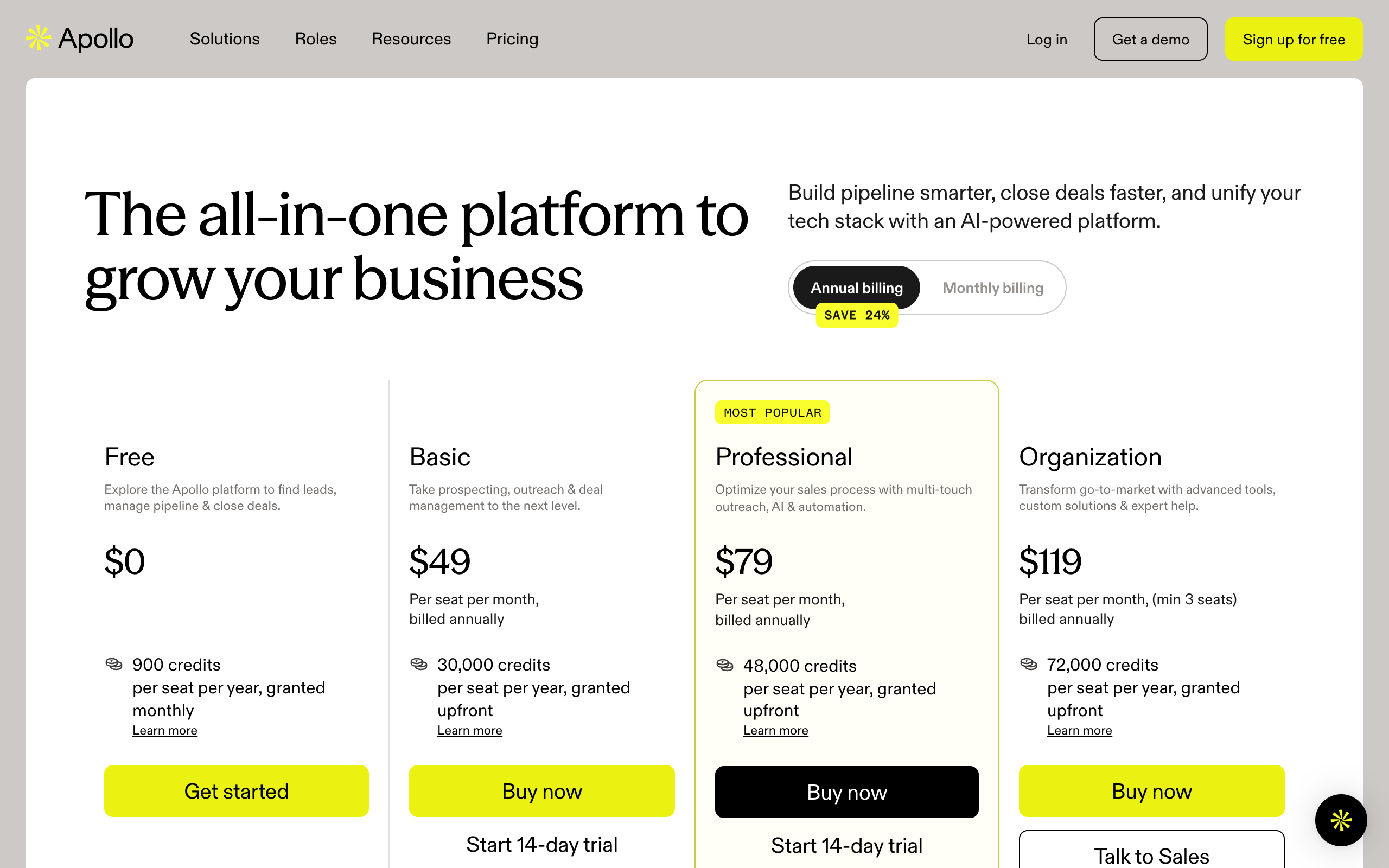
Apollo: $49-119 per seat per month, 30,000-72,000 credits a year, about $0.02 per credit. ZoomInfo: pricing not public.
Per credit, no seat
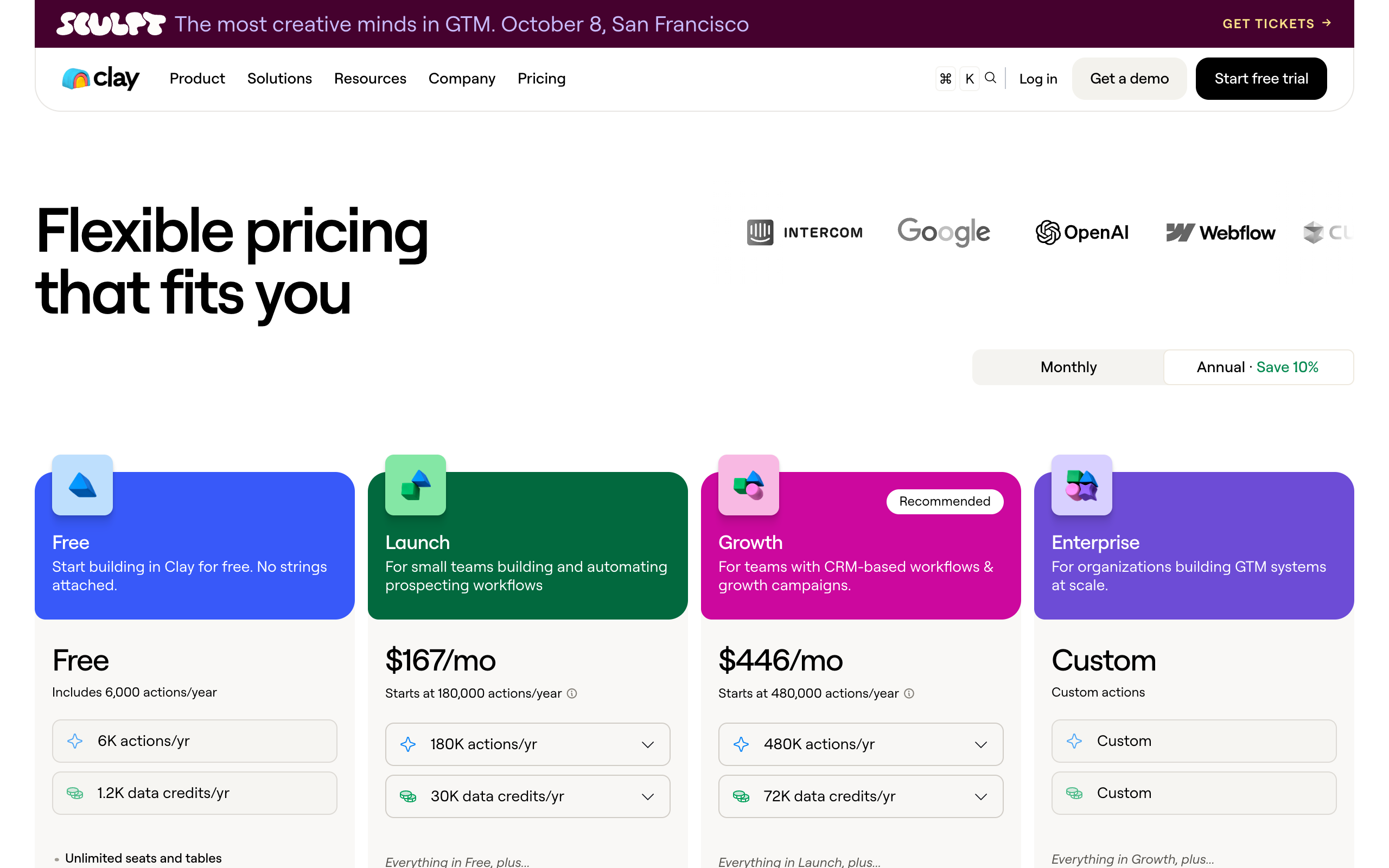
Clay: $54-446 a month, 2,500-6,000 data credits a month, $0.02-0.07 per credit. Squad: 1,000 credits included, $0.001 per purchased credit, 121 per basic lead.
Per contact touched
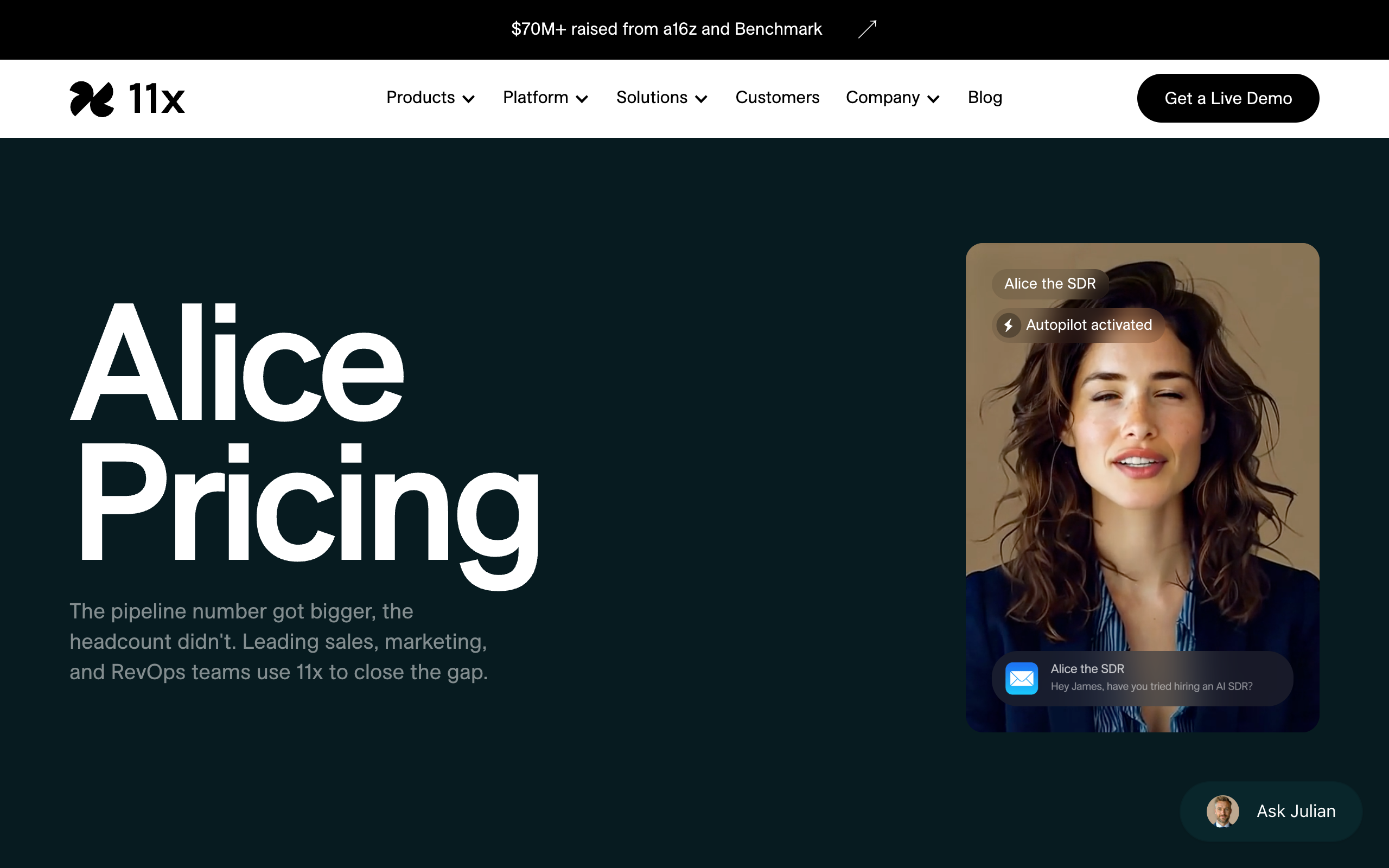
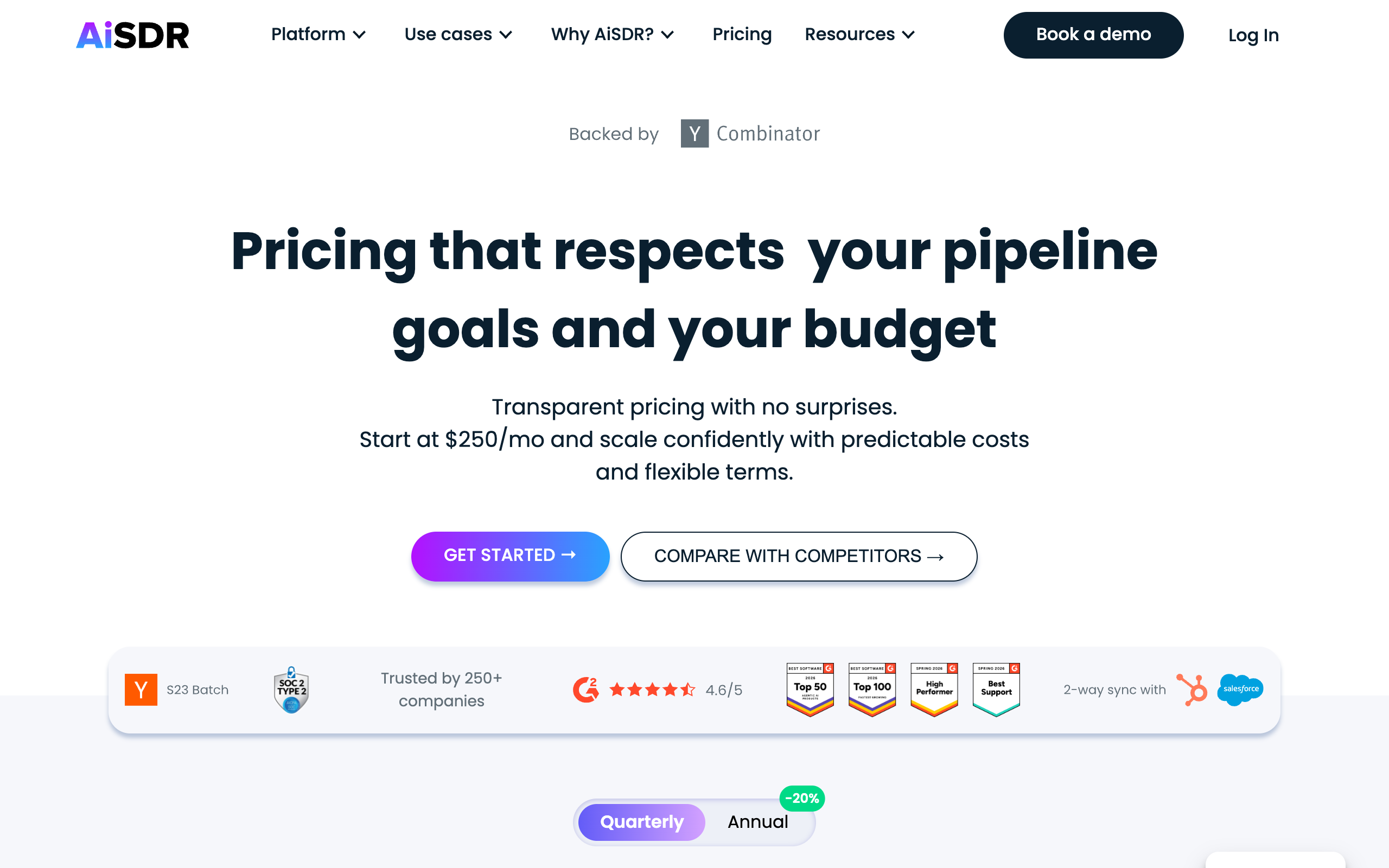
11x: $3,750 a month for 2,000 contacts. AiSDR: $250-2,500 a month for 200-2,500 contacts. Artisan: pricing not public.
Per month, per person
An SDR hire: about $9,900 a month loaded on $83,110 total compensation. Cost per lead depends on output.
What an enriched lead costs on an AI agent
One basic enriched lead costs 121 credits. Three calls from the per-tool credit menu add up to that. The research tools reference publishes the menu, and the dashboard shows it under Settings, Billing, on the CREDIT COST PER USAGE card. The seven calls that matter for sales, as of September 2026:
| Tool | Credits per call | What the call does |
|---|---|---|
| People Search | 1 | Searches for people by role, company, and location; returns a batch |
| Person Enrich | 60 | Enriches one person's contact record |
| Person Enrich Deep | 360 | Deeper enrichment of one person |
| Company Enrich | 60 | Enriches one company |
| Company Enrich Deep | 120 | Deeper enrichment of one company |
| LinkedIn Search | 145 | Searches LinkedIn profiles; returns a batch |
| LinkedIn Profile | 5 | Pulls one LinkedIn profile |
Purchased credits cost $5 per 5,000, which is $0.001 per credit. Three lead routes follow from the menu.
| Route | Calls | Credits per lead | Cost per lead (purchased credits) |
|---|---|---|---|
| Basic enriched lead | People Search 1 + Person Enrich 60 + Company Enrich 60 | 121 | $0.121 |
| Deep-enriched lead | People Search 1 + Person Enrich Deep 360 + Company Enrich Deep 120 | 481 | $0.481 |
| LinkedIn-sourced lead | LinkedIn Search 145 spread over 10 profiles (about 15) + LinkedIn Profile 5 + Person Enrich 60 + Company Enrich 60 | About 140 | $0.14 |
A People Search call returns a batch of candidates. Charging a full credit to each lead over-counts slightly, so the figure is conservative. A LinkedIn Search call also returns a batch, so the table spreads its 145 credits across 10 profiles. If every lead needed its own search, the LinkedIn route would cost 270 credits, or $0.27.
Enrichment is where the credits go. Person Enrich and Company Enrich are 120 of the 121 credits in a basic lead. Search costs almost nothing, so an agent can search wide, shortlist, and enrich only the names that make the shortlist. A brief can build that step in. The delegation guide has the brief name the decisions that come back to the founder, so the agent opens a ticket with the shortlist and the founder strikes names before any enrichment runs on them.
How many leads fit in the included 1,000 credits
Eight basic enriched leads fit in the included 1,000 credits, with 32 credits left over. The plan includes 1,000 credits a month. They arrive at the start of each calendar month (UTC) and do not accumulate. An unused allowance is gone at month end. Purchased packs work differently. They carry over from month to month while the subscription is active.
| Route | Credits per lead | Leads inside 1,000 | Credits left |
|---|---|---|---|
| Basic enriched | 121 | 8 | 32 |
| Deep-enriched | 481 | 2 | 38 |
| LinkedIn-sourced | About 140 | 7 | About 20 |
The included allowance is a baseline. It covers light research and monitoring work. A sales lane at any real volume runs on purchased packs. Budget the packs.
What 100, 500, and 1,000 leads a month cost
500 basic enriched leads a month cost $59.50 in purchased credits. The formula is fixed. Total credits equals credits per lead times leads. Purchased credits equals total minus the included 1,000. Dollars equals purchased credits times $0.001. Packs come in 5,000-credit units, so the pack count rounds up. The unspent remainder carries over, which makes the exact-credit figure the true monthly cost.
| Route | Leads a month | Total credits | Purchased credits | Monthly cost | Packs to buy | 12-month cost |
|---|---|---|---|---|---|---|
| Basic | 100 | 12,100 | 11,100 | $11.10 | 3 ($15) | $133.20 |
| Basic | 500 | 60,500 | 59,500 | $59.50 | 12 ($60) | $714 |
| Basic | 1,000 | 121,000 | 120,000 | $120.00 | 24 ($120) | $1,440 |
| Deep | 100 | 48,100 | 47,100 | $47.10 | 10 ($50) | $565.20 |
| Deep | 500 | 240,500 | 239,500 | $239.50 | 48 ($240) | $2,874 |
| Deep | 1,000 | 481,000 | 480,000 | $480.00 | 96 ($480) | $5,760 |
| 100 | 14,000 | 13,000 | $13.00 | 3 ($15) | $156 | |
| 500 | 70,000 | 69,000 | $69.00 | 14 ($70) | $828 | |
| 1,000 | 140,000 | 139,000 | $139.00 | 28 ($140) | $1,668 |
The marginal cost does not fall with volume. Packs are flat-priced, so lead number 101 and lead number 1,001 both cost $0.121 in credits on the basic route. The only volume discount is the included 1,000 credits, which is worth $1 a month at the pack rate.
Deep enrichment costs about 4 times basic enrichment. Use basic enrichment for every shortlisted lead, and deep enrichment only for the names that reach a draft. That keeps most of a month at $0.121 per lead.
The all-in monthly bill for a sales agent lane
The all-in bill for a sales lane is the $99 platform plan, plus the founder's own AI subscription at the recommended $100 or $200 tier, plus purchased credits, plus $10 a month per agent email inbox if the lane sends. The platform is one flat plan with no tiers. The AI subscription's own vendor bills it with no markup.
$99/mo
Platform, one plan, flat (September 2026)
$100-200
Your own AI subscription, ChatGPT at the recommended tier
$0.001
Per purchased credit ($5 per 5,000 credits, carry over while subscribed)
1,000
Credits included each calendar month, no carry-over
$10/mo
Per agent email inbox, the outreach add-on; sends never use credits
$0
Markup on AI tokens, and the cost of any failed or cached call
Charge the entire platform and AI plan to the sales lane, and you get the ceiling on cost per lead. The same squad runs other lanes on the same $99, so the real share is lower.
| Basic leads a month | Monthly bill, $100 AI plan | Per lead | Monthly bill, $200 AI plan | Per lead |
|---|---|---|---|---|
| 100 | $210.10 | $2.10 | $310.10 | $3.10 |
| 500 | $258.50 | $0.52 | $358.50 | $0.72 |
| 1,000 | $319.00 | $0.32 | $419.00 | $0.42 |
Over 12 months the platform and AI plan run $2,388 to $3,588. Credits add the 12-month column from the table above. An email inbox adds $120 a year. A full year at 500 basic leads a month with one inbox therefore lands between $3,222 and $4,422, all in.
$258.50 to $358.50 a month for 500 enriched leads, against about $9,900 a month for a loaded SDR
The agent lane is the $99 platform, a $100-200 AI plan, and $59.50 in purchased credits. The SDR figure is $83,110 average total compensation (Built In, 2026) loaded at the BLS ratio of 30% of compensation going to benefits (June 2026). The SDR also does the parts an agent does not: calls, discovery, and relationships.
Cost per lead by route
Cost per lead is computable for the agent route and for two of the AI SDR tools. For the data platforms it is computable per credit, though not per lead. For an SDR hire it depends on output. All vendor prices below come from official pricing pages fetched on 10 September 2026.
| Route | Published price | Unit the vendor bills | Cost per unit | Cost per enriched lead |
|---|---|---|---|---|
| Apollo.io (data platform seat) | $49 / $79 / $119 per seat per month, annual; 30,000 / 48,000 / 72,000 credits per seat per year | Credit, spent only when a contact is found | About $0.02 per credit | Depends on credits per contact found, which vary by data source; not computable from the page |
| ZoomInfo (data platform seat) | Not publicly available; contact sales | Seat plus credits | Not public | Not computable |
| Clay (enrichment credits) | Launch $167/mo or $54/mo annual, 2,500 credits/mo; Growth $446/mo or $185/mo annual, 6,000 credits/mo | Data credit | $0.02-0.07 per credit | Depends on credits per enrichment step; not computable from the page |
| Artisan (AI SDR) | Not publicly available; request a demo | Credits, per the page | Not public | Not computable |
| 11x (AI SDR) | Growth $3,750/mo ($36,000/yr), 2,000 contacts/mo, annual term | Contact sourced and messaged | $1.88 per contact | Different unit: includes outreach |
| AiSDR (AI SDR) | Solo $250/mo, 200 contacts; Explore $900/mo, 800; Scale $2,500/mo, 2,500 | AI-researched contact, messaged | $1.00-1.25 per contact | Different unit: includes outreach |
| SDR hire | $57,921 base, $83,110 total compensation (Built In, 2026); about $9,900/mo loaded | A month of a person | $9,900 a month | Loaded cost divided by output; $19.79 at 500 leads a month (assumption) |
| Squad agent lane | $99/mo platform + $100-200 AI plan + $0.001 per purchased credit | Credit per call | 121 credits per basic lead | $0.121 in credits; $0.32-3.10 all in across 100-1,000 leads a month |
The table leaves out three things.
The data platforms sell a database. Apollo spends credits only when it finds a contact, per its own pricing FAQ, and its unlimited-plan fair-use cap values a credit at $0.025. That is cheap per record, and the seat comes with a database of records the agent route has to go and find. For segments the database covers well, the seat is the better buy per contact.
The AI SDR tools bill a different unit. 11x's $1.88 and AiSDR's $1.00 to $1.25 pay for a contact the tool sourced, enriched, and messaged, with deliverability and inbox rotation bundled in. The agent route's equivalent is the all-in figure plus a $10 inbox, which runs $0.32 to $3.10 per lead depending on volume, and the founder approves the drafts the brief asks for. The point solutions cost more per contact and remove more of the work.
The SDR number is a formula. Built In puts a US SDR at $57,921 base and $83,110 total cash compensation in 2026. Payscale's sample of 840 profiles puts base at $51,677 (updated May 2026). The Bureau of Labor Statistics reports that benefits are 30.0% of private-industry compensation as of June 2026, so wages are 70%. $83,110 divided by 0.70 is $118,729 a year, about $9,900 a month. On base only it is about $6,900. Divide by the qualified leads the SDR produces in a month to get cost per lead. The 500-lead example gives $19.79, and it is an assumption. The small-business cost post runs the same loaded-cost method on a junior ops hire.
What the credit controls do to the bill
Five controls keep a sales lane's credit bill at the number in the tables. Because of them, the per-lead figures are budgets you can hold to.
- Failed calls and cache hits cost 0 credits. A retry after an error is free. A second read of a record the platform already holds is free. Only a successful live pull spends.
- A mission budget caps one mission. Tell the agent "spend no more than 500 credits on this list", and it records a budget for that mission. Squad refuses any research call that would go over it. The agent sets the budget, so it can also change it, and there is no dashboard control for it.
- One switch turns research off. The Research tools switch in Settings, Billing turns every research tool off at once, so no call can spend credits.
- Auto-recharge has a monthly cap. When the balance drops below a threshold, the platform buys packs automatically up to a monthly maximum the founder sets. A scheduled Monday run does not stall for credits until that cap is reached, and the ceiling is written down.
- Billing breaks spend down by tool, agent, task, and mission. A month that looks wrong has a named cause in one view.
Email sends never touch credits. The inbox is a flat $10 a month. The credit-model explainer covers the freshness setting and the other research tools the same credits pay for.
Does sales need one AI agent or several
Sales usually needs two agent lanes. The Lane Test is how to count them. The test asks one question of each piece of work. Would an agent have to switch context to do this well? Sales work splits into four pieces: prospect research, enrichment, outreach drafting, and follow-up.
| Piece of work | What it rewards | Lane |
|---|---|---|
| Prospect research | Breadth: many searches, cheap, wide net | Research and enrichment agent |
| Enrichment | Selectivity: 60-360 credits per name, so only shortlisted names | Research and enrichment agent |
| Outreach drafting | Restraint: the length, voice, and limits the brief sets | Outreach agent |
| Follow-up | Timing: scheduled sends on the cadence the brief sets, then stop | Outreach agent |
Research and enrichment share a context (the ICP document and the shortlist), so they sit in one lane. Drafting and follow-up share a different context (the founder's voice and the send rules), so they sit in another. Put all four in one agent, and the same search-minded agent writes the outreach. The marketing post reaches the same two-lane answer for a different function. The use-case filter tests whether a piece of work recurs on a trigger and leaves an artifact, which every row above does.
Each lane on Squad has its own line in Billing's usage by agent, so the research agent's enrichment spend and the outreach agent's zero-credit sends show up separately. Each lane can also carry a different permission level on the same CRM connection: the research agent read-only on HubSpot or Salesforce, the outreach agent read and write, changed without re-authorizing.
What the outreach lane costs and what it cannot do
The outreach lane costs $10 a month per agent email inbox on top of the plan, and its sends cost 0 credits. The inbox is pro-rated when added and drops off the subscription when deleted. The $10 buys the control set. It does not pay for the sending.
- Allow and block lists, at workspace and per-inbox scope.
- Hard send caps: per-agent daily, per-minute, distinct recipients per five minutes, and workspace daily and monthly. Each one is a hard stop.
- Drafts for review. Handling instructions can tell the agent to draft first touches instead of sending them. Each draft waits in the Drafts tab for the founder to approve and send, revise, edit, or discard. Draft-first is an instruction the agent follows, not a setting Squad enforces, so a low daily send cap is the backstop.
- A record of the work. Sent email stays on the Email screen, and every run the agent makes shows in Runs.
- Scheduled sends for follow-ups, which can be cancelled until they fire.
The lane starts with a brief, written the way the delegation guide describes: the same five parts a new teammate gets. The goal is one sentence, such as a short weekly list of prospects with a draft for each. The context names the docs to read, such as the ICP doc in Docs. The constraints set length, voice, budget, and what the agent must not do. The decisions say which calls come back as tickets, such as the shortlist and anything that touches a customer. Done looks like drafts waiting for review. Rules the lane repeats every week belong where the squad reads them every time: the inbox's handling instructions, or the instructions of a scheduled task. If the brief sets 40 to 60 names a month, the outreach lane's credit cost is the enrichment on those names, about 4,840 to 7,260 credits, or $3.84 to $6.26 in purchased credits after the included allowance.
The lane cannot do the selling. It does not take the discovery call, negotiate, or carry a relationship. Replies land in the agent's inbox, and the agent escalates the ones that need the founder's decision. The founder answers the ones that matter. The agent email post covers the inbox in detail, and the human-in-the-loop post covers where the approval gates belong.
A customer example of the drafting half: Erika Sanchez's squad turns a raw list of event contacts into follow-up drafts, and she decides what gets sent.
The build takes about two minutes, then a short onboarding conversation with the lead. A research lane and an outreach lane run on one plan at $99 a month, with 1,000 credits included and a 7-day money-back guarantee on the first payment. Billing then shows what each lead actually cost.
When you do not need an AI agent for sales
Three situations do not need an AI agent for sales, and the cost tables above say why.
A founder-led motion with about 10 deals a quarter. At that volume the whole pipeline is 30 to 50 named accounts. Manual research on each is a few hours a month, and the judgment per account is worth more than $0.12 saved. The prospect-list guide recommends manual research for a ten-account ABM play for the same reason.
A team already on a data platform with volume needs. If the segment is tech, SaaS, or US mid-market and the team pulls thousands of contacts a month, Apollo's roughly $0.02 per credit on a database that already exists beats an agent searching the open web. The agent route earns its place on niche, local, and signal-based lists the database does not hold.
A relationship-carried enterprise motion. Sales teams win six-figure deals with four stakeholders and a nine-month cycle in person. An agent can prepare the brief for every meeting. It should not send the first email to a CFO.
The agent lane fits between those: a founder or small team with a niche ICP, a steady weekly cadence of new prospects, and a wish to approve every draft without doing the research behind it.
Use-case cheat sheet
| Scenario | Best pick | Why |
|---|---|---|
| Niche ICP, a short weekly prospect list, founder reviews every draft | Agent lane, basic enrichment | About $4-6 a month in credits after the allowance at 40-60 names; the brief asks for drafts. |
| Only the names that reach a draft need full detail | Basic enrich for the shortlist, deep enrich for draft-stage names | Deep is about 4x basic; spend it on 10 names, not 100. |
| 500 enriched leads a month for a small outbound team | Agent lane on purchased packs | $59.50 a month in credits; $0.52-0.72 per lead all in. |
| Thousands of contacts a month in SaaS or US mid-market | Data platform seat (Apollo class) | About $0.02 per credit on a database that already holds the segment. |
| Want sourcing, sending, and deliverability handled with no approvals | AI SDR point solution (11x, AiSDR) | $1.00-1.88 per contact touched; the work leaves your hands. |
| Ten dream accounts, nine-month cycle | Manual research, agent-prepared meeting briefs | Judgment per account is worth more than the credits saved. |
| Sales lane must never stall on a Monday run | Auto-recharge with a monthly cap | Packs buy themselves under a ceiling you wrote down. |
Frequently asked questions
Basics
What does one enriched lead cost on an AI agent? On Squad (formerly MissionControlHQ), a basic enriched lead is one People Search call (1 credit), one Person Enrich call (60 credits), and one Company Enrich call (60 credits): 121 credits, or about $0.12 at the purchased-pack rate of $5 per 5,000 credits. A deep-enriched lead (Person Enrich Deep 360, Company Enrich Deep 120, plus the search) is 481 credits, about $0.48. Per-call costs are from the Squad research tools reference (squad.so/docs/research-tools) and the CREDIT COST PER USAGE card in Settings, Billing, as of September 2026.
How many leads fit in the included 1,000 credits a month? Eight basic enriched leads (968 credits, 32 left over), two deep-enriched leads (962 credits, 38 left over), or seven LinkedIn-sourced leads at about 140 credits each. The included 1,000 credits arrive at the start of each calendar month (UTC) and do not carry over. Purchased credits carry over while the subscription is active.
Costs
What is the cost per lead for AI agents for sales at 500 leads a month? 500 basic enriched leads use 60,500 credits. After the included 1,000, the remaining 59,500 credits cost $59.50 at $0.001 per purchased credit. Adding the $99 platform plan and a $100 to $200 AI subscription, the all-in bill is $258.50 to $358.50 a month, or $0.52 to $0.72 per lead with the whole platform charged to the sales lane. The credit cost alone is $0.121 per lead at any volume.
What does a full year of agent-built leads cost? At 100 basic leads a month, purchased credits cost $133.20 a year; at 500 leads, $714; at 1,000 leads, $1,440. The platform and AI plan add $2,388 to $3,588 a year ($199 to $299 a month). An agent email inbox for the outreach lane adds $120 a year per inbox. Figures as of September 2026.
Comparisons
How does the agent route compare with Apollo or Clay per lead? Apollo's paid plans work out to about $0.02 per credit at full use on annual billing ($49 to $119 per seat per month with 30,000 to 72,000 credits per seat per year), and credits are only spent when a contact is found. Clay's data credits cost $0.02 to $0.07 each depending on plan and billing. Neither page publishes a per-lead figure, because credits per enrichment vary by data source. The agent route is $0.121 per basic enriched lead in credits, with the $99 platform and the AI plan on top. Pricing fetched 10 September 2026.
How does an AI SDR tool compare on cost per lead? 11x publishes a Growth plan at $3,750 a month for 2,000 contacts, which is $1.88 per contact at full use. AiSDR publishes $250 a month for 200 contacts ($1.25), $900 for 800 ($1.13), and $2,500 for 2,500 ($1.00). Artisan does not publish prices. Those units include sending the outreach, so they are not the same unit as an enriched lead; the closest agent-route comparison is the all-in figure of $0.32 to $3.10 per lead depending on volume, plus $10 a month per agent email inbox for sending. Pricing fetched 10 September 2026.
What does an SDR hire cost per lead? An SDR in the United States averages $57,921 base and $83,110 total cash compensation per Built In's 2026 data. At the Bureau of Labor Statistics ratio of 30% of compensation going to benefits, the loaded cost is about $9,900 a month on total compensation, or about $6,900 on base only. Cost per lead is that monthly figure divided by the qualified leads the SDR produces; at 500 leads a month it would be about $19.79, at 1,000 about $9.89. The output number is an assumption, not a published benchmark.
Setup
Does sales need one AI agent or several? Apply the Lane Test: would an agent have to switch context to do this work well? Prospect research, enrichment, outreach drafting, and follow-up usually split into two lanes at least, a research and enrichment agent and an outreach agent, because research rewards breadth and outreach rewards restraint. Each lane on Squad shares one task board, and the credit panel shows spend per agent.
What controls stop an AI agent from overspending on lead credits? Five controls on Squad: failed calls and cache hits cost 0 credits; a mission budget the agent records on request caps what one mission can spend; the Research tools switch in Billing turns every research tool off; auto-recharge has a monthly cap you set; and Billing breaks spend down by tool, agent, task, and mission. Email sends never use credits.
Sources
- Squad: get started, homepage. Per-call credit costs from the research tools reference and the dashboard's Settings, Billing, CREDIT COST PER USAGE card, September 2026.
- Apollo.io: pricing, fetched 10 September 2026 (plan table and credit FAQ).
- ZoomInfo: pricing, fetched 10 September 2026 (no public prices).
- Clay: pricing, fetched 10 September 2026.
- Artisan: pricing, fetched 10 September 2026 (no public prices).
- 11x: Alice pricing, fetched 10 September 2026.
- AiSDR: pricing, fetched 10 September 2026.
- Built In: Sales Development Representative salary in US, 2026, fetched 10 September 2026.
- Payscale: Sales Development Representative salary, updated 29 May 2026, fetched 10 September 2026.
- U.S. Bureau of Labor Statistics: Employer Costs for Employee Compensation, June 2026, fetched 10 September 2026.
- Salesforce: 40 Sales Statistics to Watch for in 2026, State of Sales seventh edition, fetched 10 September 2026.
- Squad docs: Give your squad work that it can finish, Costs, caps, and what uses credits, Research tools reference
- Related on this site: Build prospect lists with AI agents, Web scraping for AI agents, AI agent email inbox, AI agents for business: the Lane Test, Use cases for AI agents, AI agents for small business, Human-in-the-loop AI agents, AI agents for marketing
Last updated: September 2026. Pricing and features verified as of September 2026.